Tari Protocol: The Cypherpunk Bet on Privacy You Can Actually Use
#privacy #mimblewimble #PoW #lowcap #Monero ecosystem #L1/L2 #MiCA
⚠ Before we start: This article does not constitute investment advice. These are purely personal observations from a fundamental analyst who has been covering the privacy crypto space since 2016. Micro-cap and low-cap projects carry significant risk. Do your own research.
I have followed privacy coins since 2016, and I have learned to be suspicious of two things: projects that promise everything and projects that promise nothing. Tari sits in between. It is one of the most ambitious privacy bets of the post-2018 generation, and after the May 2025 mainnet launch I think it deserves a serious, honest look. Not a press release. Not a price-prediction thread. A real fundamental analysis from someone who reads RFCs for fun.
I will not hide my interest in the project. The thesis is unusual: take the cryptographic core that made Monero credible, fix what Mimblewimble historically failed to do (interactive transactions, no smart contracts), and ship it with an onboarding flow that a non-technical user can actually use. If they pull it off, Tari is a generational privacy infrastructure. If they do not, it joins the long list of brilliant protocols that nobody used. My job here is to walk you through both possibilities, with cross-checked numbers and a clear verdict at the end.
1. The origin story matters
Monero veterans, but a different funding model
Tari was founded in 2018 by Riccardo «fluffypony» Spagni, former lead maintainer of Monero, alongside Naveen Jain and Dan Teree, co-founder of Ticketfly. The project is incorporated in Oakland, California, with a development office in Johannesburg. The institutional cap table includes Pantera Capital, Blockchain Capital, Multicoin Capital, CMT Digital, Hack VC, Slow Ventures and Trinity Ventures, with a 1.25 M$ seed round in 2018 and a 12.6 M$ Series A in 2021.
This funding history is the first thing I want to flag. It cuts both ways. On one hand, it allowed Tari Labs to invest in years of cryptographic research, fund formal audits, ship a real desktop application, and build a documented RFC corpus that very few privacy projects can match. On the other hand, it places Tari outside the «fair launch» tradition that Monero, Grin and Pirate Chain have built their moral authority on. There is no escaping this tension: Tari has chosen to look more like Zcash or Beam in financing structure than like Monero in spirit.
2. A two-layer architecture, not a Monero clone
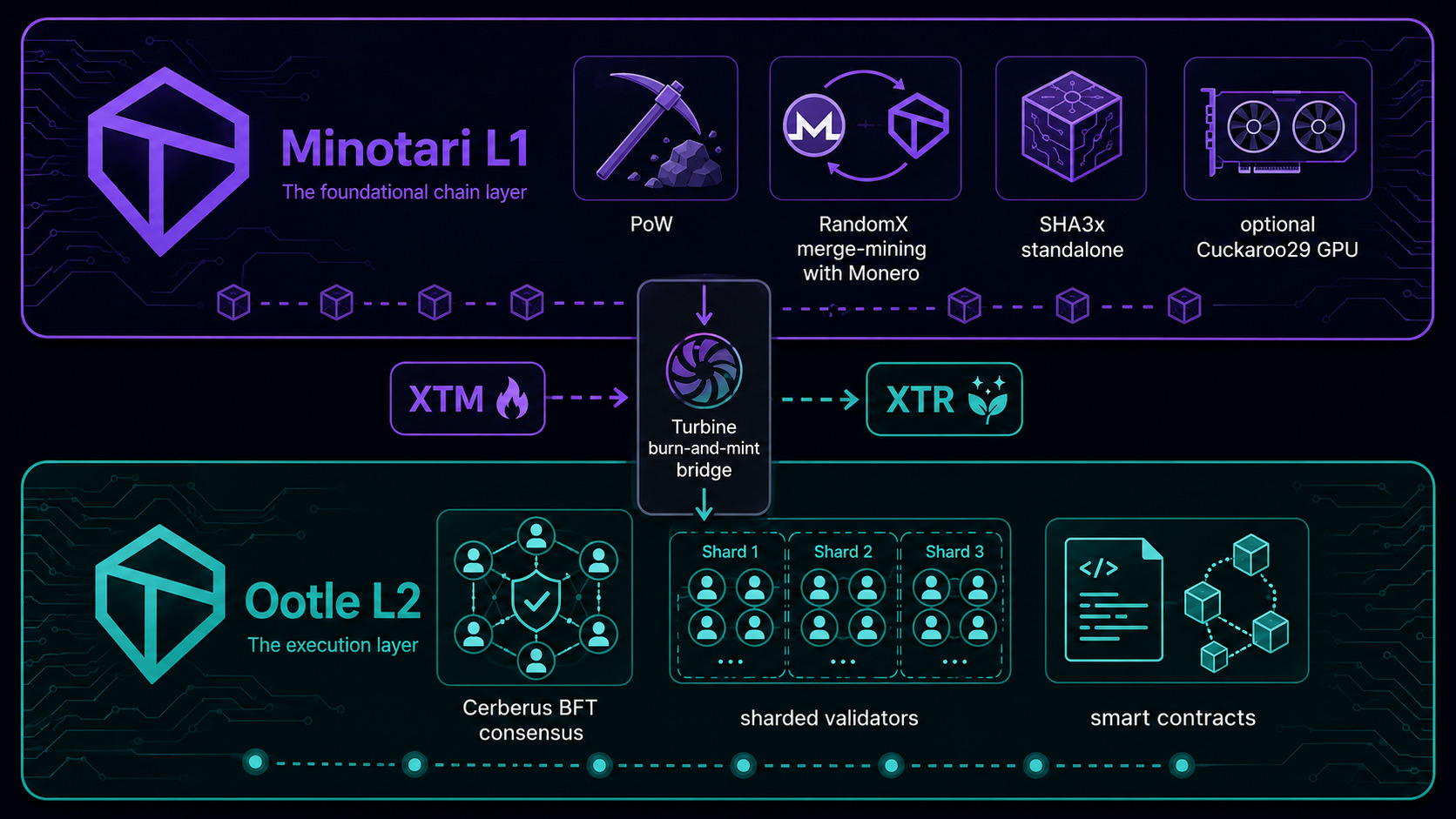
Minotari, the L1 base layer
The base layer, called Minotari, is a Proof of Work blockchain whose job is to be boring on purpose: it secures the XTM token, settles transactions, and stores the global state in a privacy-preserving way. Block rewards are distributed equally across four distinct mining lanes, 25% each, using three algorithms targeting three hardware types.
Lane 1 and Lane 2 both use RandomX, the same CPU algorithm as Monero, but they are kept deliberately separate. Lane 1 is merge-mined with Monero: a miner running XMRig simultaneously earns both XMR and XTM, with most of the USD value in the Monero rewards and the XTM as a near-free bonus. Lane 2 is Tari-only RandomX, with its own independent difficulty set by the Tari network alone. Because Monero has a mature, high-hashrate network that makes it hard for a small home miner to accumulate meaningful XTM through merge mining, the Tari-only lane has a lower difficulty, making it more rewarding in XTM terms for someone who plans to hold and believes in the project long-term. The two-lane approach is a clever design choice: profit-maximizers can take the merge-mine lane and capture both rewards, while conviction holders can focus the Tari-only lane for better XTM accumulation.
Lane 3 uses SHA3x. This algorithm was never designed to be ASIC-resistant — it was simply bootstrapped by GPUs until dedicated hardware arrived. Goldshell was first to market with the XT ASIC in 2025 and early 2026. As economics dictate, that lane is gradually becoming an ASIC lane, displacing GPU miners.
Lane 4, added with the v5.0 mainnet upgrade in September 2025, uses Cuckaroo29, a genuinely ASIC-resistant algorithm intended to give GPU miners a permanent home on the network. This matters because many home miners own a gaming PC with a GPU: with Lanes 2 and 4 available alongside the Goldshell XT, a single home setup can simultaneously access three of the four emission lanes, capturing up to 75% of total block rewards. That is a practically unusual degree of mining accessibility.
The Ootle, the L2 application layer
A PoW base layer cannot run thousands of complex smart contracts per second. Tari knows this, and that is why the second layer — the Ootle — uses Cerberus BFT consensus, a sharded Byzantine Fault Tolerant protocol where validators are randomly assigned to shards, and each shard handles a subset of state. The aim is theoretical horizontal scalability: the more validators, the more shards, the more parallel throughput. As of April 2026, the Ootle is in what Tari calls «early production», with the validator set growing and the tooling — particularly the templating system for smart contracts — still maturing.
3. Tokenomics: the Turbine model
This is where I have spent the most analytical time, and where Tari is the most original — and the most controversial.
The 21 billion XTM, and what is really at stake
The native token of the L1 is the Minotari, ticker XTM. The supply is capped at 21 billion units, with a perpetual tail emission of 1% per year paid entirely to miners after the main emission curve ends at approximately year 27.8. That 1% tail was a deliberate design choice to avoid the fee market uncertainty that plagues Bitcoin post-halving, and it is philosophically closer to Monero’s approach than to Bitcoin’s deflationary purity.
| Allocation | Share | Vesting and conditions |
|---|---|---|
| Public miners | 70% | 14.7B XTM emitted via PoW over ≈ 27.8 years, then 1% per-year perpetual tail emission entirely paid to miners |
| Initial participants and VCs | 12% | Pantera, Blockchain Capital, Multicoin, Hack VC, etc. — cliff + monthly linear unlock over 48 months starting 12 months post-mainnet (May 2026 onwards) |
| Protocol infrastructure and grants | 9% | 40% (≈ 756M XTM) released at launch for protocol bootstrapping; remainder vests over 4 years |
| Community programs | 5% | Monthly unlock over 12 months, starting 6 months after mainnet |
| Contributors and team | 4% | Vesting over 5 years starting 12 months after mainnet — standard startup schedule |
Let me be direct about what this table shows. Seventy percent of the supply goes to public miners — that is the headline number Tari marketing will use, and it is accurate. But the remaining thirty percent — the «premine» in the broad sense — goes to VCs, team, infrastructure, and community programs. For comparison: Monero has 0% premine, Grin has 0% premine, Pirate Chain has 0% premine and no developer tax. Zcash had its historical Founders Reward tax. Tari sits clearly in the «funded protocol» camp, alongside Zcash, not in the «fair launch» camp where the cypherpunk credibility is concentrated.
I do not think a 30% premine is automatically disqualifying. Beam financed itself this way and shipped a real product. Zcash funded the Electric Coin Company and the Zcash Foundation through a similar approach. The right question is not «is there a premine?» but «do the unlocks land before the project has product-market fit?». Tari’s most aggressive cliff is the VC tranche, which started monthly unlocks 12 months after mainnet — meaning May 2026 onwards. This is exactly the window we are in right now. Whether the market can absorb that supply pressure depends on whether the Ootle generates real demand for XTM by that date. As of April 2026, it is too early to call.
The Turbine: a burn-and-mint bridge between L1 and L2
The Ootle uses its own gas token, the XTR. Here is the key design decision: there is no separate XTR token sale. XTR is produced exclusively by burning XTM through a mechanism called the Turbine. A user who wants to interact with the L2 (deploy a contract, call a function, pay a gas fee) must first burn XTM on the L1 to mint an equivalent value of XTR on the L2. The burn is one-way and permanent — XTR cannot be converted back to XTM.
This design means that every unit of L2 activity is deflationary for XTM. I find this design genuinely elegant. It mechanically aligns L2 adoption with XTM value, without requiring a separate token launch or governance process. The obvious risk is bootstrapping: if the Ootle does not attract applications, there is no Turbine activity, and the burn mechanism sits dormant.
4. Tari Universe: the onboarding thesis
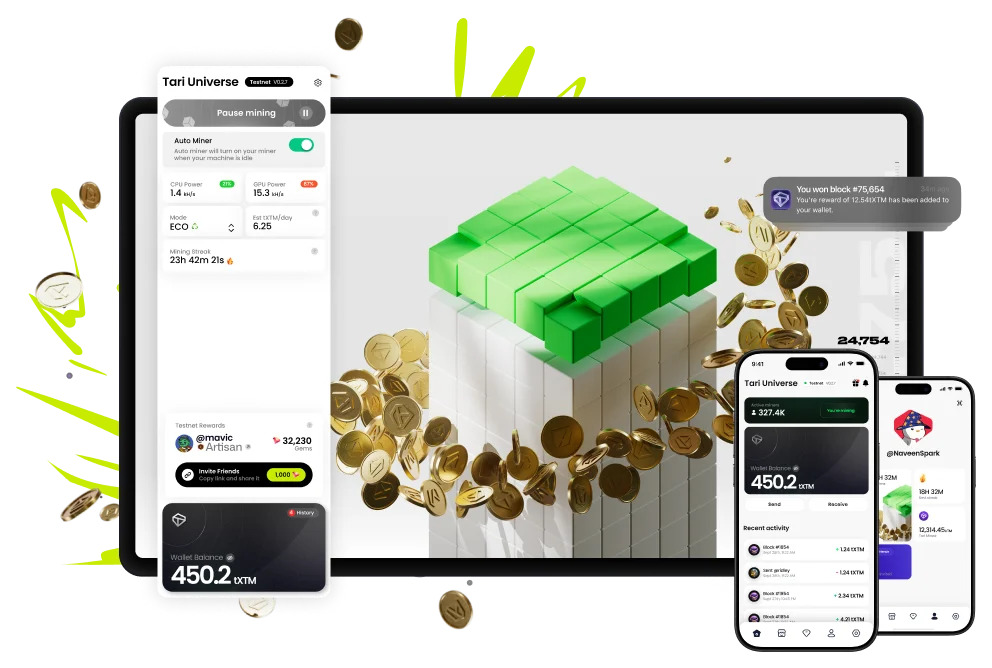
Cypherpunks like to say that decentralization is when your grandmother can run a node. Tari is one of the very few privacy projects that takes this literally. The Tari Universe desktop application, available on Mac and Windows, presents proof-of-work mining as a gamified visual experience — virtual blocks stacking up while the SHA3x algorithm hashes in the background. During the testnet phase, the app generated more than 700,000 waitlist signups and converted over 100,000 active miners. By the time of mainnet launch, the SHA3x GPU hashrate had crossed 800 GH/s. These numbers are not vanity metrics, they are signals of a successful onboarding funnel.
Behind the polished interface sits P2Pool, a decentralized mining pool implementation that addresses the centralization risk inherent to large pools. Throughout 2024 and 2025 the team rebuilt P2Pool aggressively: block intervals were extended from 10 seconds to 30 seconds to fix chain fragmentation issues, and by mid-2025 win rates above 70% were being reported for residential miners. The honesty of the development updates is one of the things I appreciate about this team. They do not pretend everything works. They publish what is broken and what they are fixing.
The Tari pitch describes mining as «democratized». The reality is nuanced, and worth getting right. The Goldshell XT ASIC for SHA3x has been shipping since early 2026 — but SHA3x was never designed to be ASIC-resistant, it was always a transitional GPU algorithm expected to eventually be taken over by dedicated hardware. That is not a failure of the design, it is the design working as intended. The addition of the Cuckaroo29 GPU lane in September 2025 was precisely the answer to this: Cuckaroo29 is explicitly ASIC-resistant, giving GPU miners a permanent home even as SHA3x industrializes. With the Tari-only RandomX lane accessible to CPU miners at a lower difficulty, and the Goldshell XT being a compact, home-friendly device rather than an industrial rack unit, a home miner with a gaming PC and one ASIC can reach three emission lanes simultaneously, up to 75% of total block rewards. That is a genuinely unusual achievement in mining accessibility. My honest read is still that Tari is more accessible than almost any other privacy L1 on the desktop today, with the caveat that the SHA3x lane will likely consolidate further around larger ASIC operators if bigger manufacturers follow Goldshell into the market.
5. The compliance gambit, and why it matters in 2026
I have written before about how the European MiCA regulation, fully active since end-2024, plus the FATF Travel Rule, have created an existential pressure on privacy coins. Exchanges are delisting assets they cannot KYC. VASPs are refusing to onboard projects that cannot demonstrate a compliance pathway. In this environment, a privacy coin that provides zero traceability tools is increasingly a coin that cannot be listed on regulated venues.
Tari’s response to this is what its founders call asymmetric privacy or opt-in transparency. The base layer is private by default, but the protocol ships several tools that allow selective disclosure without breaking the privacy of the general user population:
View keys. Tari address structures separate the spending key from the viewing key. A user, or a VASP acting on behalf of a user, can share a view key with a regulator or auditor without exposing the ability to spend funds.
Encrypted memos on the base layer. Tari supports attaching encrypted 64-byte messages to L1 transactions. These memos are private by default but can be decrypted by a VASP using the sender’s view key. This creates a KYC-at-the-VASP-layer model that keeps the public blockchain opaque while giving regulated entities the audit trail they need.
Wallet-level interactive transactions. The protocol allows transaction structures where a VASP can add compliance data to a transaction before it is broadcast, without the end user having to manually disclose anything to a public ledger.
I want to be careful here, and I need to correct something I wrote too loosely. I said Tari sits on «the survivable side» of the compliance line while «Monero, by deliberate design, does not.» That framing is too blunt and technically inaccurate, and a reader correctly pointed it out to me. Monero has had view keys since its inception in 2014 — they have always been part of the CryptoNote protocol on which Monero is built. Any Monero user can today selectively reveal a transaction on-chain, and can share incoming-only view keys to allow an auditor to verify wallet inflows. The forthcoming Carrot address protocol, accompanying the Full Chain Membership Proofs upgrade, will extend this to full-view wallets that expose both incoming and outgoing transactions to a designated third party, making Monero’s opt-in transparency toolkit more complete than it has ever been.
What is true is that Monero has been delisted by major exchanges despite having these tools, because the regulatory and compliance-services industry has largely sold «blockchain transparency» as the only acceptable compliance model. That is a political and commercial argument, not a technical one. On a purely technical basis, Monero’s opt-in disclosure capabilities are broadly comparable to Zano’s auditable wallets, and Tari’s view keys are similarly derived from the same CryptoNote lineage. Tari’s advantage in the compliance conversation is not that it has tools Monero lacks in principle, but that its compliance primitives are more deeply integrated into the base layer architecture, and that the project actively courts institutional users with a documented compliance brief rather than maintaining deliberate distance from the regulated world. Whether that institutional posture survives contact with actual regulators remains the open question for both networks.
6. The honest assessment
What I like — and where the conviction sits
Tari’s main strength is structural. It has resolved the historical incompatibility between strong privacy and smart contract functionality, which is something neither Monero nor Grin has managed. The TariScript design is audited, documented, and live on mainnet. The Coinspect audit — 15 weeks, 50 findings, 22 high severity, 0 critical — is the kind of security investment that separates serious protocols from vapourware. The Quarkslab review of the Bulletproofs+ implementation adds a second credible layer of validation.
On the macroeconomic side, the Turbine model is a genuinely interesting attempt to align L2 demand with L1 security. If the Ootle achieves real adoption — even modest — the burn dynamics on XTM should produce a structural deflationary pressure. This is more elegant than Ethereum’s EIP-1559 burn for one specific reason: the burn here is not just a fee mechanism, it is the only way to access the application layer.
Where the risk is real
I will not soften my view on the weaknesses, because that would be intellectually dishonest given my long-standing position on this site. The 30% premine is a genuine ideological compromise. It does not just dilute the «community-mined» narrative, it concentrates economic power in a small group of VCs whose unlock cliffs are now starting to land in the market. The current liquidity is dangerously thin — at a market cap of 3 to 4 M$ across roughly 6 exchanges and 8 to 12 markets (CoinGecko data, April 2026), the project sits around rank #1800 to #2000.
The architectural complexity is the second risk. April 2026 was the worst month on record for crypto market conditions broadly, and the Ootle validator network is still small. Cerberus BFT has not been stress-tested at scale with adversarial conditions. The smart contract templating system is functional but early. A protocol that needs three simultaneous breakthroughs — L2 adoption, ASIC/GPU balance, and regulatory clarity — to fulfill its thesis is a high-variance bet by definition.
The third risk is documentation drift. The RFCs sometimes refer to XTR as the L1 token and «Tari» as the L2 token, which is the reverse of the current branding. This is not a cryptographic issue, but it is a signal of a project that has iterated so fast that the documentation has not caught up with the product.
7. Where Tari stands among the privacy peers
| Comparatif – Privacy Coins | |||||
|---|---|---|---|---|---|
| Criterion | Tari (XTM) | Monero (XMR) | Zcash (ZEC) | Grin | Zano |
| Privacy stack | Mimblewimble + TariScript + stealth addresses + DHT | RingCT, ring signatures, stealth addresses, Dandelion++ | zk-SNARKs (Orchard) — optional shielded pool | Pure Mimblewimble + Slatepack | Zarcanum, confidential assets, auditable wallets |
| Consensus | Hybrid PoW (RandomX merge-mine + SHA3x) + L2 Cerberus BFT | Pure PoW RandomX, ASIC-resistant | PoW Equihash | PoW Cuckoo Cycle | Hybrid PoW / PoS |
| Smart contracts | Yes — native L2 (Ootle), templates, sharded BFT | No (deliberate scope limit) | No | No | Yes — embedded confidential apps |
| Tokenomics | 21B supply, 30% premine to team / VCs / treasury, 1% tail | No premine, no ICO, no presale, fixed tail emission | 21M supply, historical Founders Reward | No premine, no founders reward, linear infinite emission | Premine for development funding |
| Privacy by default | Yes (base layer) | Yes — strict and irreversible | Optional — transparent and shielded coexist | Yes | Yes |
| Compliance posture | Opt-in transparency — view keys, encrypted memos, wallet-level KYC | View keys native since 2014, opt-in. Carrot update adds full view wallets (in/out). Technically comparable to Zano. Delisted by major exchanges due to commercial and political pressure, not a technical gap. | Adapted (transparent default helps) | Complex — no compliance primitives | Auditable wallets natively supported |
| Mainnet age | Live since May 2025 — early production | Live since 2014 — battle-tested | Live since 2016 | Live since 2019 | Live since 2019 |
| Market cap (Apr 2026) | ≈ 3 to 4 M$ — rank ≈ #1800 to #2000 | Mid-cap, top-20 / top-30 historically | Mid-cap | ≈ 6 to 7 M$ — rank ≈ #1000 to #1200 | Lowcap, rank ≈ #200 |
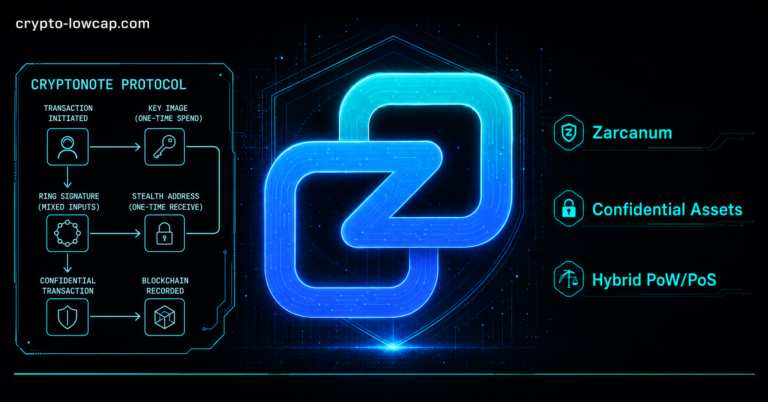
If I had to summarize this comparison in one sentence: Monero remains the gold standard for privacy-by-default with a fair launch pedigree. Zcash remains the gold standard for compliance-ready shielded transactions. Grin is the purist Mimblewimble experiment. Zano is probably the closest direct competitor to Tari on the «private economy platform» thesis. Tari occupies its own niche: it tries to be the privacy stack that is mineable, usable, and buildable, all at once. None of the others attempts that combination. Two other low-cap projects worth keeping in mind for comparison are Xelis and Salvium: both operate in the same privacy-and-compliance tension space, with different architectural bets. Xelis opts for a homomorphic encryption approach and a fast L1, while Salvium introduces a compliance layer directly on a Monero fork. Neither has Tari’s two-layer ambition, but both are serious engineering efforts in the same macro thesis — worth reading about if Tari’s compliance posture is what drew your attention here.
8. The Rowenta Verdict
CONVICTION TIER — Directional bet (mid conviction). Tari is not a shitcoin in any reasonable definition of the term. There is too much engineering substance, too much audit transparency, too much development cadence, too much honest documentation. It is also not a proven privacy protocol yet. It is a serious bet on a future privacy economy that may or may not materialize, and the next 18 months — VC unlocks, Ootle stabilization, regulatory equilibrium, real L2 adoption — will decide whether Tari converts attention into value or remains a brilliant niche.
For the reader who wants a clear positioning: I keep XTM on my privacy watchlist as a directional position, sized small, with an explicit awareness of the unlock schedule. I will not add to the position until I see two things: meaningful Ootle developer activity (not just validator count, but deployed applications with real users), and evidence that the VC unlock absorption is not causing structural sell pressure. Neither condition is met as of April 2026.
What I find most interesting, beyond the price action, is what Tari represents conceptually. The privacy coin landscape has been polarized for years between the «pure cypherpunk» camp (Monero, Pirate Chain, Grin) and the «compliance-friendly» camp (Zcash, Beam). Tari is the first serious attempt to occupy a third position: strong privacy by default, opt-in transparency for regulated use cases, and a smart contract layer that makes the privacy primitive actually programmable.
I’ll keep covering this project. In the meantime, this is my current read: technically credible, economically ambitious, driven by an adaptive compliance mindset, and well worth keeping an eye on.
EDITORIAL DISCLOSURE
This article is an independent fundamental analysis published on crypto-lowcap.com. I have no commercial relationship with Tari Labs, no paid partnership, and no token allocation outside potentially small open-market positions disclosed in my watchlist. The market data referenced reflects public sources (CoinGecko, CoinMarketCap, Yahoo Finance) as of April 2026. Cryptocurrencies, especially privacy-focused microcaps, are extremely high-risk assets. Nothing in this piece should be read as investment advice. Verify everything yourself.
Key sources and further reading
→ tari.com — official site, tokenomics page, public RFC library at rfc.tari.com
→ RFC-0131 (Mining), RFC-0201 (TariScript), RFC-0330 (Cerberus consensus)
→ Coinspect — Tari Layer 1 base layer security audit (15 weeks, 50 findings, 22 high severity, 0 critical)
→ Quarkslab — Bulletproofs+ implementation review
→ tarilabs.com / Tari Labs University — Mimblewimble explainers, Layer 2 scaling survey
→ CoinGecko — XTM market data, exchange listings as of April 2026