
01An honest starting point: the game got harder
In 2017, beating the market with altcoins took little more than curiosity. A few hundred projects traded, most of them with a real team, and a rising tide lifted almost everything. That world is gone. Since 2021, launching a token costs minutes and a few dollars. Memecoins, launchpads and copy-paste chains have produced millions of tickers, and every one of them competes for the same attention and the same liquidity.
The consequence is simple and uncomfortable. Outperforming the market is far harder than it was, because the haystack grew a thousand times faster than the needles. A method that worked by buying a broad basket of small caps in 2017 now buys mostly noise. Any approach that claims otherwise is selling something.
That is the frame for everything below. I do not claim to have found an easy edge. Instead, I describe a narrow strategy, built on experience, discernment and a fair share of luck, and I test it against the alternatives with the same yardstick. If it survives that test, it is only because it chose a smaller pond.
02Seven cohorts, one question
The question is plain: over the last cycles, what happened to the investor who held, and what happened to the one who hunted? To avoid hindsight, each cohort is frozen by an objective rule at a past date from CoinMarketCap historical snapshots. The 2018 altcoins are the top 20 of January 7, 2018, minus BTC and ETH. The 2021 flagships are the top 40 of November 7, 2021 first listed from 2019. The 2023-24 flagships are the top 60 of December 15, 2024 that were absent from the top 180 two years earlier.
On the hunter's side, three groups: every 2024 to 2026 launch on NonKYC and SafeTrade, twelve PoW lowcaps from 2022-24 still tracked by CoinMarketCap (Radiant, Neurai, Dynex, Clore.ai and others), and my own 2026 selection described in The Hidden Laws of PoW Lowcaps. The 2022-24 cohort carries a survivor bias, since dead projects are no longer tracked; it therefore looks better than reality.

The verdict is brutal. Bought on January 8, 2018, the median 2018 altcoin has lost 96.6%; only TRON and Monero are higher today. Over the same period, BTC gained 320%. The median 2021 flagship has lost 96.2%, and none of the 14 is higher, while BTC is down 6% from that date. The 2023-24 flagships have already lost a median 84.9% in less than two years. As for PoW lowcaps bought at listing and held, the median 2022-24 project has lost 98.5%.
03The bagholder's trap

Measured from their own record, the cohorts line up by age. BTC trades 51% below its record and ETH 65%. By contrast, the 2018 altcoins and the 2021 flagships both sit 97% below theirs, and the 2023-24 flagships 91%. Every one of the twelve 2022-24 PoW lowcaps has lost more than 95% from its high. An altcoin that has already had its speculative rush does not wait for the next cycle; it erodes.
Few investors choose to become bagholders. Rather, the bag forms through small renunciations. A project made you euphoric, then disappointed you, and selling would mean admitting the loss. Analyzing it again, or analyzing a new one, takes hours of reading code, explorers and communities, whereas keeping it costs nothing today. So the position stays, cycle after cycle.
Holding an altcoin from 2017, 2021 or 2024 is rarely a conviction. Most of the time, it is the absence of a decision, and the market charges for it.
I call it what it is: intellectual laziness, denial of what the chart says, and a set of well-known biases, from sunk cost to status quo. They are the main brakes on improving a portfolio. In the 2018 cohort, seven assets did briefly climb back above their January 2018 price after 2019. Their holders had a door, yet most of them did not use it. With the odds this lopsided, holding a coin whose discovery is behind it means accepting a slow and near-certain erasure of the capital.
04What the market really pays for
If old coins erode, what does the market reward? The answer runs through all my previous work, from the Asymmetric Lowcap Returns masterclass to Before the Crowd: novelty and price discovery. The crypto market behaves like a crowd looking for the next story. It pays a premium for what it has not yet seen, and it pays it again each time a new rung of visibility opens.
Three ideas from those articles matter here. First, the novelty premium: a new chain with a ten-second pitch attracts buyers that a better but older chain cannot reach. Second, the listing ladder: a project climbs from tiny incubators to mid-tier exchanges over months, and each rung releases latent demand. Third, aftershocks are not second acts. Once a project has consumed its price discovery, its later rallies are echoes, and its holders confuse them with a new beginning.
TABLE A · WHAT A FIRST DISCOVERY LOOKS LIKE
| Project | Cycle | Base to peak | Dominant narrative |
|---|---|---|---|
| Kaspa (KAS) | 2022-24 | ×1,213 | BlockDAG, fair launch |
| Alephium (ALPH) | 2024 | ×687 | PoW and smart contracts |
| Neurai (XNA) | 2023 | ×137 | AI, IoT, PoW |
| Parano1d (NOID) | 2026 | ×293 | Post-quantum, new tokenomics |
| Midstate (MDS) | 2026 | ×16 from launch | Post-quantum lifeboat |
Kaspa, Alephium and Neurai from The Asymmetric Lowcap Returns masterclass (documented pre-peak base to sustained peak). NOID: daily low to daily peak. MDS: launch price to highest daily close.
Every one of these moves happened during a first discovery, never during a revival. Hence the hunter's real question is not "which coin is good?" but "which project still has its discovery ahead of it, and will the market notice?".
05Why I hunt PoW lowcaps
My corner of the market started with privacy. In 2016, financial privacy was a cause before it was a trade, and privacy coins were almost all proof-of-work. Over the years the hunt widened to other PoW narratives, post-quantum chains, useful work and AI mining, without changing its frame. Proof-of-work remained the filter.
The reason is practical. A PoW project has to ship a working chain, a miner and a network before it trades. That constraint does not guarantee quality, but it narrows the field and leaves traces you can check: code, explorers, pools, hashrate and an emission schedule. Moreover, these projects appear in a few known places, such as Bitcointalk announcements, mining calculators and two or three incubator exchanges. Compared with millions of tokens, they are fewer, easier to find, and easier to sort between serious and empty, although never perfectly.
It is one strategy among others. It suits a temperament that likes research, accepts long silences and tolerates violent drawdowns. Others will build an edge elsewhere, and they should.
06The hunter's cycle in five moves
The method fits in five moves that repeat with each cycle. None of them relies on predicting Bitcoin or playing dominance rotations.
- Spot. Follow launches where they happen: announcements, pools, incubator exchanges. Write the ten-second pitch for each one, or drop it.
- Buy when risk is at its peak. Enter during or right after the post-listing compression, in tranches, when the market neither knows nor wants the project.
- Hold and follow. Track delivery, emission, listings and community. A thesis is a list of facts to check, not a feeling to defend.
- Take profits in tranches. Sell into strength as the discovery unfolds, and keep a residual that preserves the asymmetric potential.
- Park and wake up. Keep the proceeds in stablecoins through the decline, then wake up when the lowcap exchanges start listing new projects again, every three to five years.

The wake-up signal is measurable. SafeTrade opened 6, 4, 6 and 9 new markets per half-year from 2024 to 2025, then 8 in the first half of 2026 and 18 in the second, a record. The wave arrived 9 to 15 months after the Bitcoin top of October 2025. Therefore the hunter does not need to guess the bottom of Bitcoin; he needs to notice when the incubators wake up.
07Two analyses, one decision
The hunt combines two analyses that should never be merged. The fundamental one asks whether the project is real: does the chain run, is the code original, is mining open, is the team present? The speculative one asks whether the market will reprice it: is the discovery unconsumed, is the story simple, will access widen, is the regime favorable? A strong project can fail the second test, and a weak one can pass it for a while.
TABLE B · THE TWO QUESTIONS OF THE HUNTER
| Fundamental analysis | Speculative analysis |
|---|---|
| Does the chain run, and is the code more than a fork? | Is the price discovery still ahead of the project? |
| Is mining open, and how concentrated is hashrate? | Does the pitch fit in ten seconds? |
| Is the emission schedule documented and sustainable? | At which market cap will buyers absorb the emission? |
| Is the team active, reachable and accountable? | Which listing rung comes next, and when? |
| Which red flags are fixable, and which are structural? | Which catalysts lift a real constraint in the coming months? |
Adapted from the Hunter's Codex and the CAA-X grid used in Crypto Lowcap deep dives.
Thinking in market cap ties the two together. A price multiple means nothing on a chain whose supply triples within a year; a market cap after dilution, compared with real past winners, tells you whether the story has room. In addition, the regime matters: a perfect setup in a hostile market waits, and the hunter waits with it.
08What $1,000 became

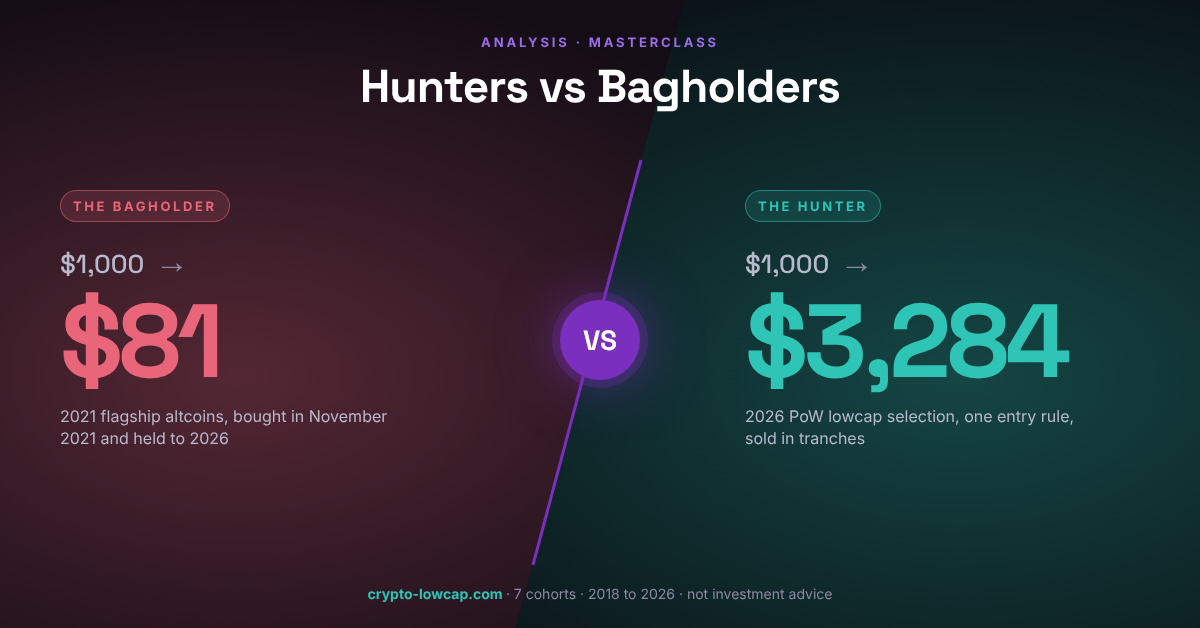
Holders of altcoin cohorts turned $1,000 into $362 (2018 altcoins), $81 (2021 flagships) and $154 (2023-24 flagships). BTC bought on the same dates turned it into $4,203, $936 and $621. A holder of 2022-24 PoW lowcaps bought at listing kept only $74. For context, gold gained 162% and the S&P 500 148% since January 2018.
A rule-based hunter, on the other hand, applied one simple rule to the same 2022-24 PoW lowcaps: buy at the first close 50% above the running floor, once that floor has held three weeks; sell 25% at ×2, ×4, ×8 and ×16 from entry; exit if the floor breaks. The basket became $2,447, mostly realized by 2024 and parked in stablecoins since. Applied to the 2026 selection, the same rule gives $3,284 today.
09A rule alone does not make a hunter
This is where honesty matters most. The same rule, applied to every launch without screening, does not beat the market. On 2024 launches it gives a median ×0.55, on 2025 launches ×0.47, and on unpicked 2026 launches ×0.62. Even on the 2022-24 PoW lowcaps, the median trade loses 24%; the positive mean comes from three winners, Dynex, Clore.ai and Alephium.

Two conclusions follow. The rule protects: compared with holding from launch, it turns near-total losses into partial ones. Yet the edge comes from the pick. Applied to the 2026 selection, the rule yields ×2.5 in median, against ×0.62 for the unpicked launches of the same year. The rule limits the damage; the screening creates the return.
Experience, discernment and luck
Screening is a craft, and it is not clean. When I bought NOID at $0.00185, it was a falling knife, down 81% in eighteen days. What turned it into a ×293 was a change in tokenomics and well-orchestrated announcements. I had studied the project, bought what nobody was discussing with its red flags in view, and could not know the timing. Luck played its part.
Saying no is the other half. I passed on Kerrigan: launched around $0.138, it trades near $0.015 today, down 89%. My own archive also holds the opposite errors, bags kept too long in earlier cycles and positions sold before their best move. That is why a hunter must be judged on the whole wave, failures included, and never on his best trade.
10The locomotive variant: the same logic, less risk
The PoW lowcap strategy is the most degenerate version of the method. The same logic, however, works at lower risk levels. Every cycle has a few new assets that are not lowcaps for long: they lead a narrative, gain deep liquidity and climb the listing ladder fast. Buying them early, during their first discovery, follows the same rules with thicker order books.
Kaspa was that locomotive in the last cycle. From a weekly low near $0.00024 in 2022, it reached $0.19 in June 2024, about ×800. It also shows the second half of the lesson: it now trades near $0.026, 87% below its peak, so even a locomotive must be sold into its wave. In 2026, Pearl, which applies useful proof-of-work to AI, looked like an obvious case to me. Listed around $0.44 in May, it dipped to $0.23 in July, closed at $2.43 on October 21 and trades near $1.95, with several million dollars of daily volume.
TABLE C · ONE METHOD, FOUR LEVELS OF RISK
| Level | Examples | Liquidity | Main risk |
|---|---|---|---|
| Locomotive in first discovery | Kaspa 2022-24, Pearl 2026 | Deep, several venues | Selling too late in the wave |
| PoW lowcap after compression | NOID, TSC, MDS in 2026 | Thin, one or two exchanges | Gains given back fast |
| Pre-discovery micro-option | KRX, ZKAS, KV5, SOQ, DRGX | Very thin | Discovery that never comes |
| Old altcoin bag | 2018 and 2021 cohorts | Deep | Slow, near-certain erosion |
Classification by Crypto Lowcap, November 2026. Illustration, not a recommendation.
The point is not that one level is right. Rather, the same principles apply at each level: buy novelty before the crowd, follow the discovery, sell into strength, keep a residual, and leave the coin once its discovery is consumed. Only the size of the positions and the tolerance for drawdowns change.
11The price of the hunt

Volatility rises with each step down in size: 44% a year for BTC, 56% for ETH, around 75% for the older altcoin cohorts, 93% for the 2023-24 flagships, 132% for the 2022-24 PoW lowcaps and 457% for the 2026 selection. That is the price of the asymmetry, and it is paid in sleep as much as in money.
- Total loss is a normal outcome for a single lowcap, not an accident.
- Exit liquidity is thin: the displayed price is not an exit price.
- Delistings are frequent on incubator exchanges, sometimes without notice.
- Long waits in stablecoins are part of the method, while others enjoy rallies.
- Survivor bias flatters any backtest of past lowcaps, including this one.
- Size is the first defense: every position is a micro-option, never a conviction bet.
12Ten lessons for hunters
TABLE D · TEN LESSONS
| # | Lesson |
|---|---|
| 1 | Outperforming got harder after 2021; choose a small pond where research still pays. |
| 2 | A coin whose discovery is consumed erodes; holding it is a decision, not a default. |
| 3 | The market pays for novelty and for each new rung of visibility. |
| 4 | Aftershocks are not second acts. |
| 5 | Buy when risk is at its peak, in tranches, and accept missing the exact low. |
| 6 | Keep fundamental and speculative analysis separate, then decide. |
| 7 | A rule limits the damage; screening creates the return. |
| 8 | Sell into strength, keep a residual, park the rest in stablecoins. |
| 9 | Wake up when the incubator exchanges wake up. |
| 10 | Judge yourself on the whole wave, failures and luck included. |
13Verdict: what I would tell a 2021 holder
The data do not say that hunting is easy. They say that holding is not neutral. Across three cohorts and eight years, keeping the altcoins of the last cycle destroyed capital, while BTC alone held its ground. By contrast, selling the waves, waiting in stablecoins and returning to new PoW projects at the right moment of their tokenomics is what created returns, with discipline and luck as silent partners.
So my advice to a 2021 holder would be simple. Look at your coins and ask whether their discovery is ahead or behind them. If it is behind, the next cycle will most likely belong to something else. Whether that something is a locomotive like Pearl or a micro-option on an incubator exchange depends on your temperament and your size. Either way, the market will reward novelty again, and it will not wait for the bags.
Further reading
- The Hidden Laws of PoW Lowcaps, the companion masterclass on the first year of a launch.
- The Hunter's Codex, the definitive PoW lowcap masterclass.
- The Asymmetric Lowcap Returns masterclass and Before the Crowd.
- Project Watch and The Cycle Call for live tracking.
- Data sources: CoinMarketCap historical snapshots, Yahoo Finance, NonKYC, SafeTrade.