
The Hidden Anatomy of Asymmetric Lowcap Returns
A masterclass on asymmetric lowcap returns, in fundamental and speculative analysis, distilled from ten years of lowcap cycles, thirteen dissected cases and one uncomfortable conclusion.
Author: Rowenta01 | crypto-lowcap.com | Est. reading time ~28 minutes
Tags: #Lowcap #PoW #Privacy #Speculation #Backtest #Tokenomics #MarketCycles
I bought my first lowcap in 2016. Since then, I have watched hundreds of small projects launch, a few dozen of them reprice by fifty or a hundred times, and most of the rest quietly disappear. Over those ten years, the conclusion about asymmetric lowcap returns I resisted the longest is also the one my own data supports most clearly: the quality of a project does not decide whether its token reprices. What decides it is how much of its story the market has not priced yet.
How this masterclass is built
This article is not a shopping list. My current map of the segment lives in Before the Crowd: 8 Overlooked Lowcaps for the Next Cycle, and the projects I follow month after month sit on the Project Watch dashboard. It is not a step-by-step method either. Instead, it is the distilled result of a decade of lowcap crypto analysis: the concepts that survived contact with real markets, the anatomy of the projects that repriced violently, and the anatomy of those that failed to do it twice.
Concretely, I go back over thirteen historical cases in detail and twenty-five coded project-cycle episodes. Along the way, I explain the factors that move price on this segment, the ones that only look important, and the arithmetic most investors skip. Finally, I spend real time on risk, because a framework that only explains winners is a marketing brochure, not an analysis.
| ⚠️ BEFORE WE START, NOT FINANCIAL ADVICE. This article does not constitute investment advice. These are purely personal observations from a fundamental analyst who has been covering the privacy and lowcap crypto space since 2016. Every case cited here is historical, and none should be read as a current recommendation. Micro-cap and low-cap projects carry significant risk, including the total loss of capital. Do your own research. |
1. Two questions that should never be merged
Every lowcap analysis answers two different questions, whether the analyst admits it or not. The first one is fundamental: is this project good? Is the code public, does the network run, is the team delivering, is the supply verifiable, is the security budget coherent? The second one is speculative: is there still something left for the market to discover? Has this story ever been priced, which doors to new buyers remain closed, and how many first times are still ahead of it?
Most lowcap research merges those two questions into a single score, and that is where the expensive mistakes begin. A protocol can be excellent and already consumed. Conversely, a much rougher project can carry an almost intact reserve of speculative potential. Quality and available asymmetry are two different rankings, and both statements can be true at the same time.
Fundamental analysis still matters a great deal, but its role in asymmetric lowcap returns is different from what most people assume. It protects you from fraud, from unverifiable supply and from projects that will not survive long enough to be discovered. Speculative analysis, on the other hand, measures the runway. The first one filters, the second one ranks.
| A note on epistemic discipline Throughout this article I separate five kinds of statements: what is verified on a primary source, what is a model computed from verified parameters, what a team declares without independent confirmation, what I infer by crossing signals, and what remains a gap. Gaps stay gaps. In my experience, a dataset with twenty honest unknowns beats a precise regression built on invented numbers. |
2. The coin is not the unit, the project-cycle is
My backtests deliver a first structural lesson that is almost philosophical. Ergo and Firo both appear in the column of spectacular reratings and in the column of failures. That is not a contradiction, it is the central result.
The same asset can keep the same technology, the same team and a similar tokenomics, yet deliver a huge multiple in one cycle and fail completely in the next one. Between the two episodes, something changed that has nothing to do with code. Its access friction was removed, its story stopped being new, a large base of holders bought near the top, its chart carries an old high, and the market regime no longer opens the same window.
As a result, I stopped asking whether a token is good. The useful question is narrower and harder: is this token, in this cycle, still early on its own curve? A backtest that studies names rather than episodes confuses the structural quality of a project with the state of the market at the moment it is observed. That is why everything that follows reasons about asymmetric lowcap returns in project-cycle episodes.
3. What a decade of asymmetric lowcap returns actually has in common
To test my intuitions against something firmer than memory, I reconstructed thirty-five project-cycle episodes between 2017 and 2025. Twenty-five of them were documented well enough to be coded factor by factor. Each factor received a score of 0 (absent), 1 (partial) or 2 (strongly present), using only information available before or during the rerating window, never after it.
Two methodological rules protect the result. First, multiples are always measured between a documented base that predates the peak and the peak itself, and only on prices sustained over several days, never on a wick lasting a few minutes. Second, no low printed after the peak is ever used to inflate a ratio. Equally important, no volume threshold filters the sample, for reasons I develop in section 09.
The Discovery Gap, factor by factor
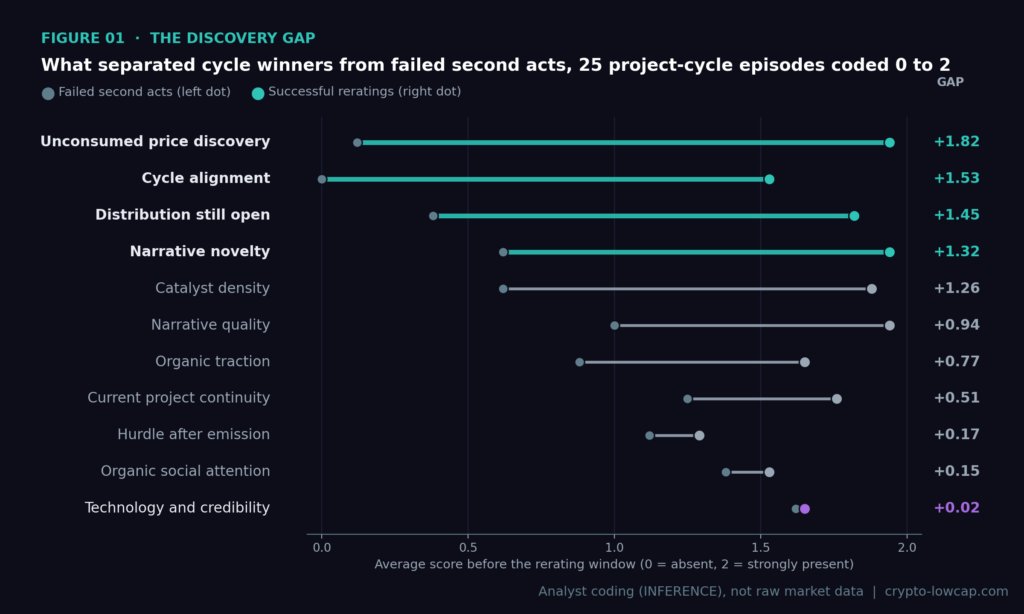
The hierarchy is brutal. Unconsumed price discovery shows the widest gap of every factor tested (+1.82 on a two-point scale), followed by cycle alignment (+1.53), distribution still open (+1.45) and narrative novelty (+1.32). Catalyst density follows closely.
At the other end of the chart sits the factor most investors spend most of their time on. Technology and credibility shows a gap of +0.02. In other words, it is almost as present among failures as among successes. It makes a story more credible, yet it almost never explains the size of a multiple on its own.
| What this chart does not prove This is a pilot backtest, not an econometric proof. The sample is small, the coding is mine, and the historical data on hashrate, order-book depth or social audience before 2021 is fragmentary. Consequently, the direction of the results is useful, their amplitude should not be over-interpreted. A formal calibration would require a time-stamped panel of thirty to fifty distinct projects. |
The reference multiples
Before going further, it helps to look at the raw material. The table below gathers some of the cleanest reratings of past cycles in the proof-of-work and privacy segment, measured from a documented pre-peak base.
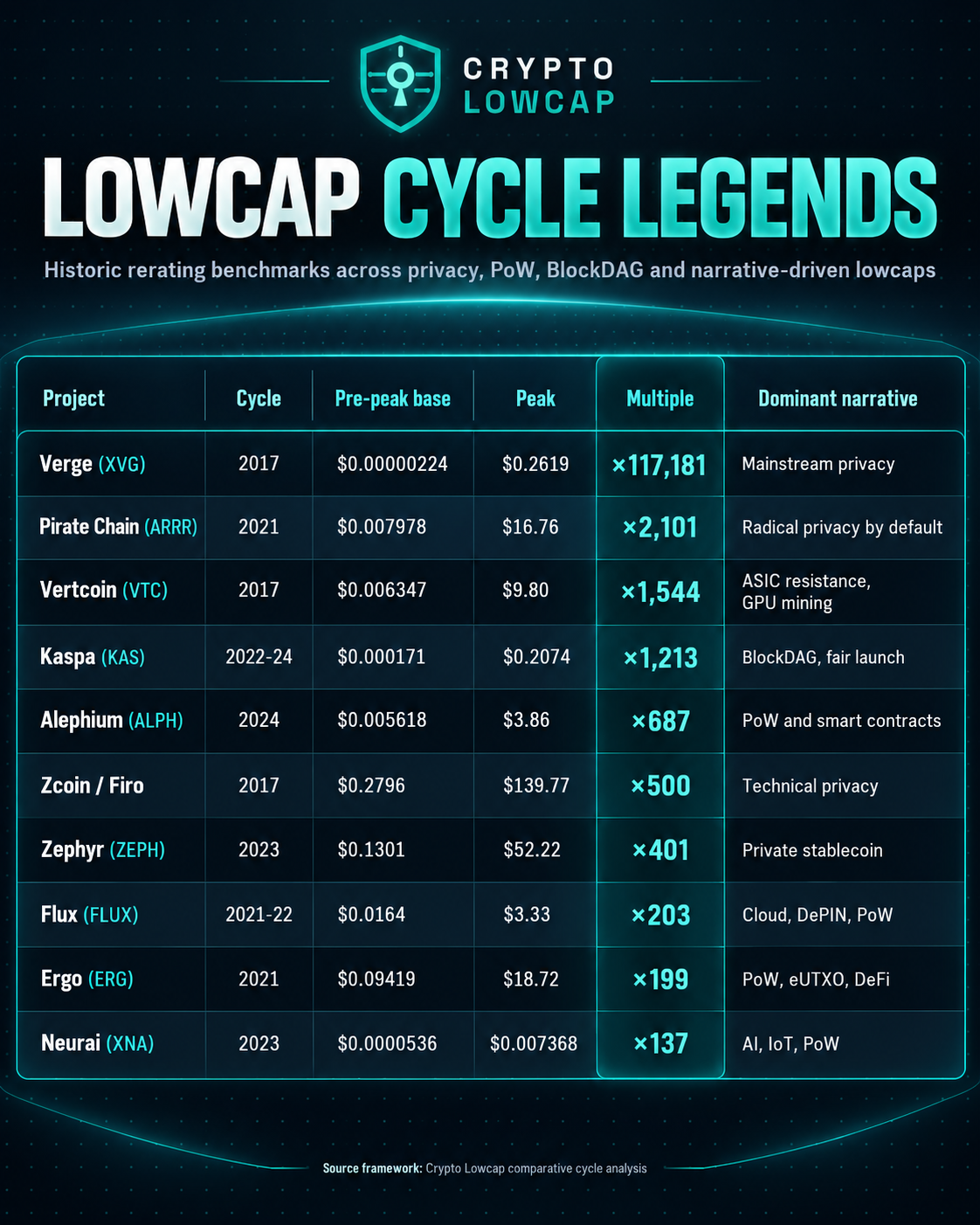
Two readings matter here. On one hand, the most extreme ratios, Verge above all, start from prices so low that liquidity at the base was close to zero, which means nobody could realistically capture the full multiple. By contrast, Kaspa, Alephium, Zephyr, Flux, Ergo and Neurai form a far more comparable set: a documented price discovery, a traceable climb through exchange tiers and an identifiable buyer base. Those are the cases worth studying.
The sequence behind asymmetric lowcap returns
Across those cases, the same sequence repeats with a regularity that makes coincidence unlikely. A project starts with a low valuation, weak attention and real friction to buy it. Then a founding community forms, usually through mining, forums or Discord. Next, a pitch emerges that fits in one sentence: radical privacy, a fast BlockDAG, decentralized storage, a private stablecoin.
After that, a first usable centralized exchange reduces the friction, often through a stable pair. Depth, volume and listing requests then grow faster than market capitalization itself. One or several technical deliveries validate the story, a higher-tier exchange widens the buyer base, and finally the market regime rotates toward small caps, amplifying everything at once. At the euphoric end, the same thin float that accelerated the rise accelerates the fall.
A project becomes interesting when organic interest starts to outrun its distribution infrastructure. Community, volume and listing demand accelerate before the major platforms are obtained.
4. The novelty premium, the hidden engine of asymmetric lowcap returns
If I had to keep a single idea from ten years of lowcaps, it would be this one. An asset the market has never priced on its narrative and its technology carries a potential that remains almost intact. The phase of speculative catch-up, when the market discovers what a story is worth, has simply not happened yet. As long as it has not, the full hype and discovery dynamic remains available. That is a market phenomenon, not an opinion about quality.
The mechanics behind it are concrete. A new project has no old all-time high anchoring expectations, no tired holders waiting for the first bounce to exit, and a long list of first times still ahead: first serious exchange, first stable pair, first mainstream wallet, first narrative carried by someone outside the community. Moreover, its audience is small, so the same inflow of capital produces a much larger relative effect than on an asset everyone already knows.
By contrast, an asset that already carved a high on a comparable narrative, then fell eighty to ninety-eight percent, carries a liability that fresh projects do not have. Its holders who bought higher are waiting for one thing, a chance to cut their losses. That latent supply mechanically caps every recovery, even when the technology remains just as sound as on day one.
Survivors rarely replay the multiple
History supports this, with the usual caution about survivorship bias. Many 2017 winners rebounded in 2021, but rarely with the same convexity. As orders of magnitude from low to high, Dash did roughly ×5.6, Neo ×9.9, Zcash ×6.6, Monero ×4.2 and Litecoin ×4.0, mostly without reclaiming their former peaks. Cardano (around ×18) and Ethereum Classic (around ×30) were the exceptions. Meanwhile, assets that were new at the time went through first-cycle expansions of a completely different scale.
Zcash, however, offers the exception that confirms the mechanism. In 2025, it returned among the strongest performers once privacy became a dominant narrative again. An old project is therefore not condemned, it needs a real reset of perception. Novelty is a premium, not a precondition.
Five questions that separate open from consumed
Calendar age is a poor proxy. What matters is how much speculative capital the project has not consumed yet, and five questions capture it well:
- Price discovery. Has the market ever seriously priced this story, or does the asset still lack a meaningful valuation history?
- Multiple already consumed. Has a ×40 or a ×100 already happened during a real market phase, or does that path remain to be walked?
- Remaining distribution. Does the project still sit on the early rungs of the exchange ladder, or has it reached the major exchanges?
- First-time catalysts. How many firsts remain ahead of it, and how many were spent in the previous cycle?
- Chart structure. Is the price still building a base, or does it carry an old high and residual selling pressure that caps every rally?
Why young projects keep more runway
One nuance deserves attention for the projects born between 2023 and 2025. The broad altcoin market never enjoyed a spillover comparable to 2017 or 2021: according to CoinGecko, Bitcoin dominance stood at 59.1 % at the end of the first quarter of 2025 and 62.1 % at the end of the second. A truncated cycle leaves more residual potential to young projects than a complete altseason would. Still, a coin that made its own large wave, collected several exchanges and built an old high has consumed part of its capital even if the rest of the market did not participate.
| The rule I have applied every bull cycle since 2016 Never get emotionally attached to a project, never hold on to old lowcap positions out of loyalty, and rotate into new lowcaps at each cycle. The novelty premium and unconsumed price discovery drive most asymmetric lowcap returns. Staying focused on projects the market already knows, has already priced and has already brought back down is not a moral failure, it is an analytical error about catalysts. |
5. Two gaps that must open at the same time
Asymmetric lowcap returns live in the distance between what an asset could be worth and what the market makes of it today. I find it useful to break that distance into five gaps. The first two are discriminants; the next three are only amplifiers.
Meanwhile, the Perception Gap asks whether the project is worth more than the market thinks. Next, the Distribution Gap asks whether access friction remains that has not been removed yet. Then come three amplifiers. The Valuation Gap checks whether the required arrival capitalization stays within a plausible historical band. Meanwhile, the Attention Gap asks whether the project is alive without being watched yet. Finally, the Data Gap asks whether missing information creates an unjustified discount, or a justified one.
Why asymmetric lowcap returns need both gaps at once
The retro-analysis of cycle winners is unambiguous on one point: a rerating does not come from the intensity of a single gap, it comes from the Perception Gap and the Distribution Gap opening simultaneously. A deeply undervalued project already listed on a top-tier exchange does not reprice like a microcap, because the access friction is gone. Equally, an invisible project whose story means nothing to anyone does not reprice either, because no demand forms behind the friction.
Kaspa remains the cleanest illustration. Its organic traction ran ahead of its distribution infrastructure long before the large listings arrived. The pattern worth hunting is therefore not “the next Kaspa” but organic traction already exceeding distribution, with several access rungs still open.
| When missing data is an opportunity, and when it is not A Data Gap becomes exploitable only if the missing information can be published by the project in the short term and a dated event will make it available. Structural opacity, linked to an absent team or non-existent infrastructure, is not a temporary discount. It is a permanent state, and it deserves its discount. |
6. The listing ladder, and why timing beats prestige
Distribution is the only catalyst family that gets consumed irreversibly. Every rung climbed widens access once and for all. That is precisely why a new project, which has not consumed any rung yet, keeps the whole reserve of asymmetric lowcap returns tied to distribution. I picture it as a ladder with six levels, from mining and over-the-counter trades up to the largest global exchanges.
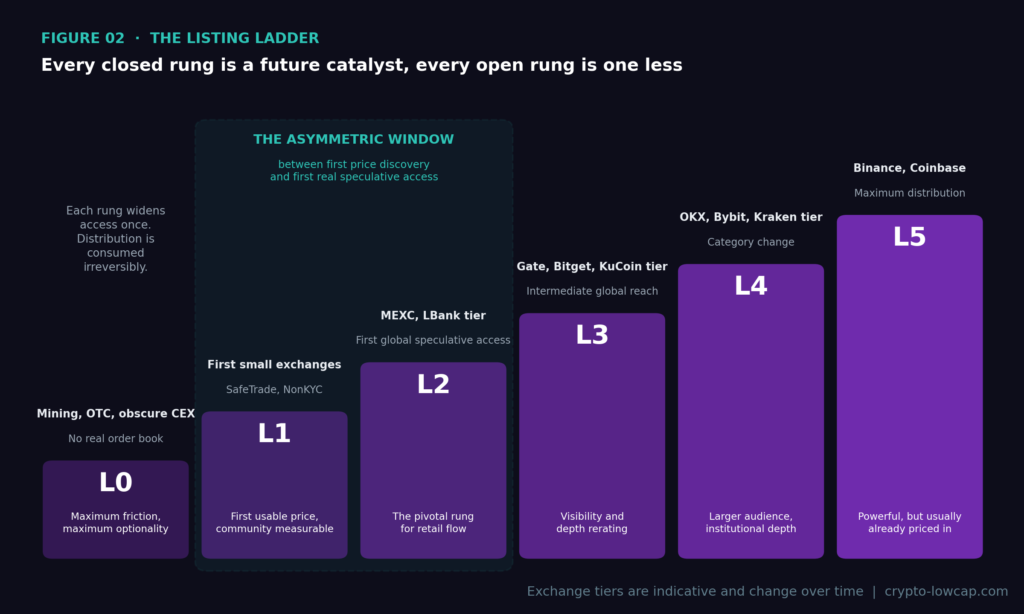
Academic work on cross-listings finds positive abnormal returns around new listings, especially for small capitalizations, with a strong heterogeneity across platforms and timing. In practice, that heterogeneity is the whole story. A listing is conditional, not causal. Obtained before or during the formation of demand, it amplifies the move. However, when it comes after a first peak, it does not recreate a first arc.
The right event at the wrong time
Radiant is the textbook case of the right event at the wrong time. Launched on 20 June 2022, it printed its major peak in April 2023, while the higher-tier listing only arrived in late April 2024, after attention had already peaked and circulating supply had grown much larger. Nexa tells a similar story: a first listing in March 2023, a top-tier exchange in July 2024, and a price still more than 98 % below its high in 2026. A bigger exchange does not automatically recreate the Perception Gap.
Ergo, by contrast, shows the right temporal direction. KuCoin opened an ERG/USDT pair on 5 August 2021, and the cycle peak printed on 2 September 2021. Kaspa went further still: its listings followed organic validation rather than preceding it.
The theoretically optimal entry point is not the first listing. It sits between the first price discovery and the first real speculative access, when a project starts being validated while its Distribution Gap remains wide open.
One last warning comes from experience. An announcement on a lower-quality exchange can be negative. It has the shape of progress up the ladder, but it adds counterparty risk without widening access in any meaningful way.
7. What a catalyst really is
The word catalyst is used for almost any piece of good news, which empties it of meaning. My working definition is stricter: a catalyst is an event that removes a previously identified constraint on access, supply, credibility or attention, and whose effect can be measured through an indicator other than price. Good news that removes no constraint remains news.
Three questions test any announcement. Which precise constraint does this event remove, and was it documented before? Next, which non-price indicator will move if the event works, and over what horizon? Finally, what should I observe thirty to ninety days later to conclude that it failed?
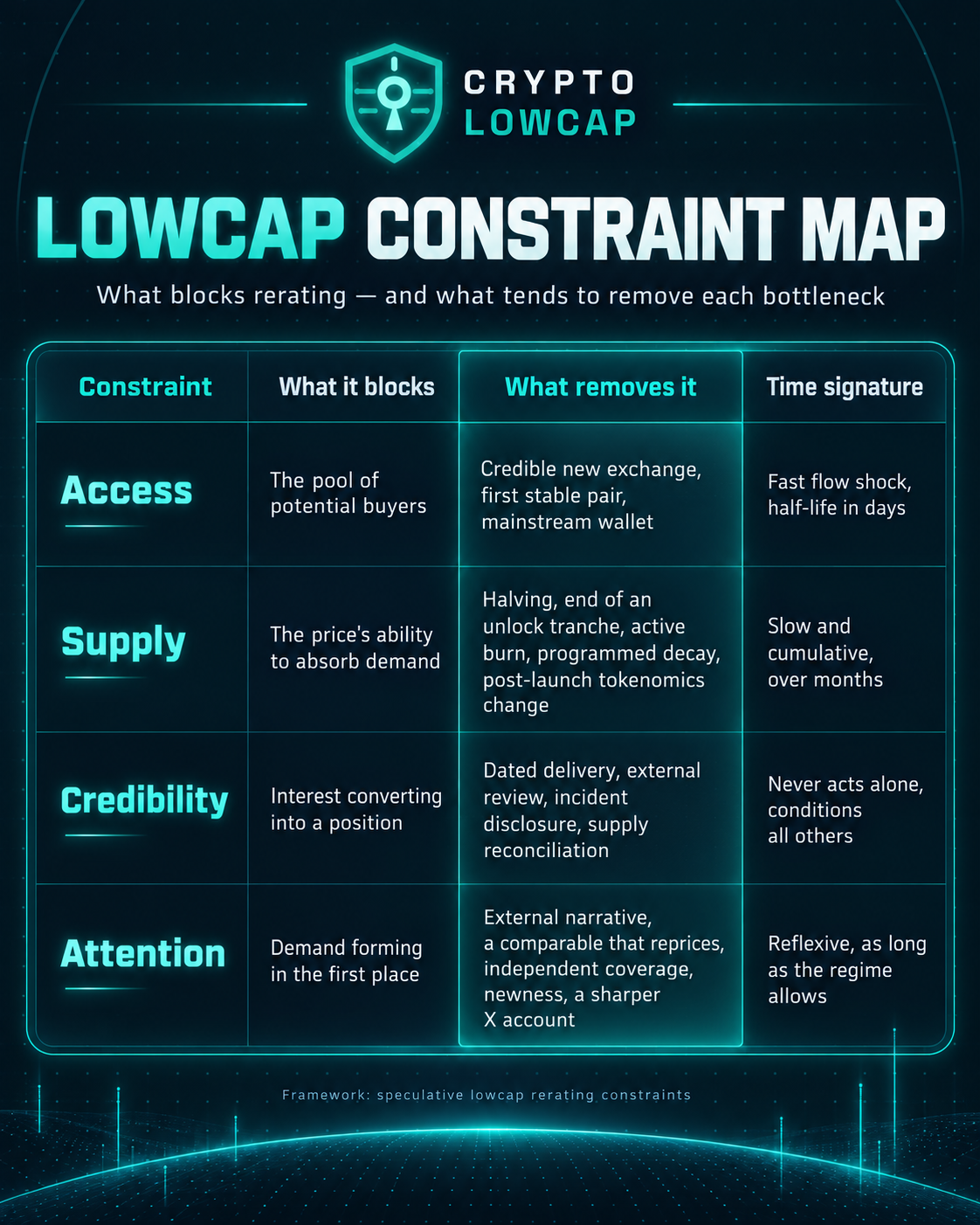
On the projects I study, the healthy order is almost always the same: credibility, then supply, then access, then attention. When access arrives before credibility is established, the result is a spike that does not hold. That reversed order, more than the nature of the event itself, explains most rallies that fall back as fast as they rose.
Three laws that cut across every catalyst
Density beats intensity. Two to four independent catalysts reinforcing each other within a few months are worth more than one spectacular isolated event. Zephyr in 2023 is my favourite example: a new narrative, a differentiated monetary product, a first price discovery and listings, all compressed into a short window, reinforcing each other instead of simply adding up.
The organic signal must precede the announcement. When traction appears before the event, the event produces a change of category. Conversely, when the event comes first, it produces a spike. Market regime is a multiplier, not an addition. In a defensive regime, every catalyst produces a dampened reaction, and no selection work compensates for a bad regime.
Some catalysts, finally, create no new valuation regime at all; they only move demand in time. Zclassic spiked ahead of the hard fork of 28 February 2018, printed a peak just under $200, then dropped by roughly 80 % right after the event. Buying it meant buying a ticket to a dated event. Once the snapshot passed, the constraint no longer existed. That is why I always ask what remains thirty to ninety days after.
Two catalysts the market underestimates
The first one is a change of tokenomics after launch. Many investors treat emission as fixed at genesis, yet a team can rewrite it through a network upgrade, and when the change is large it reshapes the whole hurdle arithmetic described in section 10. Parano1d, a project I follow, has announced an update that would cut its inflation by 78 %. That is massive: with the same entry market cap, far less future supply has to be absorbed, so the capitalization required to deliver a given multiple falls, and the structural selling pressure from miners shrinks with it. Until the update is live on mainnet, however, it remains a team declaration, and its effect should be verified on the explorer rather than on the roadmap.
The second one is a change in communication. When a project’s X account goes from sporadic to very active and smart, with a regular, well-designed output clearly built to capture attention, the attention constraint starts to move. Good communication does two things at once. It reaches people outside the community, and it gives existing holders a sense of belonging, a shared identity that keeps them holding and talking through quiet periods. This shift is one of the earliest attention signals I watch, and its non-price indicators are easy to follow: posting cadence, quality of engagement, new accounts relaying the content, Discord growth. Like any attention catalyst, though, it amplifies a story; it cannot replace one.
8. Narrative, the ten-second pitch
In asymmetric lowcap returns, narrative is the only catalyst family that feeds itself. A story that spreads attracts attention, which reinforces the story, which attracts more attention. For that reason, a poorly compressed pitch, one that needs several sentences to explain, almost always fails to produce a durable move, whatever the quality of what it describes.
Verge is the canonical case. It printed its cycle peak at $0.2619 on 23 December 2017 with one of the most ordinary technologies of its generation and one of the simplest stories. A low denominator, a ten-second pitch, a retail bull market and social amplification: that combination produced the largest multiple of my panel. Pirate Chain in 2021 followed the same logic with a sharper edge, privacy by default, a small float, an ideological community and a powerful external relay.
Timing is an independent factor as well. Neurai combined AI, IoT and proof of work exactly when AI became the dominant theme; listed on MEXC on 24 November 2023 after a community funding campaign, it repriced around ×137. Dynex rode the same wave with two listings in June and July 2023, then a peak of $1.39 in November. Launched two years earlier or later, the same technologies would have met a different demand curve.
DERO adds a subtler lesson. The market priced the anticipation of programmable privacy during the 2021 wave, before the new protocol was formalized in February 2022. Once delivery arrived, the regime had turned, and technical quality did not produce a new high. The market can pay for the promise before the product, then ignore the delivery.
Two uncomfortable corollaries
First, real usage is not a precondition. Several historical winners repriced long before any measurable economic activity existed. A working product strengthens the narrative, but treating usage as a selection criterion would have excluded most of the cases in Table A. Second, concentrated attention is not proof of manipulation. A trading group, an influencer or an ideological community can trigger the reflexive phase. Equilibria (XEQ) shows the other side: attention concentrated around a single relay, then a lead developer who appeared to step away in October 2022. Concentration should be observed and sized, never confused with quality.
I keep one hypothesis permanently on the table: privacy, proof of work, useful compute and post-quantum security may not be the dominant stories of the next cycle. Autonomous agents, tokenized real-world assets, stablecoin rails and prediction markets all compete for the same attention.
9. The volume illusion
Few beliefs cost lowcap investors more than this one: “not enough volume, not investable”. On a recent asset, or on any small project during the low phase of a bear market, a daily volume of a few hundred to a few thousand dollars is the norm. Volume is not a fixed attribute of a project. It follows attention at the same pace as price.
When a narrative works and its catalysts trigger at the right time, market depth generally tracks the same order of magnitude as price, sometimes more at euphoric peaks. A market moving from one or two thousand dollars of daily volume to several million is nothing unusual on this segment. In 2017, Verge traded on obscure exchanges before the privacy narrative captured retail; volume followed the move, it did not anticipate it.
Published research on wash trading adds an independent argument. Declared volume can be heavily artificial on some platforms, particularly incubator exchanges hosting very small assets. High volume can be manufactured. Low volume cannot be manufactured downward. It is the less manipulable of the two signals, yet the one most investors treat as disqualifying.
None of this means the market is irrelevant. The signature of a structurally dead market is not a low number; it is incoherence. Aggregators showing different prices, a circulating supply that does not reconcile across sources, or a bid-ask spread of several tens of percent are the real warnings. Dormant liquidity on an otherwise coherent asset is not a trap, it is one of the conditions of asymmetric lowcap returns.
Where volume does matter
In practice, volume matters for execution. Relative turnover, daily volume divided by market cap, tells you whether a meaningful share of the denominator changes hands each day, which is a timing signal rather than a quality signal. The size of a position must also be read against capitalization: $500 represents 1 % of a $50,000 market cap, 0.1 % of $500,000 and only 0.005 % of $10 million. Volume answers one question only: how much can I buy today without becoming the market?
10. Think in market cap, never in price
A unit price tells you nothing. In practice, a token at $0.0001 is not cheap, and a token at $50 is not expensive; only the capitalization, and above all the future capitalization, carries information. Positions on this segment should therefore be reasoned in market cap at every step, including on charts.
Inflation deserves the same rethinking. On young proof-of-work networks it is often treated as a red flag and used as an automatic veto. In reality, inflation is a cost of time. It raises the market cap required to deliver a given multiple, it makes bottoms harder to identify and it adds structural selling pressure from miners. Yet it does not cancel the convexity behind asymmetric lowcap returns when the starting capitalization is tiny.
The arithmetic is simple: the arrival capitalization required for a given multiple equals today’s market cap, times the multiple, times the growth of supply over the period. A project at $50,000 whose supply triples in twelve months needs about $15 million to deliver a ×100: demanding, but within reach of past winners. By contrast, a $50 million asset with negligible inflation needs $5 billion for the same multiple. Low inflation does not help an asset that is already expensive.
Time therefore dilutes the patient buyer. Waiting for a specific nominal price without modelling what supply will do in the meantime is one of the most common errors I see. If supply grows tenfold before that price is reached, the capitalization needed for the next ×50 has grown tenfold as well.
A plausibility band, not a target
A required capitalization only makes sense against what comparable projects reached in a bull market. Pirate Chain peaked around $344 million in 2021, DERO around $250 to $300 million by my own estimate, Verge around $121 million and PIVX around $119 million in 2017. Excluding outliers, a proof-of-work or privacy microcap winner of a cycle has landed between roughly $50 million and $350 million. Kaspa, at several billion, is the outlier, and a model built on an outlier is not a model. Any scenario above that band has to be defended explicitly, not assumed.
Two corollaries follow. A low hurdle never justifies a large allocation: the project with the lowest required capitalization is often the one with the most fragile market. Furthermore, a stable price during heavy emission is information in itself. When supply doubles while price holds, capitalization has absorbed that growth. A falling price with an intact network and active development can be healthy compression; a falling price with a vanishing network is a survival discount, not an opportunity. The best price is rarely the lowest price observed.
11. Reading the chart of a newborn
When chasing asymmetric lowcap returns, technical analysis on a lowcap that just listed obeys different rules from those of a mature asset, and misreading them is a classic way to sell at the bottom or buy at the top. Over the years, I have settled on a few principles.
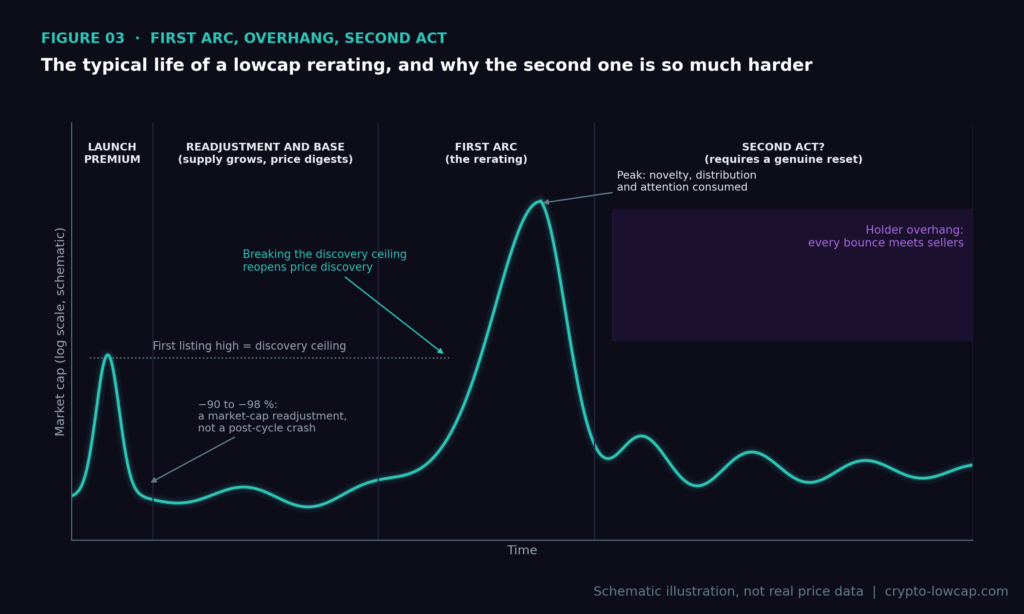
The highest price of the first listing is the first all-time-high marker. I read it as a discovery ceiling: a level the market will have to break, often months later, to reopen price discovery. Likewise, a drop of 90 to 98 % after the first indexation is usually a market-cap readjustment, as the launch premium deflates while supply grows. It is not the post-cycle collapse it resembles.
Two paths after the first listing
Two post-listing configurations coexist, and neither is discriminating on its own. Some projects go through a long markdown before their real arc, as Pirate Chain did. Others climb in stairs without a major drawdown, as Neurai and Zephyr did. What builds the final return is the gap between the entry capitalization and the capitalization the project can plausibly reach, provided the team manages both the speculative vehicle (narrative, community, listing funding) and the technology (credible delivery, bugs and incident handling).
An older asset can still hold high potential if its chart never spent months drawing a falling knife, because it was never really priced on its story. Conversely, an asset that already burned through its discovery phase carries a discount that neither technology nor narrative can offset.
| The signal no spreadsheet captures The dynamics of a project’s Discord, how members talk to each other, how fast and how precisely developers answer, how the community handles a bug, remain one of my most reliable instinct signals. I cannot score it, but I have learned not to ignore it. |
12. Market regime, the uncontrollable multiplier of asymmetric lowcap returns
Every driver of asymmetric lowcap returns operates inside a market regime that no project controls. I distinguish five of them: defensive, when Bitcoin dominance rises and small caps should be avoided; accumulation, when dominance stabilizes at a high level; altcoin rotation; microcap expansion, when breadth surges across small caps; and euphoria, when retail search, memes and leverage go parabolic and profits should be taken progressively.
The 2024-2026 cycle broke the historical pattern. Indeed, the rotation of capital largely stopped at Bitcoin and, to a lesser degree, Ethereum. The most documented explanation is the spot index products: a large pool of institutional capital reaches Bitcoin through a regulated vehicle and never flows further down the risk curve. Pantera summarized in early 2026 that tokens outside Bitcoin had been in a bear market since December 2024.
Two practical consequences follow. Historical rotation thresholds, such as dominance falling under 45 %, are probably obsolete. More importantly, a cycle without broad rotation remains possible, in which case reratings would be selective and driven by each project’s own catalysts. Around mid-August 2026, my own reading was selective accumulation: the global regime did not validate a generalized expansion of small caps. In that phase, research builds the list; it does not trigger the reinforcements.
13. The anatomy of failed second acts
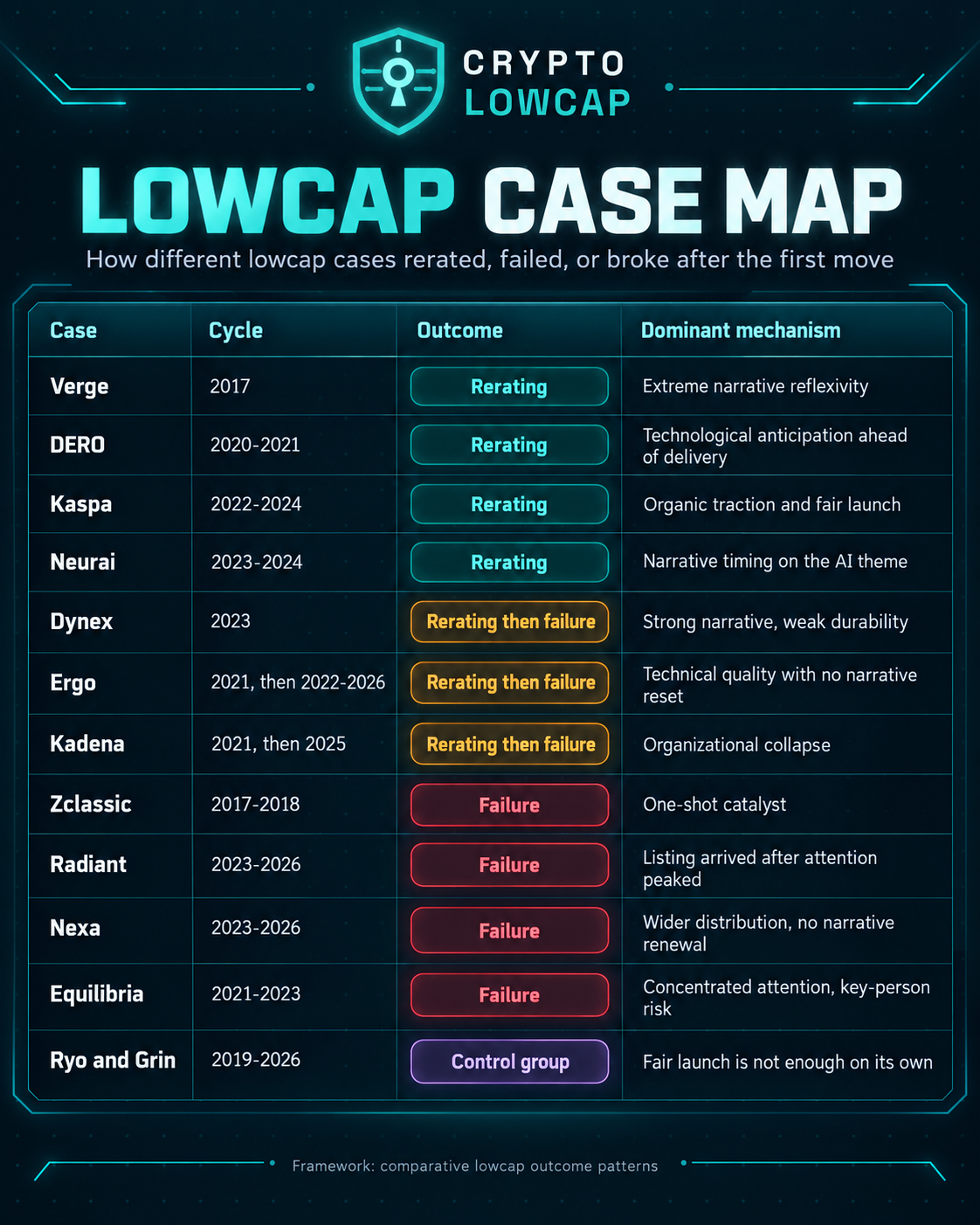
Studying winners teaches half the lesson about asymmetric lowcap returns. The other half comes from projects that had everything on paper and failed, either from the start or the second time around. Below, Table C summarizes the thirteen cases I dissected.
Aftershocks, not second acts
The first lesson of this table is about frequency: true second acts are rare. Most of the time, what follows a first arc looks like the aftershocks of an earthquake. Each new wave is noticeably weaker than the previous one, carried by a shrinking pool of new buyers and met by a growing pool of disappointed holders, until speculative death, the point where the market simply stops reacting to news. Exceptions exist, Zcash in 2025 being the most striking one, but each of them required a complete reset of perception. Their rarity confirms the rule rather than weakening it.
Three instructive failures
Ergo is the best control I know against the bias that good technology means the next big multiple. It peaked at $18.72 on 2 September 2021, then lost about 99 % of its value while its eUTXO architecture remained as sound as ever. No breakout narrative ever came to renew demand. Firo tells a related story: real research, several generations of privacy primitives, but a second act that had to happen on an already mature and widely distributed asset. A 51 % attack in January 2021 acted as a point shock, not as the structural cause.
Kadena adds a risk that code quality never captures. After topping $25 in 2021, the organization announced on 21 October 2025 that it was ceasing operations and active maintenance. A blockchain can keep running technically while the structure that develops it disappears.
Ryo and Grin, finally, form my fair-launch control group. Grin launched on 15 January 2019 with no ICO, no premine and no founder reward. Both projects have strong distribution qualities and ideological coherence, yet neither captured a durable trajectory comparable to the best cases. Excellent tokenomics alone does not trigger demand; low inflation only lowers the capitalization required to reach a given multiple.
None of these cases repriced twice the same way. Every success was built on price discovery that had not been consumed yet. In contrast, every failed second act shares the same trait: that discovery had already happened, and nothing came along to renew it.
14. What does not separate winners from losers
It is at least as useful to state what the retro-analysis of asymmetric lowcap returns does not show. Across the cases I studied, I found no exploitable regularity on the following points, and I consider any thesis built mainly on them to be weak.
- Technological superiority. Verge holds the highest multiple of the panel with the most ordinary technology.
- The funding model. Fair launches and funded projects appear in both columns.
- Age. Some winners repriced four years after launch, others within six months.
- Team size. Several winners had fewer active contributors than projects that stayed at zero.
- Presence on price aggregators. A necessary condition, never a sufficient one.
- Measured real usage. An amplifier of the story, not a condition of the rerating.
This list is not an argument against quality. Instead, it is an argument for putting quality where it belongs: as a filter against fraud and fragility, and as a multiplier of credibility once the speculative engine is running.
15. Risks: what no framework protects you from
Everything above about asymmetric lowcap returns describes probabilities, not certainties, and the segment punishes overconfidence harshly. Proof-of-work micro and nano caps can lose 70 to 100 % of their value, become illiquid, suffer a consensus bug or lose their team. The risks I document systematically fall into seven families.
- Supply risk. A circulating supply that does not reconcile across explorer, documentation and aggregators can make a project look like a nanocap when it is not. No reconciled supply, no position.
- Security risk. Network attacks, consensus or virtual-machine bugs. A resolved and documented incident acts as a point shock; an active or recurring one outweighs any valuation argument.
- Verifiability risk. Any project whose critical security components remain private cannot receive the same trust premium as one with fully auditable code.
- Key-person and organizational risk. A single developer stepping away, as observed around Equilibria, or an organization shutting down, as with Kadena.
- Exchange and liquidity risk. Incubator exchanges carry counterparty risk, withdrawals can be suspended, and order books can be thin enough that one order becomes the market.
- Regulatory risk. Under Article 79 of Regulation (EU) 2024/1624, crypto-asset service providers will no longer be able to handle anonymity-enhancing coins from July 2027. For privacy-by-default assets, the European rungs of the ladder may simply close.
- Narrative and regime risk. The themes of the next cycle may lie elsewhere, and a defensive regime dampens every catalyst, however good.
The analyst’s own biases
Two further risks belong to the analyst rather than the asset. Backtests built on known outcomes carry hindsight and survivorship biases, which is why I freeze data at a date of decision and publish my coding for audit. Moreover, the same thin float that creates convexity creates violent reversals: at the euphoric end of a cycle, the exit door is as narrow as the entry was. Position size should reflect fragility, entries should be split over time, and a thesis should always come with the observation that would break it.
16. Ten lessons from ten years of asymmetric lowcap returns
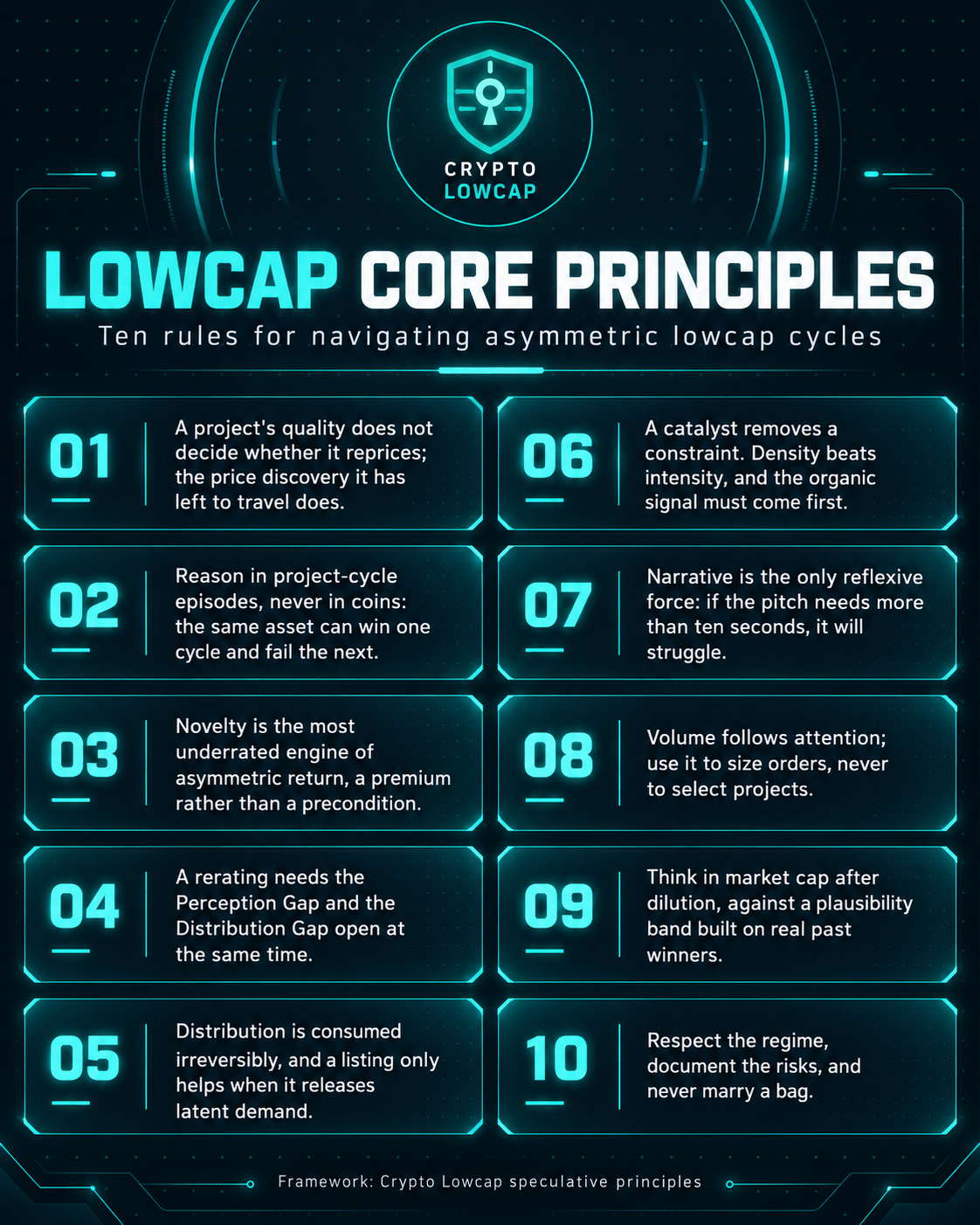
17. Verdict: what I would tell my 2016 self
If I could hand one page to the investor I was in 2016, it would not contain a list of tickers. It would contain a question: how much of this story has the market not heard yet? I would also tell him that the best technology rarely wins the cycle, that the crowd always arrives, though never where the price is still low, and that the projects he loves most are often the ones he should let go first.
Yet I would not tell him that analysis is useless. Fundamental work remains the only protection against fraud, unverifiable supply and teams that will not survive long enough to be discovered. Speculative analysis does not replace it; it decides where, among the projects that pass that filter, the remaining asymmetry actually lies.
Most importantly, I would remind him that nothing in this article guarantees anything. In reality, most lowcaps fail, including well-chosen ones, and every one of the patterns described here has exceptions. The edge in asymmetric lowcap returns, when it exists, comes from patience, sizing and rotation, not from certainty. As usual, my job is to map the terrain honestly. What you do with the map remains entirely your decision.
Further reading
- Before the Crowd: 8 Overlooked Lowcaps for the Next Cycle, the current map these concepts are applied to.
- Project Watch, fundamental and speculative briefs kept separate on purpose.
- Privacy Coins: A Decade of Cryptographic Resistance (2012-2026), the long history behind today’s privacy lowcaps.
- External reference: Y. Liu and A. Tsyvinski, Risks and Returns of Cryptocurrency, Review of Financial Studies (DOI 10.1093/rfs/hhaa113), on momentum and investor attention in crypto markets.
- Price histories used for the cases: CoinGecko, Kaspa and CoinGecko, Ergo, among others.
| ⚠️ FINAL DISCLAIMER. This article is a research and educational piece, not a buy or sell recommendation, nor personalized financial advice. Proof-of-work micro-caps can suffer network attacks, consensus bugs, delistings, a complete loss of liquidity and a total loss of capital. |
Related reading: my speculative map in Before the Crowd, the case for why proof-of-useful-work could finally matter, and the long view in a decade of cryptographic resistance.
crypto-lowcap.com | Privacy, Decentralization & Blockchain Innovation
Follow @CryptoRowenta01 on X | Subscribe to the newsletter
© 2026 crypto-lowcap.com, not financial advice. Always DYOR.