Zano: The Forgotten CryptoNote Heir Building a Multi-Asset Privacy Layer
From Boolberry to Zarcanum: a fundamental deep dive into one of the most technically differentiated privacy projects you have never heard of.
| ⚠️ BEFORE WE START — NOT FINANCIAL ADVICE This article does not constitute investment advice. These are purely personal observations from a fundamental analyst who has been covering the privacy crypto space since 2016. Micro-cap and low-cap projects carry significant risk. The positions and opinions expressed here are my own. Do your own research. |
I have followed privacy coins since 2016, and I have learned to be suspicious of two things: projects that promise more than they can deliver, and projects whose genuine technical depth goes unnoticed despite genuine marketing efforts — because the market is not yet ready to reward real technical work over narrative. Zano falls into the second category, and that is precisely what makes it worth a serious analysis.
Let me be honest about something. I have been watching Zano for a while, but I delayed writing about it for one simple reason: the adoption gap between what the technology actually does and what the ecosystem shows in real usage metrics is wide enough to raise legitimate questions about whether this is a research project with a token attached, or an infrastructure play that has not yet found its moment. Both framings are partially true, and my job here is to walk you through both possibilities, with cross-checked numbers and a clear verdict at the end.
What Zano offers is genuinely unusual. It is not a Monero fork. It is not a Zcash variant. It is, arguably, the only Layer-1 privacy chain that combines mandatory privacy-by-default, multi-asset confidentiality with hidden asset types, a Proof-of-Stake consensus where staked amounts are cryptographically hidden, and a cross-chain bridge — all audited by an independent cryptographic firm. That stack is rare. Whether the market will recognize it is a different question.
1. From CryptoNote to Zano: The Longest Line in Privacy Crypto
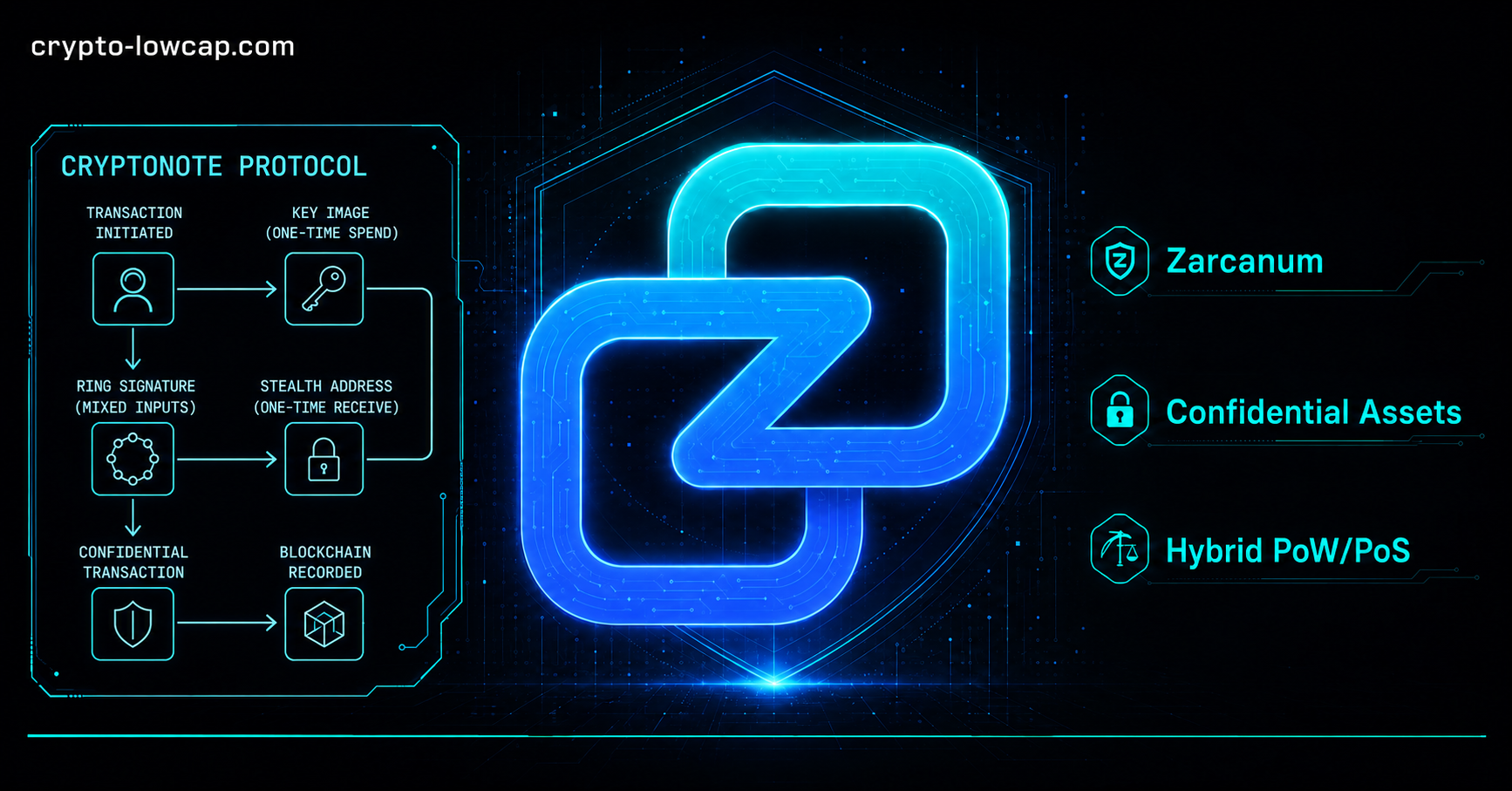
To understand Zano, you have to understand where it comes from. The CryptoNote protocol, published in 2012 under the pseudonym Nicolas van Saberhagen, was the first serious attempt to build transactional privacy from scratch, outside the Bitcoin codebase. Ring signatures to hide the sender, stealth addresses to hide the recipient, Pedersen commitments to hide the amounts. The intellectual contribution was real and lasting: Monero, the most battle-tested privacy coin in existence, is a direct descendant of CryptoNote.
Andrey Sabelnikov, known by his handle crypto_zoidberg, is documented as the lead developer of the original CryptoNote implementation. The primary mathematician behind Zarcanum and the Confidential Assets construction is Crypto Sowle (Val), Zano’s lead researcher — a distinction that meaningfully distributes the key cryptographic knowledge across the core team. He worked alongside Nicolas van Saberhagen during the protocol’s construction phase. Whether Sabelnikov is Saberhagen is a question he declines to answer definitively, and I will not speculate beyond the documented record. What matters for the analysis is that Sabelnikov’s role in the CryptoNote codebase is not disputed, and his subsequent work on Boolberry and then Zano represents the most continuous thread of CryptoNote development outside of Monero.
1.1 The Boolberry Problem
Before Zano, there was Boolberry (BBR), launched in 2014. Sabelnikov describes it as his attempt to improve on CryptoNote with dynamic ring signature sizes, a memory-intensive hash function, and other innovations. Some of these ideas were later adopted independently elsewhere. But Boolberry suffered from a structural problem that no amount of technical quality could solve: it had no premine, no dev fund, no sustained financing. A 1% block reward tax proved insufficient to maintain full-time development. By 2017-2018, Boolberry was effectively stalled.
Zano was the answer to that impasse. Launched in 2019 with Pavel Nikienkov as co-founder and project manager, Zano kept the cryptographic heritage of CryptoNote but built a completely new codebase, added a premine for funding, and set out an explicit roadmap toward something more ambitious than a payment coin: a privacy infrastructure for multiple assets.
1.2 The Microsoft / Kelihos Affair
| ⚠️ ANALYST NOTE — The Kelihos Lawsuit In January 2012, Microsoft named Andrey Sabelnikov as a defendant in a lawsuit related to the Kelihos botnet, alleging he had written the malware and operated the botnet. In October 2012, the case settled. The joint statement reads explicitly: the parties understood that Sabelnikov wrote code that was used in the Kelihos botnet code, but that the programmer is not the operator of the botnet and is not involved in its activities. No criminal charges were filed. Microsoft itself corrected its initial allegations. I include this because omitting it would be irresponsible. But misrepresenting it would be equally so. The legal record establishes code reuse, not malicious operation. Any analysis that treats this as a conviction or a disqualifying red flag is misreading the facts. |
2. The Problem Zano Is Actually Solving
Monero solves the digital cash problem. You want to transfer value privately, without anyone knowing how much you sent, who you sent it to, or where it came from. Monero does this extremely well for one asset: XMR. If you want to do the same thing with a stablecoin, a synthetic asset, or a tokenized real-world asset, Monero offers you nothing. You have to use Ethereum or another public chain, where your transaction is visible to anyone who knows your address.
Zcash takes a different approach with shielded pools, but privacy is optional. The well-documented adoption problem is that the vast majority of ZEC transactions remain transparent, defeating the privacy purpose for most real-world usage. This is one of my core editorial theses: an optional privacy model is a broken privacy model for network-level analysis.
Zano’s stated thesis is distinct from both: build a Layer-1 where any asset, whether native ZANO, a user-issued token, or a bridged Bitcoin or ETH, gets the same default privacy guarantees. Amount hidden, sender hidden, recipient hidden, and uniquely, asset type hidden. An observer looking at a Zano transaction cannot tell whether it involves native ZANO, a private stablecoin, or a tokenized security.
That last property, asset type indistinguishability, is the technical claim that most distinguishes Zano from every other privacy chain I have analyzed. Whether the market ever values this property at scale is the open question.
3. The Technology Stack: What Zano Actually Does
Let me walk through the technical components in plain terms, because this is where Zano earns or loses its credibility.
3.1 Privacy Foundations
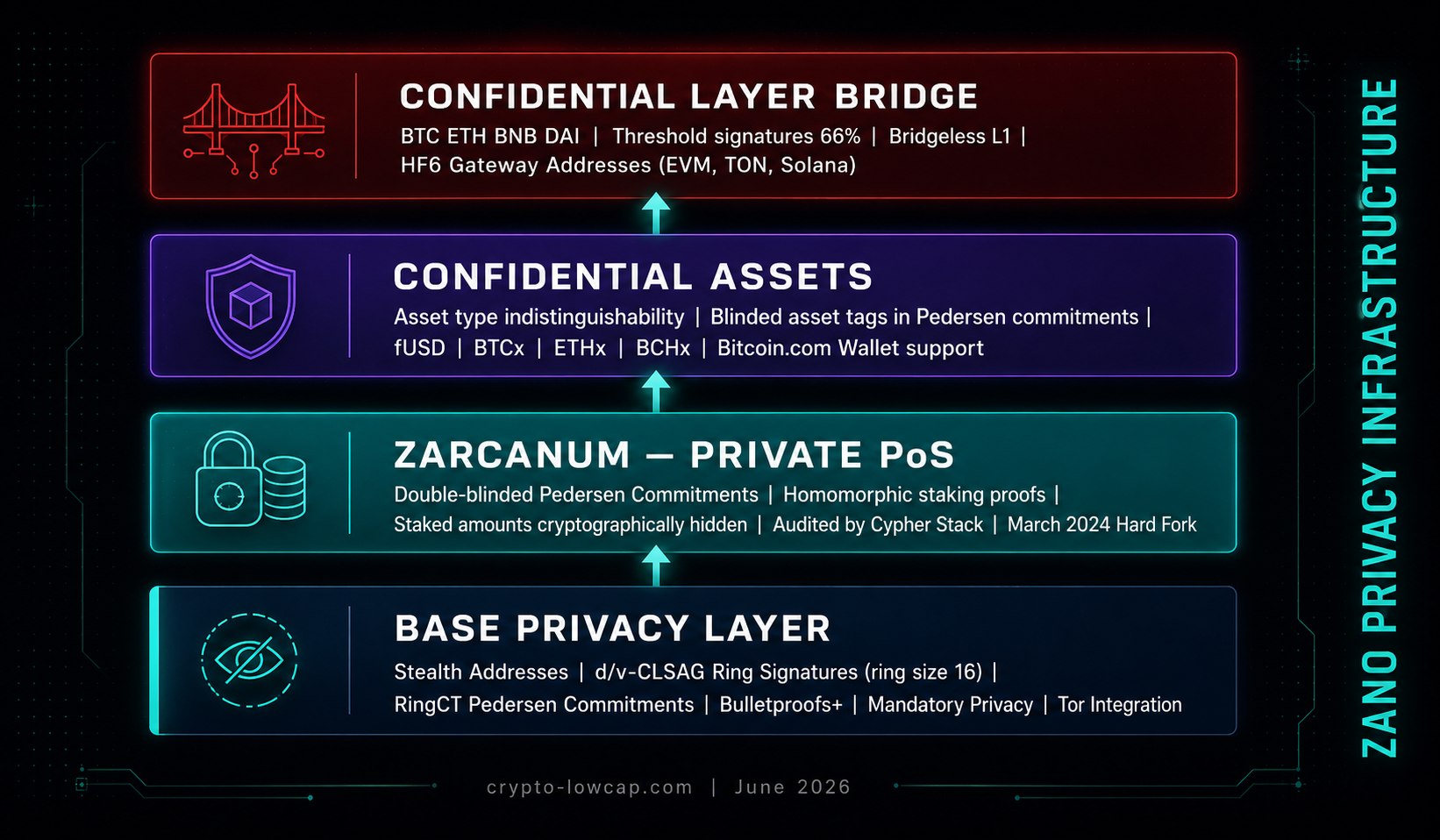
Zano’s base privacy layer combines stealth addresses, d/v-CLSAG ring signatures (an evolution of Monero’s CLSAG), RingCT for amount hiding via Pedersen commitments, and Bulletproofs+ for efficient range proofs. The ring size is 16, in line with Monero. Privacy is mandatory: there is no transparent transaction mode. IP obfuscation via SOCKS5 proxy, supporting Tor, NYM, and other compatible privacy networks is included.
This is table-stakes for a serious privacy coin in 2026. What differentiates Zano starts with the next layer.
Source: Zano documentation, project whitepapers, Cypher Stack audit report. Data as of June 2026.
3.2 Zarcanum: The First Private PoS
Zarcanum is the contribution I find most technically interesting, and the least discussed outside the project’s immediate community. Activated via hard fork in March 2024 at block 2,555,000, it solves a problem that sounds obvious once stated: how do you run a Proof-of-Stake consensus on a privacy chain where amounts are hidden?
In a standard PoS system, stakers broadcast their stake to the network to prove they have the right to produce blocks. On a privacy chain where amounts are encrypted, this creates a contradiction. You need to prove you hold a certain amount without revealing what that amount is.
Zarcanum resolves this using double-blinded Pedersen commitments and extended Bulletproofs+. The staker proves possession of a valid output and satisfies the staking difficulty condition via homomorphic commitments, without revealing the amount. The academic preprint on eprint.iacr.org received contributions from koe, a Monero Research Lab associate, and was reviewed by Sarang Noether (Aaron Feickert), a former Monero Research Lab cryptographer. That level of external peer engagement is unusual for a project of Zano’s size.
That is a real engineering achievement. Whether it matters in practice depends on adoption, but as a cryptographic construction it deserves recognition.
3.3 Confidential Assets
Confidential Assets (CA) are Zano’s token standard. Any party can issue a fungible token on Zano, and that token inherits the full privacy stack: hidden amounts, hidden sender and receiver, and, critically, hidden asset type.
The asset indistinguishability property is the technical claim that matters most. A transaction involving native ZANO and a transaction involving a CA token are computationally indistinguishable on-chain. The mechanism extends the RingCT dv-CLSAG scheme with blinded asset tags embedded in Pedersen commitments. The academic description is in the paper Confidential Assets for RingCT and Zarcanum.
In practice, as of June 2026, the ecosystem is nascent but moving. fUSD is a private stablecoin already in circulation on Zano. BTCx, ETHx, and BCHx are bridged assets accepted at merchants via the Bitcoin.com payment system. The Bitcoin.com Wallet supports Confidential Assets. These are small but concrete data points, not projections.
3.4 Ionic Swaps and zDEX
Ionic Swaps are Zano’s version of atomic swaps, redesigned to preserve the confidentiality properties of both sides of an exchange. In a classic atomic swap (HTLC), the hash lock is visible on-chain and can reveal correlations between the two legs of the trade. In an Ionic Swap, the exchange happens within a single Zano transaction, keeping all privacy properties intact.
Zano Trade (zDEX) is the P2P exchange interface built on Ionic Swaps, in beta since June 2024. The honest assessment: adoption is minimal in mid-2026. The infrastructure works technically. The market for it has not materialized yet.
3.5 The Confidential Layer Bridge
Launched in July 2025, the Confidential Layer Bridge allows users to move BTC, ETH, BNB, and DAI to Zano, where they become Confidential Assets with full privacy. The bridge uses threshold signatures distributed across a validator network built on the Bridgeless L1 chain, with a 66% signing threshold.
Hard Fork 6, tested as of early June 2026, introduces Gateway Addresses: a new native address type enabling trustless bridging of ZANO to EVM chains, TON, and Solana. An important caveat: Gateway Addresses are transparent by design, meaning the bridged amount is visible on-chain, while only the sender identity (stealth address) remains hidden. Once assets leave Zano for Ethereum or Solana, they are public again. The privacy exists on Zano, not on the destination chain.
4. Hybrid PoW/PoS Consensus
Zano runs a hybrid model: PoW blocks using ProgPoWZ (a GPU-optimized, ASIC-resistant derivative of ProgPoW) and PoS blocks via Zarcanum, split 50/50. Block time is one minute. Rewards are shared equally between miners and stakers.
The security argument for this design is straightforward. A 51% attack requires simultaneously controlling a majority of hashrate AND a significant portion of the stake. The team’s modeling suggests that with just 20% of the stake, an attacker would need over 800% of the current total hashrate to succeed. That is a materially higher attack cost than pure PoW.
| 💬 ZANO TEAM — UPCOMING PROTOCOL UPDATE The Zano team has announced a forthcoming transition to full Proof-of-Stake consensus. According to Mr_Kwibs (Head of Marketing & Growth), the associated whitepaper is expected to be released in late June 2026. Key announced parameters: 15-20 second block times, 3 confirmations required before assets unlock (meaning assets received can be re-sent within approximately one minute), approximately 20x faster finality than Monero and Zcash, and 100% fee burns. These figures are announced by the team and have not yet been independently verified by Crypto-Lowcap at time of publication. We will update this section upon whitepaper release. |
The open questions are on the PoS side. Without published data on stake distribution, it is impossible to assess whether the PoS component is genuinely decentralized or concentrated in a few large holders, including the foundation fund. The privacy of staked amounts, the unique feature of Zarcanum, is both a security feature and an opacity concern for analysis.
Source: Project documentation, Crypto-Lowcap analysis. June 2026.
5. Tokenomics and Emission
Zano’s emission model is one of its less-discussed and more interesting properties. The following data is sourced from docs.zano.org, CoinGecko, and cross-checked via on-chain explorers as of June 3, 2026.
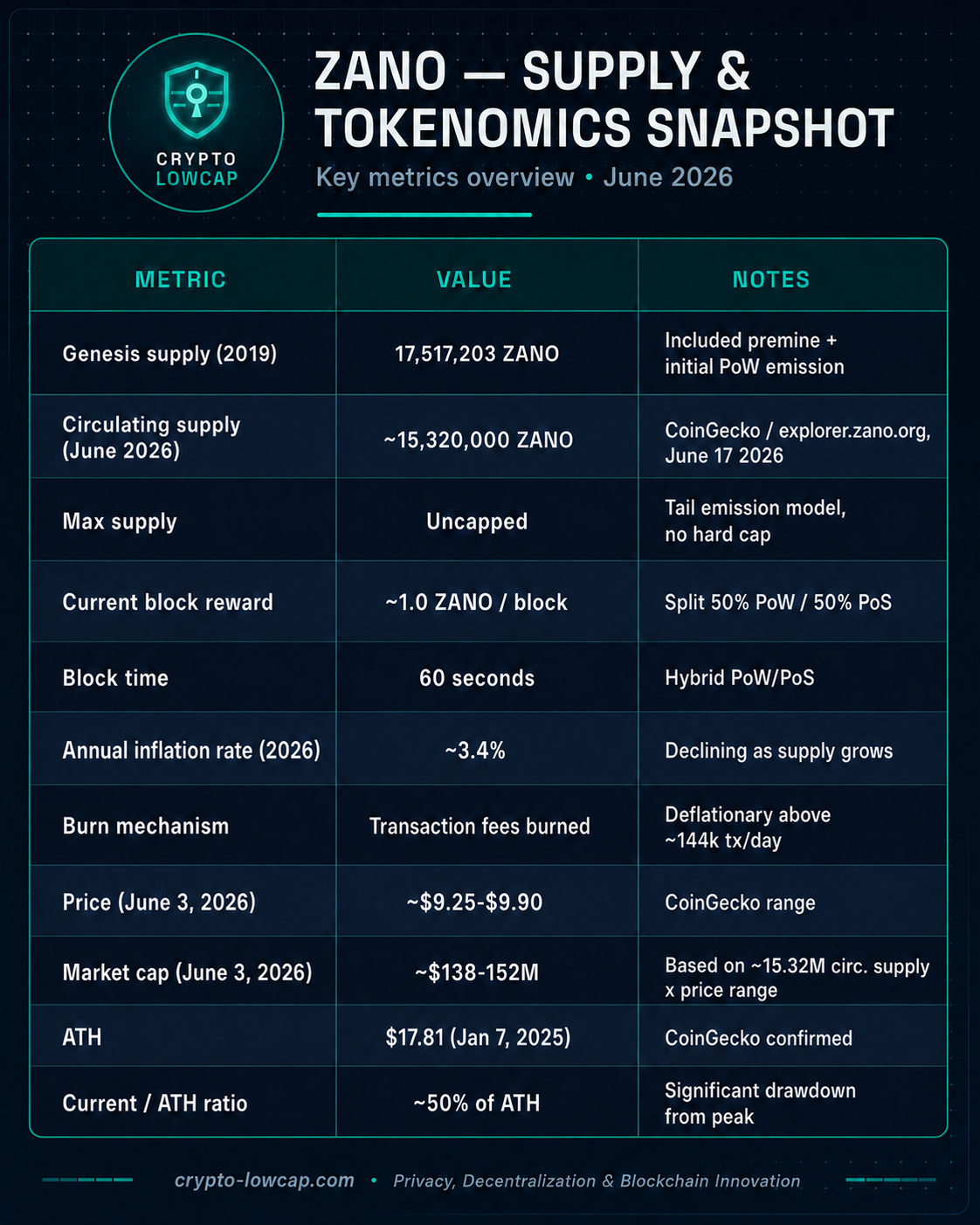
Source: Zano documentation (docs.zano.org), CoinGecko, on-chain explorer. Data as of June 3, 2026.
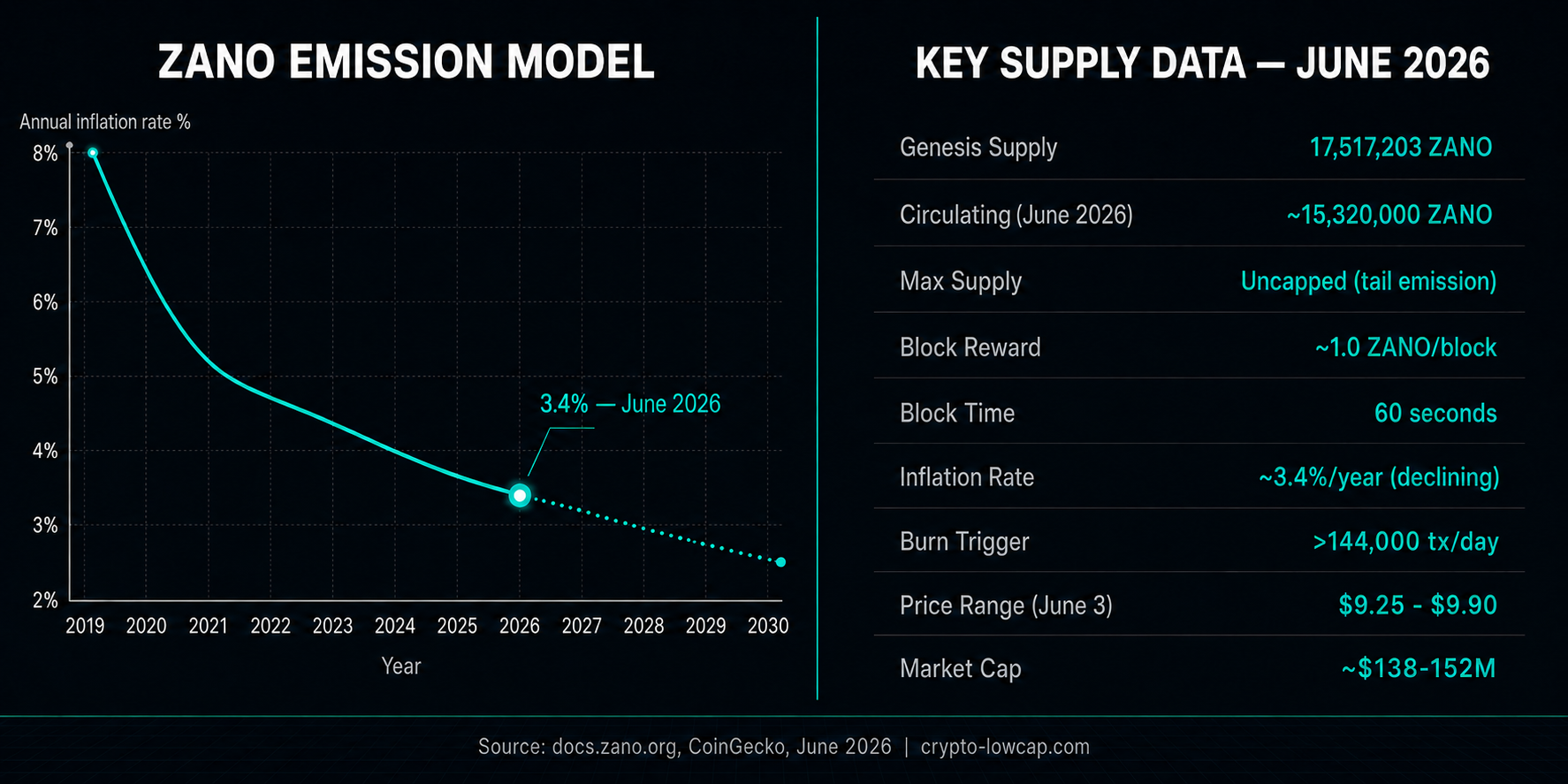
There are two notable features here. First, the circulating supply is slightly above the genesis supply due to ongoing PoW/PoS emission, but the burn mechanism is net deflationary if transaction volume exceeds roughly 144,000 per day. That threshold is far from met in mid-2026, but it establishes the structural mechanic.
Second, the uncapped supply is occasionally cited as a negative. I do not think this framing holds. Zano’s model is philosophically similar to Monero’s tail emission: a perpetual low inflation rate guarantees permanent mining and staking incentives, which is arguably more honest about long-term security economics than Bitcoin’s assumption that fees alone will sustain security post-halving. The current inflation rate is approximately 3.4% per year and declining.
6. The Premine Question
I will not sugarcoat this. The premine is the part of Zano’s story that gets the most critical attention from the cypherpunk community, and for legitimate reasons.
The initial premine was 3,600,000 ZANO, approximately 20% of the genesis supply. By December 2024, approximately 78% of this premine had been spent, leaving the foundation fund at roughly 5.4% of total circulating supply. The foundation fund address is publicly trackable via a published tracking seed, which is a genuine transparency positive.
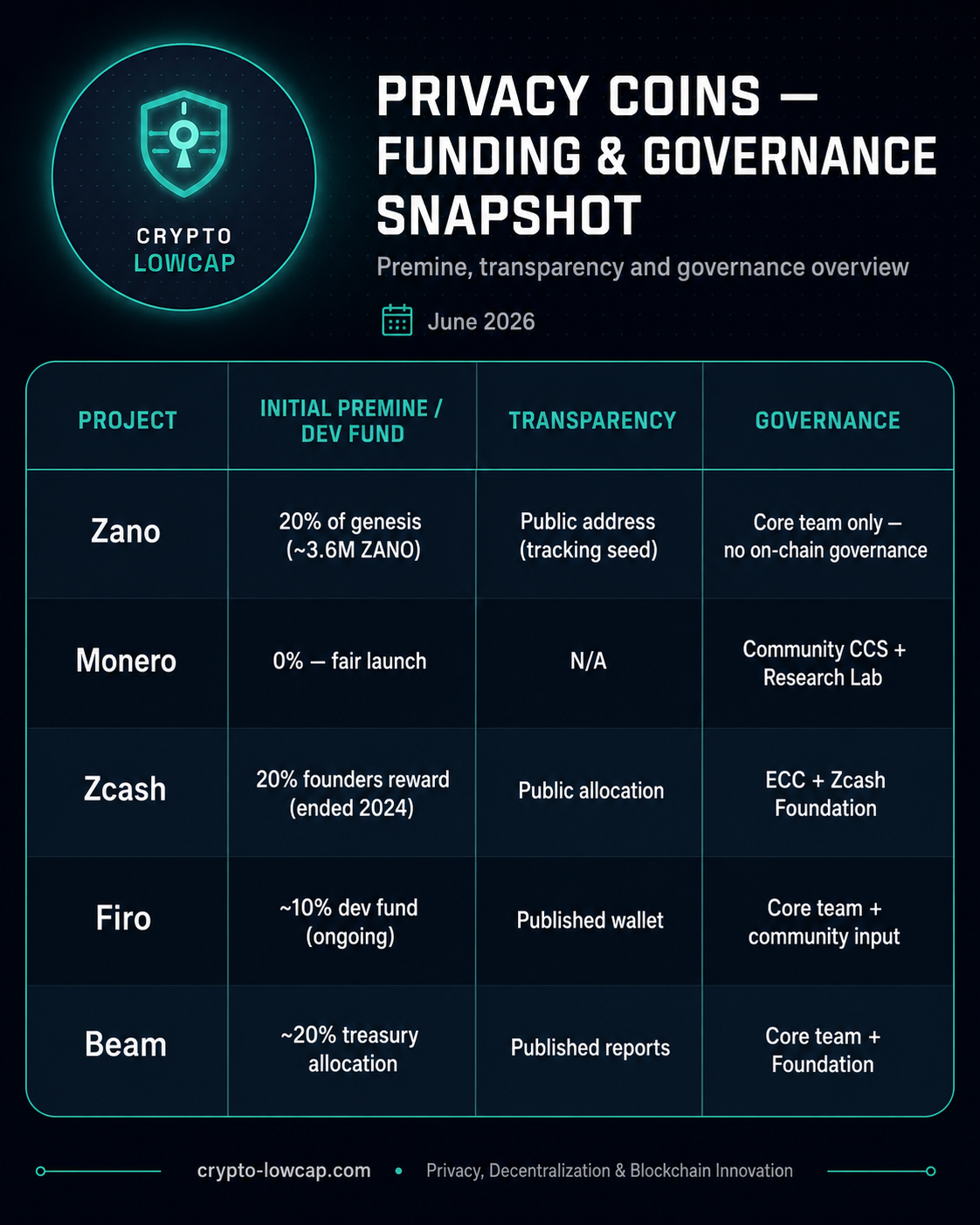
Source: Project documentation, Crypto-Lowcap research. June 2026.
My position: the premine is not an automatic disqualifier. It funded real development, including the Zarcanum hard fork and external audits. The public address provides accountability that most projects with dev funds lack. The legitimate concern is governance: decisions about how to spend the remaining fund are made by the core team without on-chain governance. A community crowdfunding system (CCS) inspired by Monero’s model is referenced in official communications, but not yet operational.
The transition to a community-funded model will be a meaningful signal. Until then, the premine and its spending remain a centralization risk.
It is also worth noting that on-chain voting has been implemented, though it has only been used twice as of June 2026. The CCS (Community Crowdfunding System) model represents the next step toward a more decentralized governance structure.
7. Team, Governance, and Development Activity
The core team is small. Identified contributors include Andrey Sabelnikov (crypto_zoidberg, lead cryptographer and developer), Pavel Nikienkov (co-founder, project management), and Quinten van Welzen (community). The GitHub organization hyle-team lists 23 contributors across 41 repositories as of June 2026 — a figure that includes issue reporters, frontend, and mobile contributors. The core team with full protocol knowledge comprises 3 members. The core node is primarily C++ (69.9%), with Go and TypeScript for bridge and UI components.
Activity is moderate by absolute standards but significant by contribution type. Zarcanum was not a simple feature addition, it was a fundamental protocol redesign. The last major release (v2.1.7.411) was in June 2025. The HF6 testnet was live in early June 2026. The development cadence is slow but consistent.
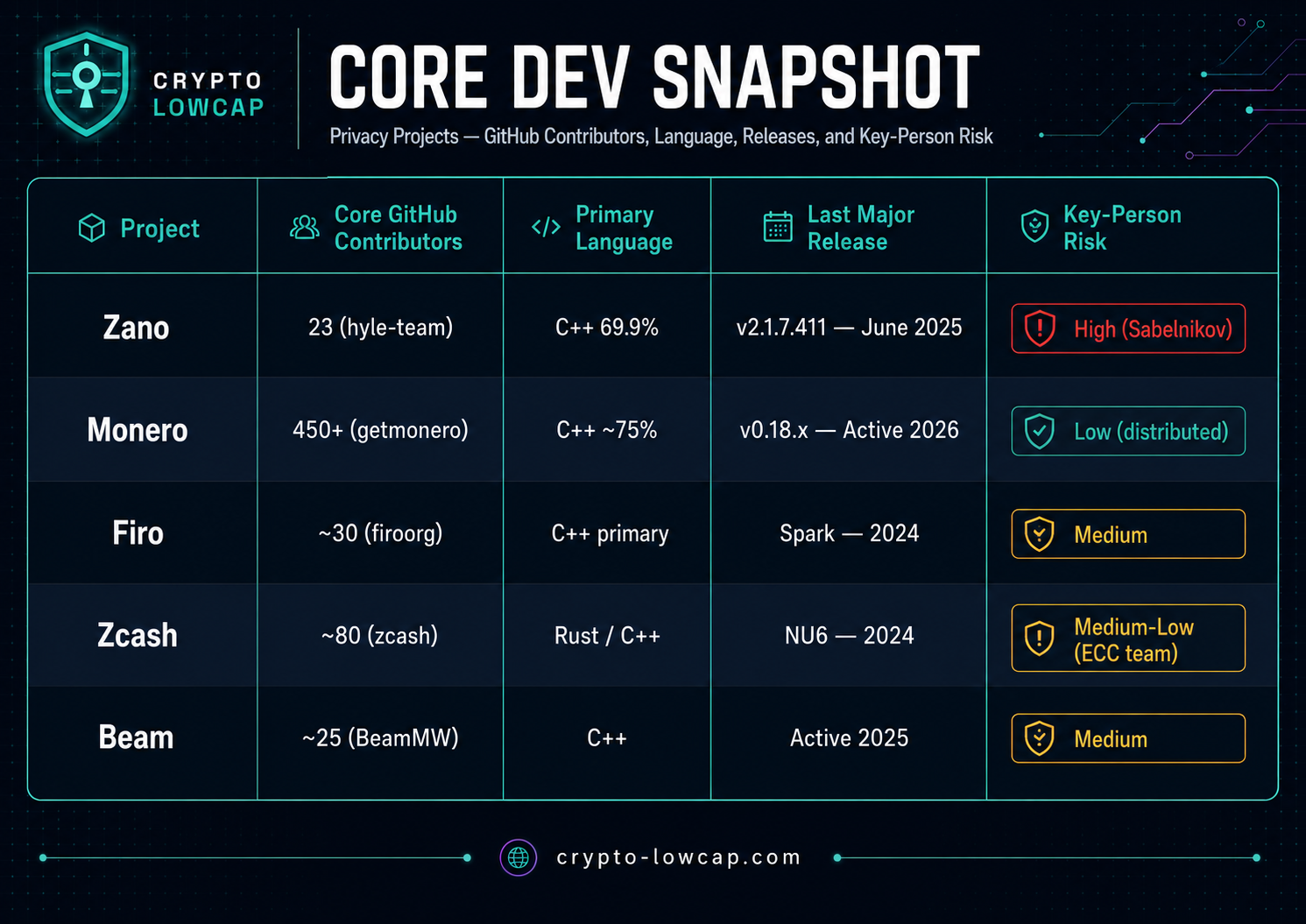
Source: GitHub hyle-team/zano, Zano official blog, Crypto-Lowcap editorial evaluation. June 2026.
For comparison: Monero has 450+ contributors to its core repository. Firo has around 30. Zano has 23. This is a meaningful difference. The risk is structural: a protocol whose cryptographic innovation is concentrated in one person (Sabelnikov) is exposed to a key-person risk that cannot be diversified away without deliberate team expansion.
8. The Adoption Problem — Honest Numbers
I want to spend time on this because I think it is the most important section for anyone considering Zano as a position. The technology works. I have no fundamental dispute with the cryptographic claims. The architecture is coherent. The external audits are credible. But the following metrics, cross-checked from official sources as of June 2026, tell a story that demands critical attention. Note that communication and community quality — where Zano actually punches above its weight with 77K engaged followers on X and a well-executed site — are not the constraint here. The constraint is on-chain usage.
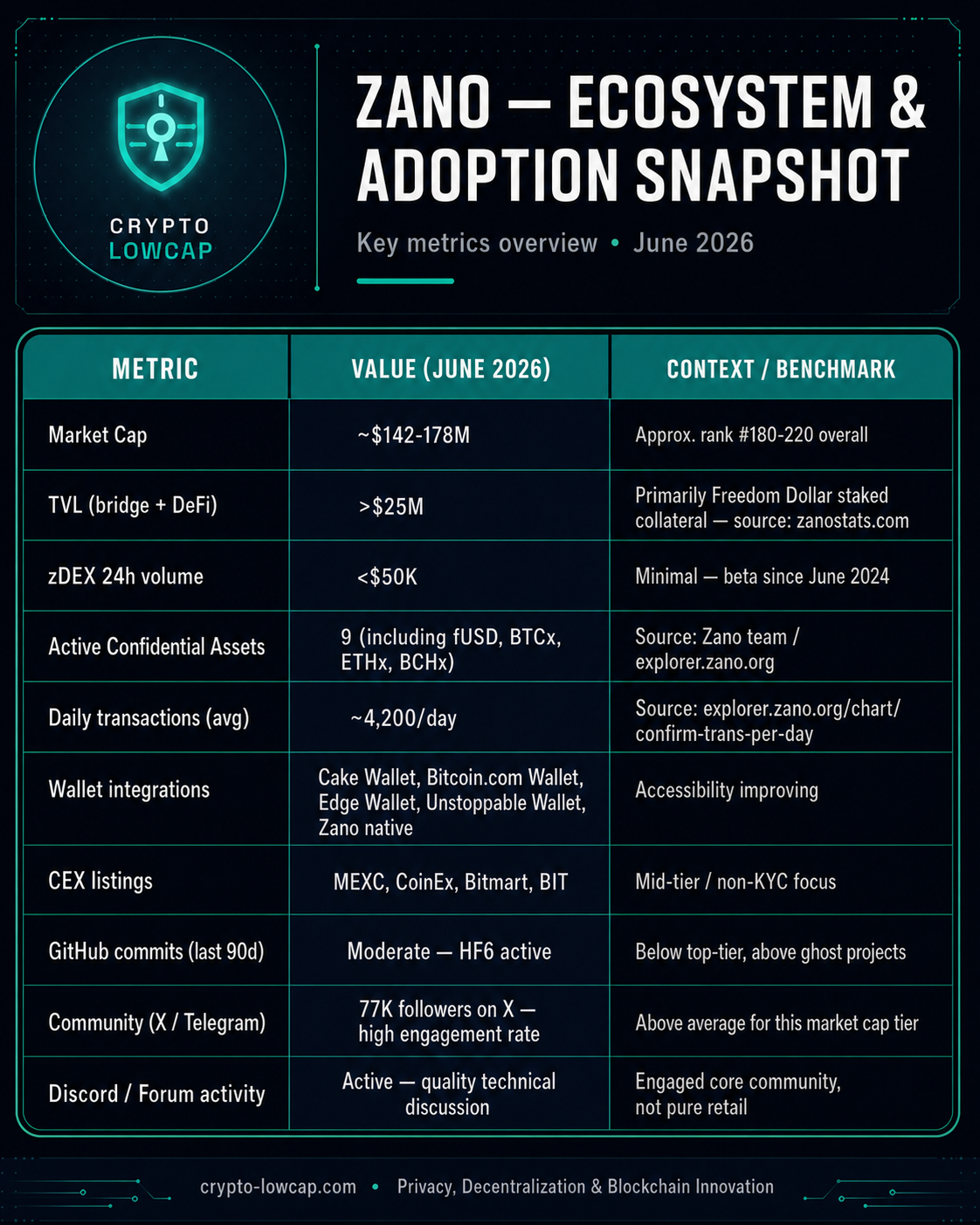
Source: Zano official site, CoinGecko, GitHub, Crypto-Lowcap estimates. Cross-checked June 3, 2026.
The gap between technical ambition and broad diffuse adoption remains real, but the picture is more nuanced than raw DEX metrics suggest. With a TVL exceeding $25M via Freedom Dollar staked collateral, approximately 4,200 daily transactions, and a position as the second most used blockchain on Zebec Networks debit cards after Solana, Zano has genuine on-chain activity — concentrated on specific use cases rather than broadly distributed. The market is not yet pricing the full stack, but the foundation is more active than it appears at first glance.
The wallets are progressing: Cake Wallet and Bitcoin.com Wallet integrations are real milestones for accessibility. The presence of fUSD, BTCx, and ETHx as active Confidential Assets is a small but genuine signal. The bridge was launched in July 2025 and HF6 was in testnet by June 2026. These are lagging indicators of adoption build-up, not proof that adoption has arrived.
I have seen this pattern before in the privacy coin space. Projects with genuine technical depth that stay invisible to the market for years, then get a burst of attention tied to a narrative cycle. I am not predicting that will happen for Zano. I am noting that the technical prerequisites for it are being assembled, quietly.
| 💬 ZANO TEAM — RIGHT OF REPLY Mr_Kwibs (Head of Marketing & Growth, Zano) provides additional adoption context not captured in public data at the time of writing: Zano is the second most used blockchain on Zebec Networks debit cards, after Solana and before Ethereum, with hundreds of active card users topping up with ZANO and fUSD representing hundreds of thousands of dollars per month. Additional integrations include AEON Pay and 5+ major wallets. The team considers Zano to have stronger real-world adoption than Firo, Beam, and Dash at this stage. This data was not independently verified by Crypto-Lowcap at time of publication — we include it here in the interest of completeness and fairness. |
9. Regulatory Risk: Structural and Aggravated
Privacy coins face structural regulatory hostility in 2025-2026, and Zano is not exempt. MiCA’s Travel Rule requirements are mechanically incompatible with mandatory privacy protocols. By 2025, 73 exchanges worldwide had delisted at least one privacy coin, a 43% increase from 2023. Binance removed Monero, Zcash, and DASH from European and US platforms.
Zano’s position is roughly comparable to Monero’s from a compliance standpoint: mandatory privacy, no transparent mode. The auditable wallet feature (aZx addresses allowing read-only disclosure) is a partial mitigation but does not satisfy FATF Travel Rule requirements for CASP-to-CASP transactions, which require identification of both sender and receiver.
There is an argument that Confidential Assets and the bridge actually aggravate the regulatory risk relative to Monero alone. A protocol that allows users to take publicly-issued assets like BTC or ETH and render them fully untraceable is a more direct challenge to AML frameworks than a pure privacy coin used for native transfers. Regulators and compliance teams at large exchanges will understand this distinction. It limits CEX listing potential structurally.
My assessment: Zano’s primary liquidity will remain concentrated on non-KYC and mid-tier exchanges for the foreseeable future. That is a real constraint on price discovery and institutional access — but it is not the same as inadequate liquidity. At ~$1.2M/24h in June 2026, during a bear market cycle and without any tier-1 exchange listing, the volume-to-market cap ratio is solid relative to privacy coin peers. MEXC and CoinEx provide functional depth for positions of reasonable size. The structural ceiling is regulatory, not technical: a MiCA-compliant tier-1 listing is structurally improbable under current rules. That limits the upside, it does not threaten the floor. The current CEX footprint (MEXC, CoinEx, Bitmart, BIT, NonKYC.io) reflects this reality. It is worth noting that HF6 Gateway Addresses introduce a structural mitigation: native ZANO will be bridgeable as a transparent EVM token (wZANO) that can be listed on any tier-1 exchange, then swapped back to native ZANO privately via compatible wallets. Additionally, the team is actively working with the THORChain team to enable native ZANO trading on their platform — a meaningful permissionless liquidity layer independent of CEX regulatory constraints.
10. Risk Matrix
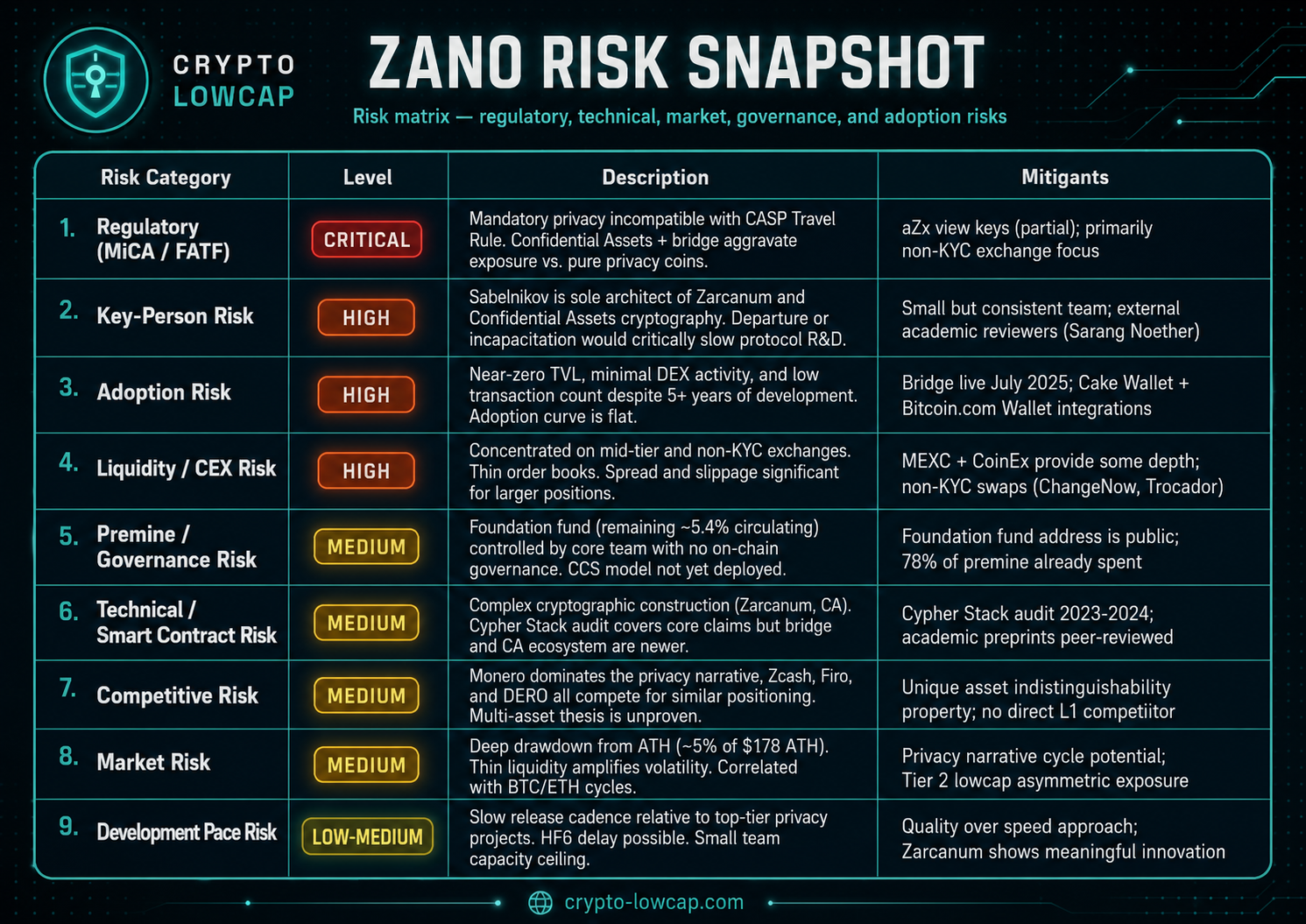
Source: Crypto-Lowcap editorial analysis, cross-checked with ChatGPT / Deepseek / Mistral AI research dossiers. June 2026.
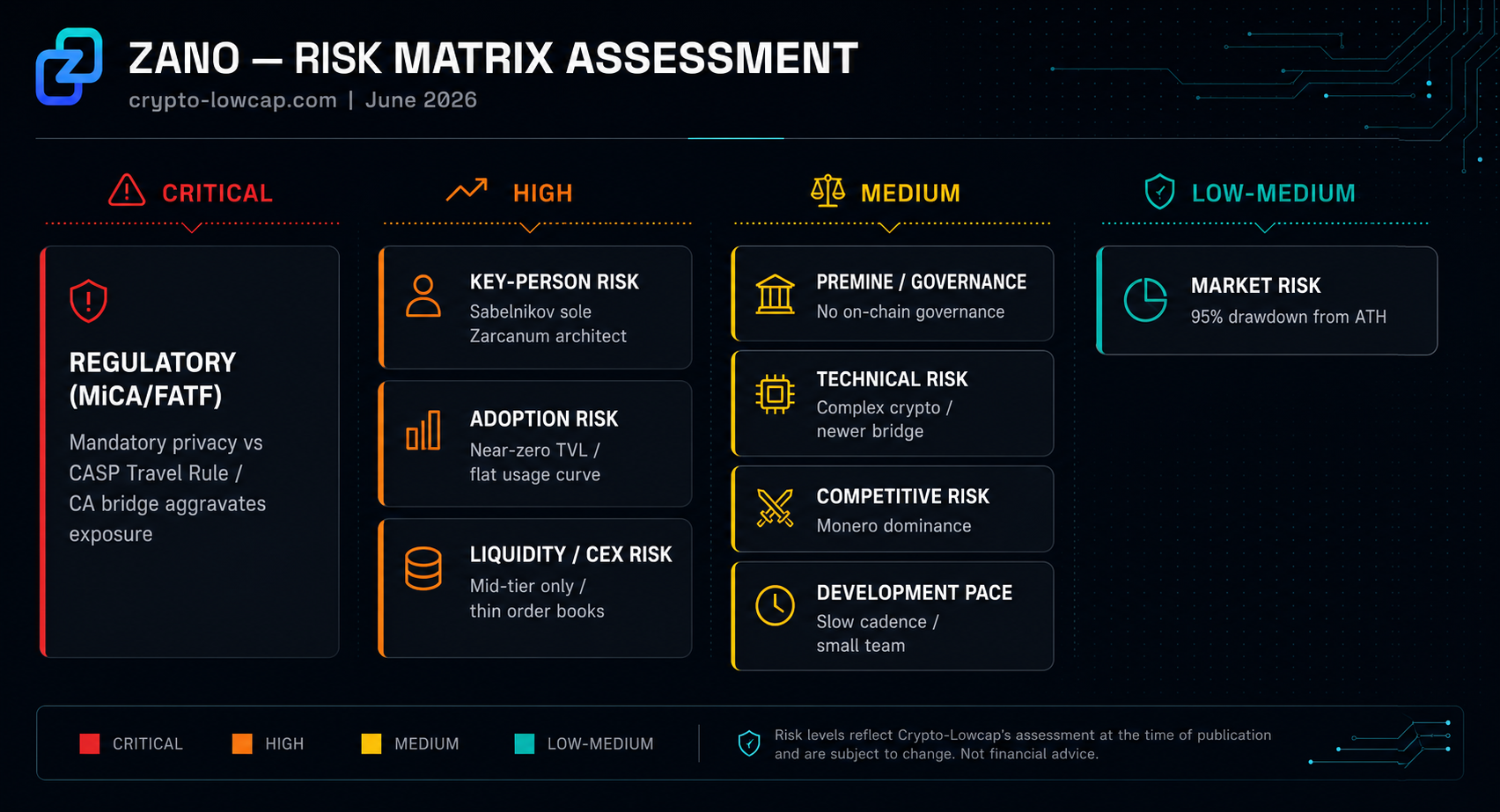
11. Investment Thesis: Three Scenarios
I will not give you a price target, because that would require predicting a market environment I cannot control. What I can do is define the scenarios clearly.
| BEARISH SCENARIO — Technology Without Adoption (Probability: ~30%) zDEX remains near-zero usage. Confidential Assets stay empty. The bridge is technically live but economically irrelevant. The foundation fund depletes before the CCS model activates. No significant new CEX listings. A key-person departure slows innovation. Regulatory pressure leads to additional delistings, shrinking the already thin liquidity base. Result: Zano survives as a technically respected niche project at a fraction of its current valuation. Market cap converges toward $30-60M. The multi-asset thesis is not validated. |
| NEUTRAL SCENARIO — Steady Builder (Probability: ~50%) HF6 ships cleanly. Bridge TVL grows slowly, reaching $2-5M within 18 months. A handful of Confidential Assets find real usage cases: private stablecoin, a governance token, at least one commercial application. The CCS model activates and proves viable. Community grows to partially mitigate key-person risk. One or two mid-tier exchange listings improve liquidity. Result: Zano consolidates in the top 10-15 privacy coins by reputation. Market cap in the $150-400M range. Position appropriate for a privacy watchlist with reduced concentration. |
| BULLISH SCENARIO — The Infrastructure Bet Pays Off (Probability: ~20%) Confidential Layer bridge attracts significant flow from BTC and ETH holders seeking privacy. fUSD or a successor becomes the reference private stablecoin and integrates into privacy-focused DeFi workflows. On-chain governance deploys and credibly decentralizes the protocol. Several wallets add support, lowering the UX barrier substantially. A rotation in market narrative toward privacy infrastructure amplifies attention. Result: Zano recognized as the primary multi-asset privacy infrastructure. TVL reaches $20M+. Market cap moves into $500M-1B territory in favorable market conditions. The Monero (digital cash) / Zano (privacy DeFi infrastructure) distinction is understood and priced by the market. |
12. Catalysts to Watch
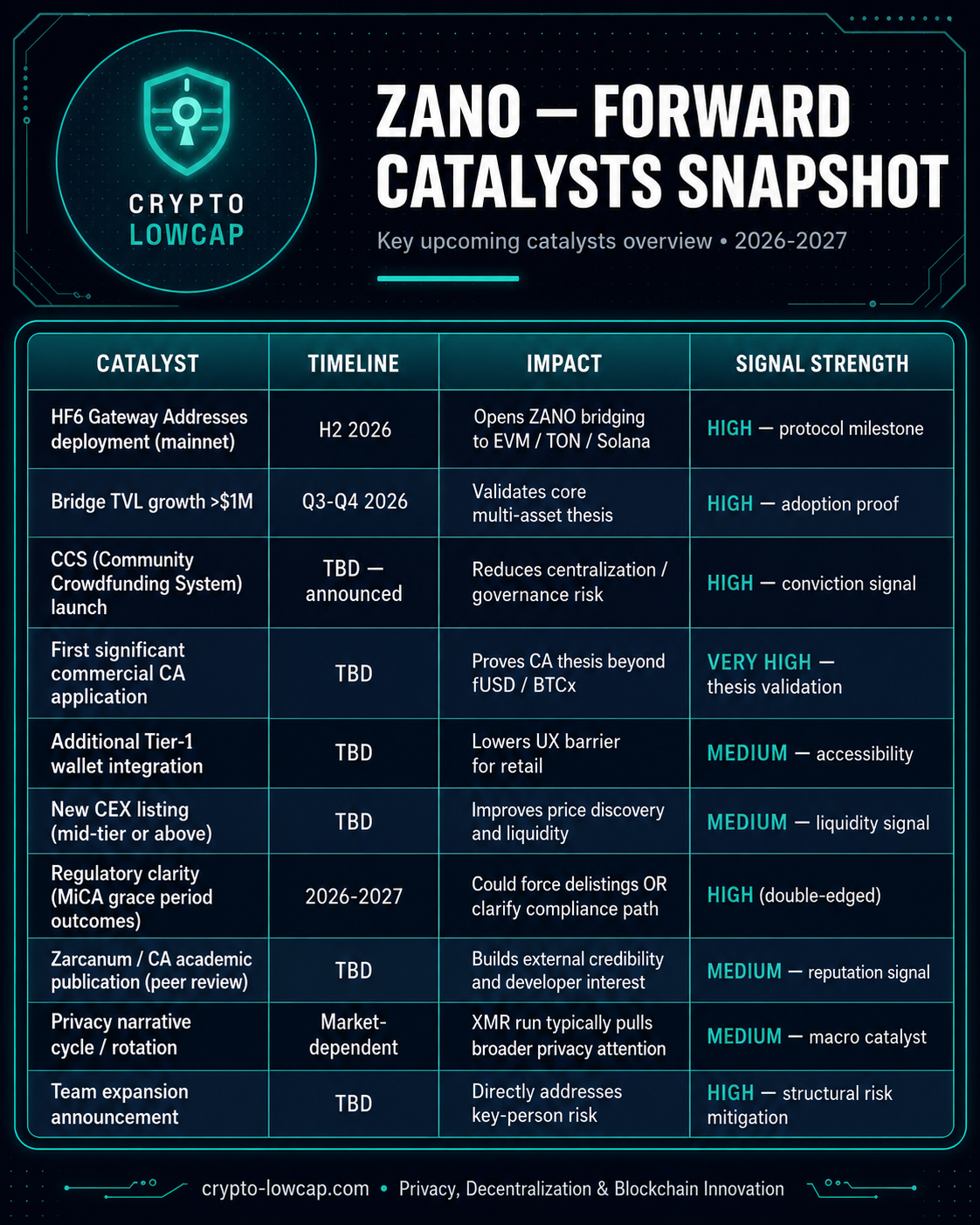
Source: Crypto-Lowcap editorial analysis, Zano official roadmap, CoinGecko data. June 2026.
13. Scoring Grid
The composite score reflects the tension between technical quality and ecosystem adoption. Each dimension is scored independently.
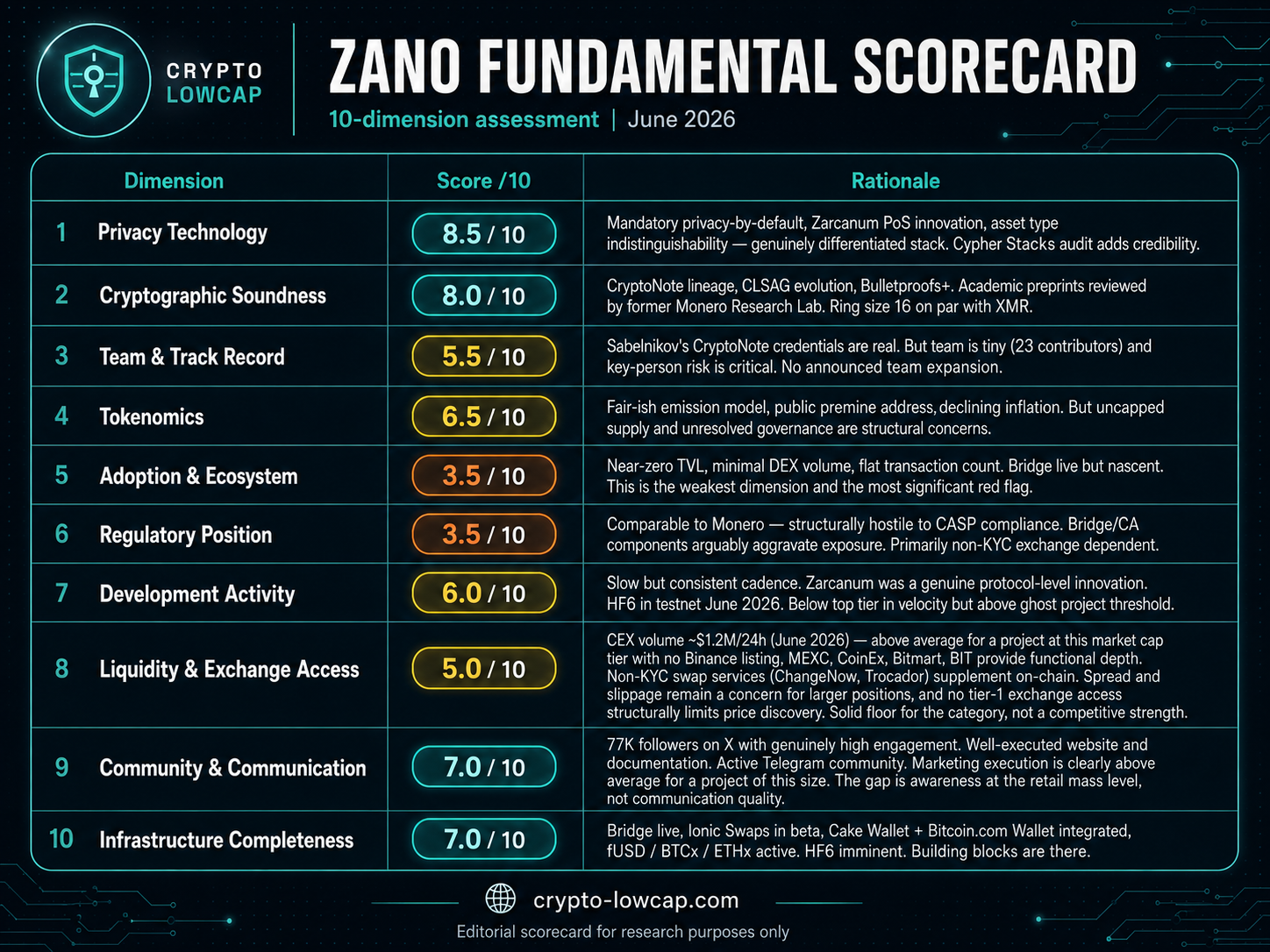
| COMPOSITE SCORE: 6.0 / 10 — Interesting, not comfortable Weighted average across 10 dimensions (technology and cryptographic soundness weighted 1.5x, adoption and regulatory weighted 1.5x). The score reflects a project with genuine technical depth and a differentiated thesis, held back by structural adoption failure and regulatory exposure. This is not a project to dismiss. It is a project to watch carefully, with position sizing calibrated to the adoption risk. |
Source: Crypto-Lowcap fundamental analysis, cross-validated across three independent AI research dossiers (ChatGPT, Deepseek, Mistral). June 2026.
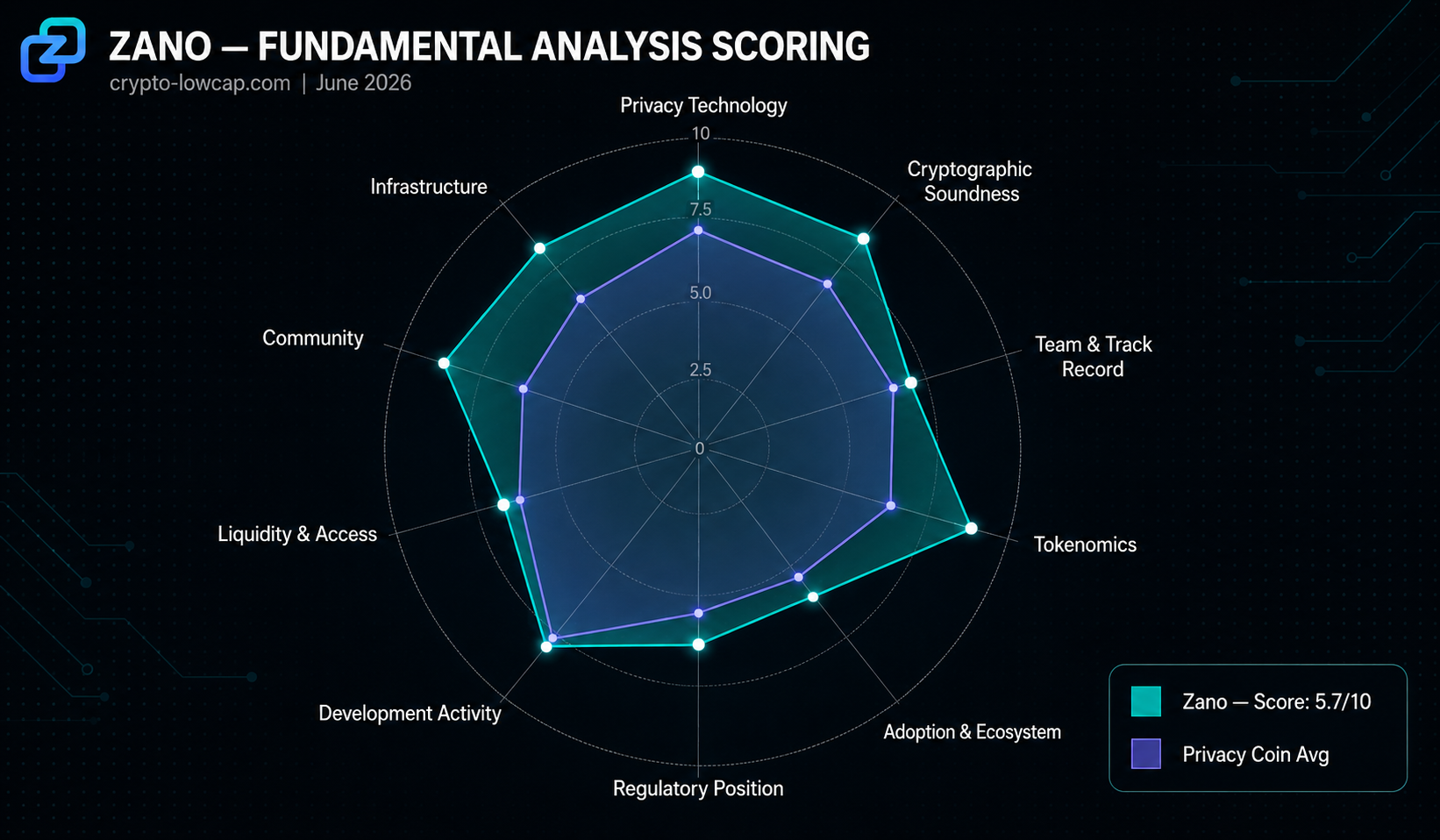
14. Conviction Tier
| CONVICTION TIER: TIER 2 — Directional Bet / Vigilance Required Rationale: Zano has a technically differentiated stack that no other Layer-1 privacy chain replicates, specifically mandatory privacy combined with asset type indistinguishability and private PoS. The cryptographic credentials are real, the audits are credible, and the infrastructure build (bridge, HF6, CA ecosystem) is progressing. These are Tier 1 signals on the technical side. What holds this at Tier 2 is the adoption reality: near-zero TVL, minimal DEX usage, no tier-1 exchange access, and a regulatory exposure that structurally limits listing potential. The key-person risk concentrated in Sabelnikov is not yet mitigated. A project with this adoption profile at a $150-178M market cap is priced for a future that has not yet materialized. Bull case (upgrade to Tier 1): Bridge TVL exceeds $2M, CCS model activates, on-chain governance deploys, second cryptographic contributor joins the core team, and at least one meaningful commercial CA application launches. Bear case (downgrade to Tier 3): HF6 delayed beyond Q1 2027, TVL remains below $500K by end 2026, foundation fund usage raises governance concerns, or a Sabelnikov exit occurs. Conditions for upgrade: Simultaneous evidence of adoption traction (TVL >$2M, CA usage beyond current 4 assets) AND governance decentralization (CCS active, on-chain voting). Either alone is insufficient. Conditions for downgrade: Sustained flat adoption through end 2026 with no new catalysts, or any governance incident around the foundation fund. |
15. Verdict
Zano is not a Monero killer. I want to be explicit about this because the comparison is lazy and misleading in both directions. Monero excels at digital cash. Its community, code quality, and battle-tested protocol are not going to be displaced by a smaller project, however technically interesting. Zano is not trying to displace Monero. It is trying to occupy a different and largely vacant space: privacy for everything else.
The right mental model is not Monero vs Zano but digital cash (Monero) vs privacy infrastructure for tokenized assets (Zano). These can coexist. They are addressing different problems.
On the technical side, Zano scores among the highest of any project I have analyzed in this niche. The cryptographic lineage is real. Zarcanum is a genuine innovation. Confidential Assets extend the privacy model in a direction no other L1 has matched. The external audits from Cypher Stack provide meaningful assurance on the core claims.
On the adoption side, the picture is much more honest. TVL remains concentrated rather than broadly distributed, DEX activity is minimal, and CEX access is structurally capped at mid-tier. These are facts, not projections. The distance between what the technology can do and what the market is actually using it for is wide. That gap is either the investment opportunity or the warning sign, depending on how the next 12-24 months unfold.
The composite score of 6.0/10 and Tier 2 classification reflect this tension precisely. Interesting, not comfortable. A project worth watching with calibrated position sizing — not ignoring, and not overweighting.
Key Takeaways
- Zano is not a Monero fork or competitor. Its thesis is complementary: privacy infrastructure for multi-asset environments, not digital cash for one asset.
- Zarcanum is a genuine cryptographic innovation: the first PoS system where staked amounts are cryptographically hidden, audited by Cypher Stack and peer-reviewed by former Monero Research Lab contributors.
- Confidential Assets offer asset type indistinguishability, a property unique among L1 privacy chains: observers cannot determine which token is being transferred.
- The adoption gap is narrowing but real. TVL exceeds $25M via Freedom Dollar staked collateral, daily transactions average ~4,200, and Zano is the second most used chain on Zebec Networks debit cards after Solana. Broad diffuse adoption has not yet arrived, but concentrated real-world usage is established.
- The premine is acknowledged and partially spent (78% by end 2024). The foundation fund address is public. The transition to a community-funded model (CCS) is announced but not complete.
- Regulatory risk is structurally high and likely aggravated by the bridge and CA components. Primary liquidity will remain on non-KYC and mid-tier exchanges.
- Key-person risk (Sabelnikov) is the structural risk that concerns me most. His role in cryptographic innovation is not easily replaceable in the near term.
- Watching closely: HF6 Gateway Addresses deployment, bridge TVL growth, CCS activation, first meaningful commercial Confidential Asset application.
crypto-lowcap.com | Privacy, Decentralization & Blockchain Innovation
Follow @CryptoRowenta01 on X | Subscribe to the newsletter
© 2026 crypto-lowcap.com — Not financial advice. Always DYOR.