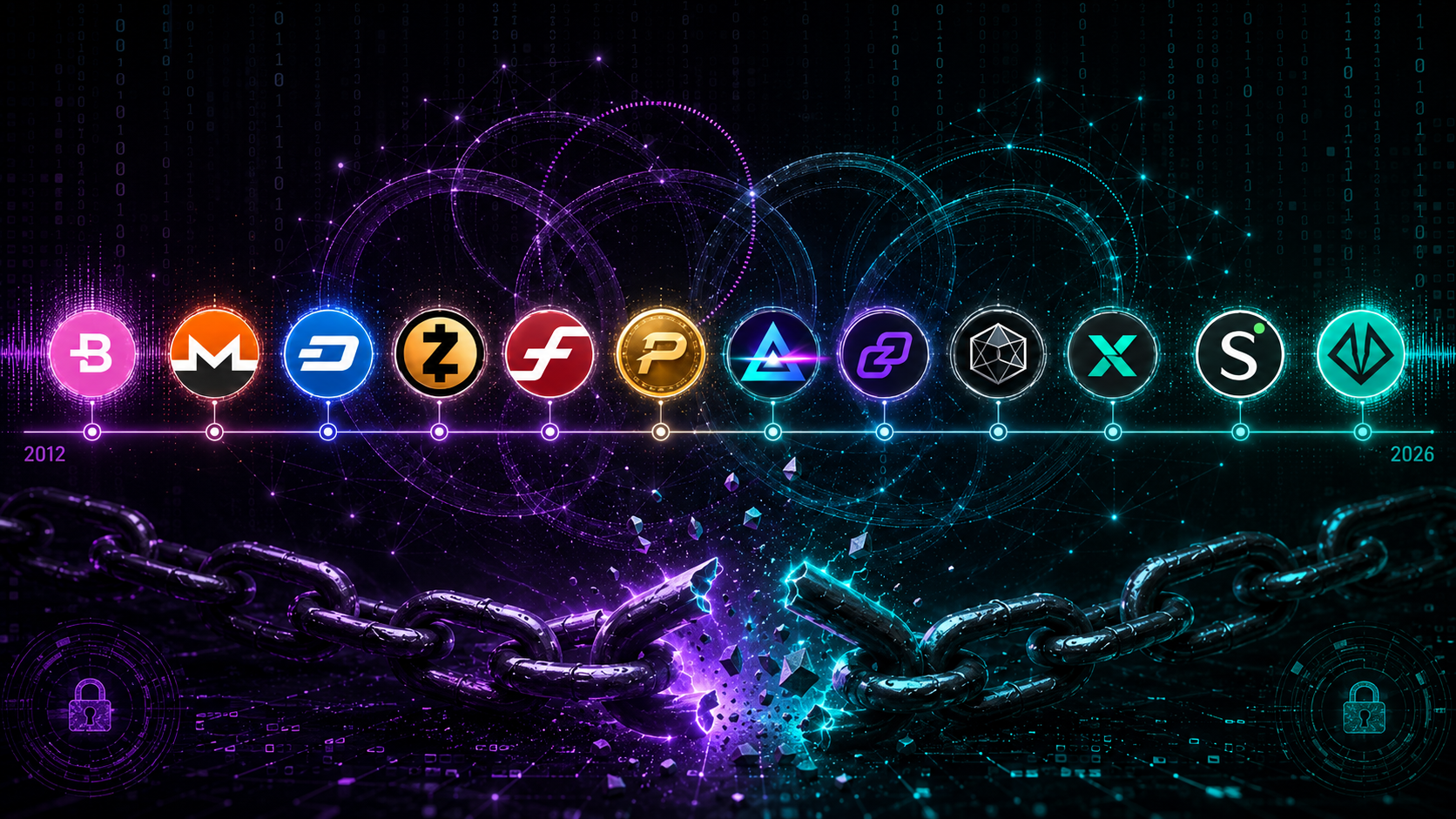
Privacy Coins: A Decade of Cryptographic Resistance (2012–2026)
DEEP DIVE · ANALYSIS & OPINION · MAY 2026
From Bytecoin’s Genesis to FCMP++ and the MiCA Compliance Wars — History, Technology, Strategies and the Current Landscape
By Rowenta01 | crypto-lowcap.com | Est. reading time: ~30 min
#PrivacyCoins #Monero #Zcash #MiCA #CryptographicResistance #Lowcap #ZkSNARKs
Important disclaimer: This analysis is purely informational and reflects my independent opinion as an editor and researcher. Nothing written here constitutes financial advice. Privacy coins represent high-risk, highly speculative assets. Many of the projects discussed could trend to zero. Always do your own research.
HOW TO READ THIS ARTICLE
Part 1 covers the historical arc 2012–2020: CryptoNote genesis, the Monero fork story, Zcash, Dash, Mimblewimble. Part 2 examines the current generation of projects (2020–2026), organized by strategic posture: Resisters, Adaptors, Compliance Builders, and Emerging Architectures. Part 3 maps the regulatory landscape globally, from MiCA to the Dubai ban to Latin America. Part 4 delivers the strategic framework and conviction scorecard.
Introduction: The Ledger That Sees Everything
I have been covering privacy-focused cryptocurrency projects on this site since 2016. For almost a decade, I have watched this niche go from a fringe experiment to a battlefield — technologically, legally, and economically.
Let me start with a fact that does not get enough attention: Bitcoin — the asset that supposedly liberated us from bank surveillance — is one of the most transparent monetary systems ever designed. Every transaction, every address, every balance, permanently recorded on a public ledger, auditable by anyone with an internet connection. Firms like Chainalysis have built billion-dollar businesses out of exactly this transparency. The pseudonymity that Satoshi promised has, in practice, been largely eroded.
Privacy coins exist to solve this problem. However, they do not all solve it in the same way, with the same tradeoffs, or with the same willingness to exist outside the regulatory perimeter. That is the central tension this article explores: not just the technology, but the choices — architectural, philosophical, strategic — that define each project’s relationship with both its users and the regulatory systems trying to contain it.
For context on specific projects covered here, see our deep analysis of Xelis, Nonos, and Salvium and our AMA with the Salvium team — both directly relevant to the themes developed in this article.
PART 1
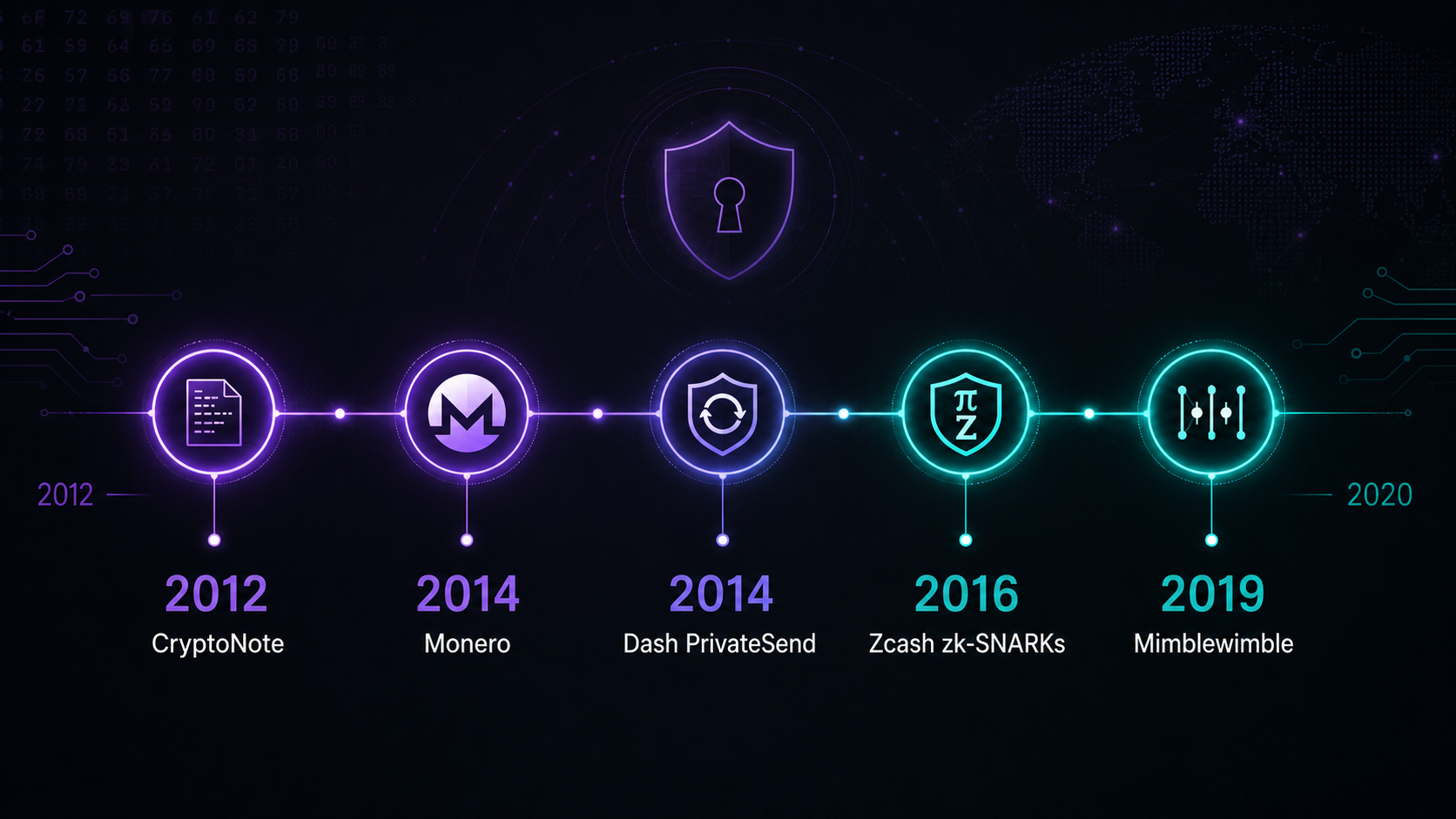
The Cryptographic Arms Race (2012–2020)
1.1 — The CryptoNote Foundation: A Birth Shrouded in Mystery
Nicolas van Saberhagen and the Protocol (2012)
The privacy coin story does not begin with Monero. It begins in October 2012, with a cryptographic whitepaper published under the pseudonym “Nicolas van Saberhagen” — an identity whose true nature has never been established. The CryptoNote protocol introduced two foundational primitives that would define an entire category of privacy technology.
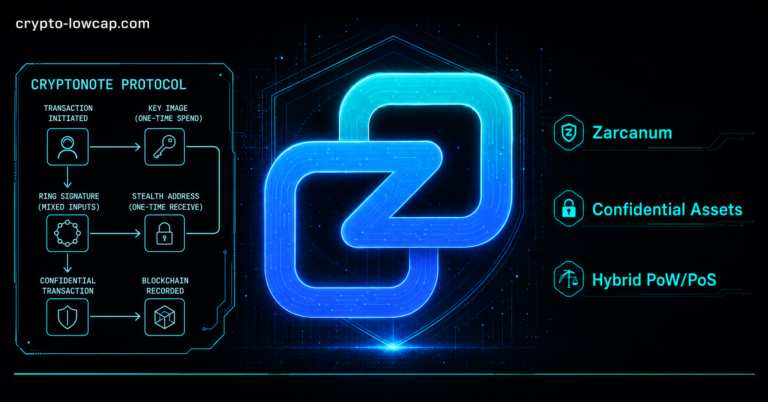
Ring signatures: when you send a transaction, your signature is combined with a set of decoys drawn from the blockchain, making it computationally infeasible to determine which input you actually spent. The sender is hidden in a crowd.
One-time stealth addresses: for each transaction, the sender derives a unique single-use recipient address from the receiver’s public key. External observers cannot link payments to a known wallet.
Neither primitive was entirely new. Ring signature theory traces to 2001 academic work by Rivest, Shamir, and Tauman. CryptoNote’s contribution was synthesizing them into a deployable, coherent cryptocurrency protocol optimized for untraceable payments.
Bytecoin: The Manufactured Discovery (March 2014)
The first CryptoNote implementation was Bytecoin (BCN), whose blockchain data showed mining activity going back to July 2012 — yet Bytecoin was never publicly announced at launch. It simply mined in silence for nearly two years, accumulating supply, building what appeared to be a secret community.
On March 12, 2014, a post on Bitcointalk “discovered” Bytecoin as if for the first time. It was immediately suspected to be a sockpuppet operation — a planted introduction by the coin’s founders after two years of private accumulation. What curious observers found when they examined the blockchain was staggering: more than 80% of the total supply had already been mined. The official explanation was two years of private mining. The community’s interpretation was simpler: premine fraud, executed with an optimized mining client the public never received.
ANALYST NOTE — The Bytecoin Premine as Foundational Warning
The premine scale was verified through code analysis. Developer NoodleDoodle — later part of Monero’s early team — confirmed the public mining software was deliberately deoptimized, running approximately ten times slower than the version insiders used. This episode established the single most important precedent in privacy coin analysis: a clean launch is a structural guarantee, not a marketing claim. A premined privacy coin creates permanent misalignment between its stated mission of fungibility and the vested interests of its founders. Every subsequent privacy project launch must be evaluated against this benchmark.
The Seven-Member Fork: Bitmonero Becomes Monero (April–May 2014)
Among the first serious respondents to the Bytecoin announcement was a Bitcointalk user known as “thankful_for_today” (TFT). Within weeks he had absorbed enough of CryptoNote to propose a clean relaunch. On April 18, 2014, the fork launched as Bitmonero — from “Bit” (Bitcoin) and “Monero” (Esperanto for “coin”).
Bitmonero’s model was deliberately minimal: no premine, no ICO, no founder allocation. Mining from genesis was the only acquisition path. However, thankful_for_today became immediately controversial — rejecting community pull requests without explanation, disappearing for days, refusing merge-mining objections. Within weeks, a coalition of seven community members forked Bitmonero without his approval, reclaimed governance, and renamed the project simply Monero.
This founding episode is not merely historical trivia. It established the governance DNA that makes Monero uniquely resilient today: no single founder, no corporate structure, no entity that can be pressured, acquired, or silenced. The community revolt against a single point of control is the origin of Monero’s most valuable long-term property. For a comprehensive technical breakdown, refer to the Monero GitHub repository.
1.2 — The Dash Approach: Privacy as an Optional Feature
Launched in January 2014 as XCoin, then Darkcoin, then Dash, this project took a radically different philosophy. Privacy in Dash is not native — it is PrivateSend, an optional mixing layer based on CoinJoin. When you send a transaction, your coins can be mixed with those of other users before reaching the recipient, obscuring the transaction trail without cryptographic enforcement.
The strategic upside of optionality is compliance survivability. Dash has maintained listings on major exchanges precisely because regulators can point to the transparent base layer. By 2026, the project has aggressively distanced itself from the “privacy coin” label entirely, positioning as a payments network where PrivateSend is merely an optional utility. Emin Gün Sirer’s observation from 2019 remains accurate: when your privacy feature is optional and analytically traceable, the question of what exactly you are competing on becomes difficult to answer.
1.3 — Zcash and the zk-SNARKs Revolution
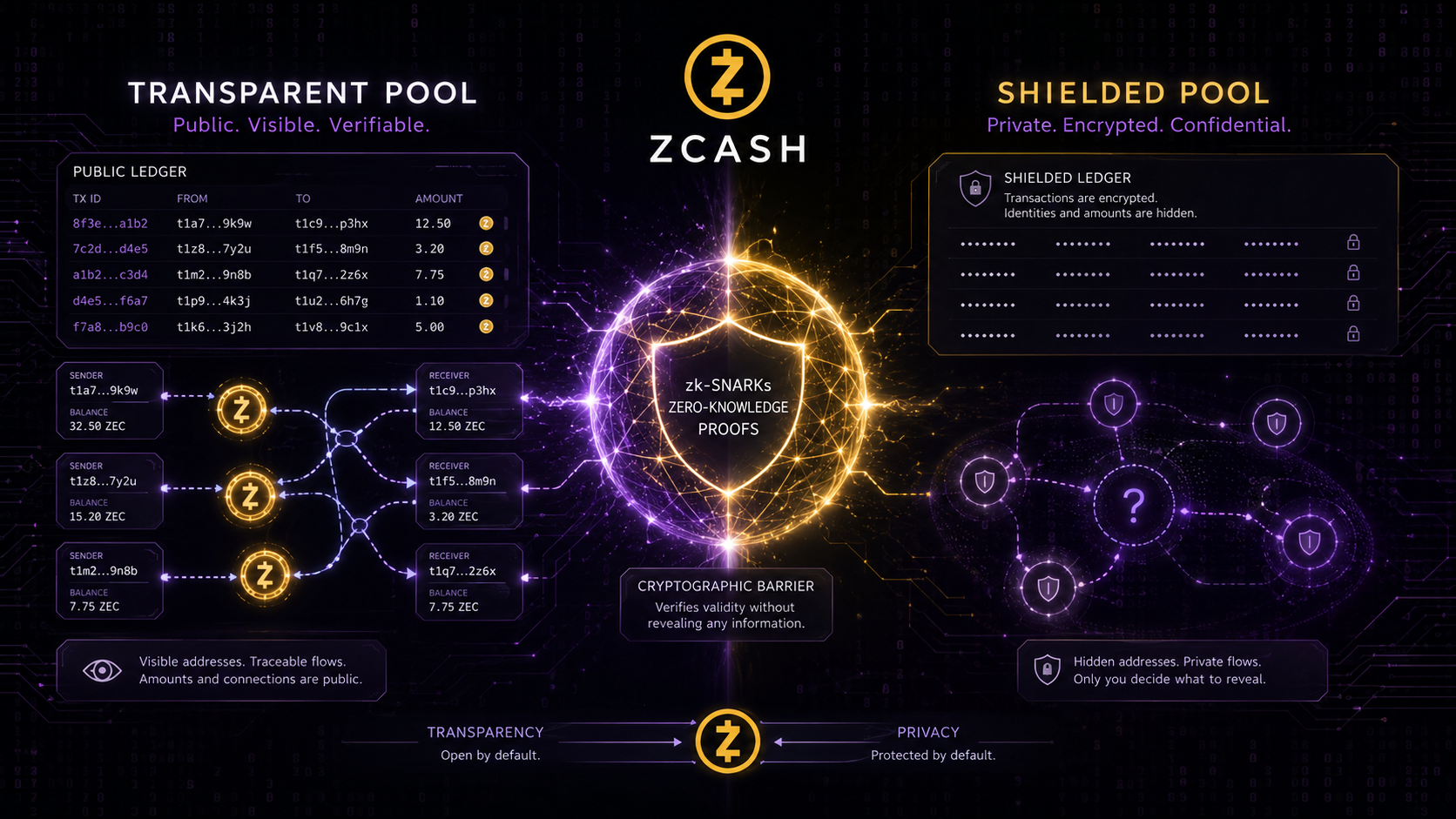
October 2016 saw the launch of Zcash — arguably the most technically sophisticated privacy project ever built at its time. Zcash uses zk-SNARKs (Zero-Knowledge Succinct Non-Interactive Arguments of Knowledge): a cryptographic construction that allows proving the validity of a transaction without revealing any information about it. The team included Zooko Wilcox, Matthew Green, and Ian Miers — academic cryptographers with no peer in the space. The Electric Coin Company (ECC) was funded through a 20% Founders Reward on all newly mined ZEC for four years.
Zcash’s fundamental architecture creates a persistent tension. The chain supports both transparent t-addresses (functionally identical to Bitcoin) and shielded z-addresses. Historically, shielded transactions represented only 20–25% of total volume, meaning the effective anonymity set is far smaller than the theoretical maximum. Furthermore, privacy requires a sufficiently large pool of users transacting privately simultaneously.
ANALYST NOTE — From Trusted Setup to Halo 2
Zcash’s early Achilles heel was the trusted setup: zk-SNARKs parameters required a multi-party computation ceremony where any single conspiring participant could have created counterfeit coins undetected. Sprout (2016): 6 participants. Sapling (2018): ~200 participants. The Halo 2 protocol, deployed with the Orchard upgrade, eliminated the trusted setup entirely — a genuine cryptographic milestone. The “trusted setup” objection to Zcash is now technically obsolete for the Orchard pool. The shielded adoption problem, however, persists.
In 2026, Zcash’s governance underwent a major rupture. The Bootstrap Foundation and the Electric Coin Company entered public dispute over treasury control. The ECC team departed to form the Zcash Open Development Lab (ZODL), backed by $25M from a16z and Paradigm, now led by Josh Swihart. The Tachyon project targets recursive zk-SNARKs for dramatically improved scalability. The governance crisis exposed a structural vulnerability: a protocol whose development depends on a single well-funded entity has a corporate attack surface that community-governed protocols do not.
1.4 — Horizen and the Founders Reward Wars
In 2016, Rhett Creighton forked Zcash to create Zclassic, removing the Founders Reward entirely. From Zclassic emerged Horizen (ZEN), which built sidechain infrastructure (Zendoo) and a global node network. For years it appeared to be a sustainable middle path: Zcash technology without the corporate overhead.
Horizen’s story became the most instructive cautionary tale in the sector. In February 2024, under regulatory pressure, Horizen permanently disabled its shielded pool — the core privacy feature of the network. The privacy is gone. In 2025, ZEN migrated to Base (Ethereum L2) as an ERC-20 token, repositioning as a ZK infrastructure layer for compliant computation. The pivot enabled survival on Coinbase and Binance. The privacy mission, however, was abandoned. This is the first major lesson of this sector: when a project with a registered legal entity has to choose between compliance and privacy, survival usually wins.
1.5 — Mimblewimble: Elegance, Compactness, and a Known Flaw
Named after a Harry Potter tongue-tying curse, Mimblewimble was published pseudonymously in 2016 by “Tom Elvis Jedusor” (the French name of Voldemort). Its approach to privacy is structurally different from everything discussed above: transactions are aggregated at the block level such that intermediate inputs and outputs cancel out mathematically. The result is a blockchain with no addresses, dramatically smaller than Bitcoin or Monero.
Two projects implemented Mimblewimble in January 2019. Grin (GRIN) is the minimalist, cypherpunk implementation: written in Rust, fair launch with no premine or ICO, infinite linear emission of 1 GRIN per second. Beam (BEAM) is the professional implementation in C++, company-backed with a 20% dev reward, Confidential Assets support. The only major CEXs currently listing Beam are MEXC and Gate.io. Note: the ‘BEAM’ token visible on Coinbase is the rebranded Merit Circle gaming token, with no connection to Beam privacy coin. This dev reward ended entirely in January 2023 as planned. Since then, 100% of block rewards go to miners. The founding company wound down after mainnet launch, replaced by a non-profit foundation, which itself migrated governance to a community DAO. As of 2026, no central entity controls Beam. In 2026, Beam faces strong competition from Ethereum L2 solutions for DeFi volume.
ANALYST NOTE — The Bogatyy Attack: Mimblewimble’s Structural Limit
In November 2019, researcher Ivan Bogatyy (Dragonfly Capital) demonstrated that by running a modified full node intercepting unconfirmed transactions before block aggregation, he could reconstruct the transaction graph — who sent to whom — for 96% of Grin transactions at roughly $60/week of compute. Grin’s developers acknowledged the input-output linkability problem as a known limitation. The honest bottom line: Mimblewimble hides amounts effectively via Pedersen commitments. It does not hide the transaction graph with the robustness of ring signatures or zk-SNARKs. For use cases where amount privacy suffices and the counterparties are already known, Mimblewimble is an excellent, lightweight solution. For adversarial threat models where the transaction graph itself is sensitive, it is not the right tool.Important clarification: this limitation applies to raw Mimblewimble and to Grin as of 2026. Beam has addressed it through two mechanisms: (1) Dandelion++ dummy UTXOs of zero value, indistinguishable from real UTXOs since amounts are concealed, ensuring real outputs are always conjoined before broadcast; (2) the integration of a Mimblewimble-compatible Lelantus shielded pool in 2020, which breaks the transaction graph definitively. The Bogatyy limitation as described no longer applies to Beam.
PART 2
The Current Landscape (2020–2026): Strategies Under Pressure
The current generation of privacy projects can be understood through the lens of a single question: how does this protocol respond to a regulatory environment that treats mandatory privacy as incompatible with legal financial infrastructure? The answers fall into four strategic postures — Resisters, Adaptors, Compliance Builders, and Emerging Architectures. Each posture carries distinct technical tradeoffs, governance implications, and risk profiles.
2.1 — The Resisters: Privacy Without Compromise
Monero (XMR) — The Gold Standard
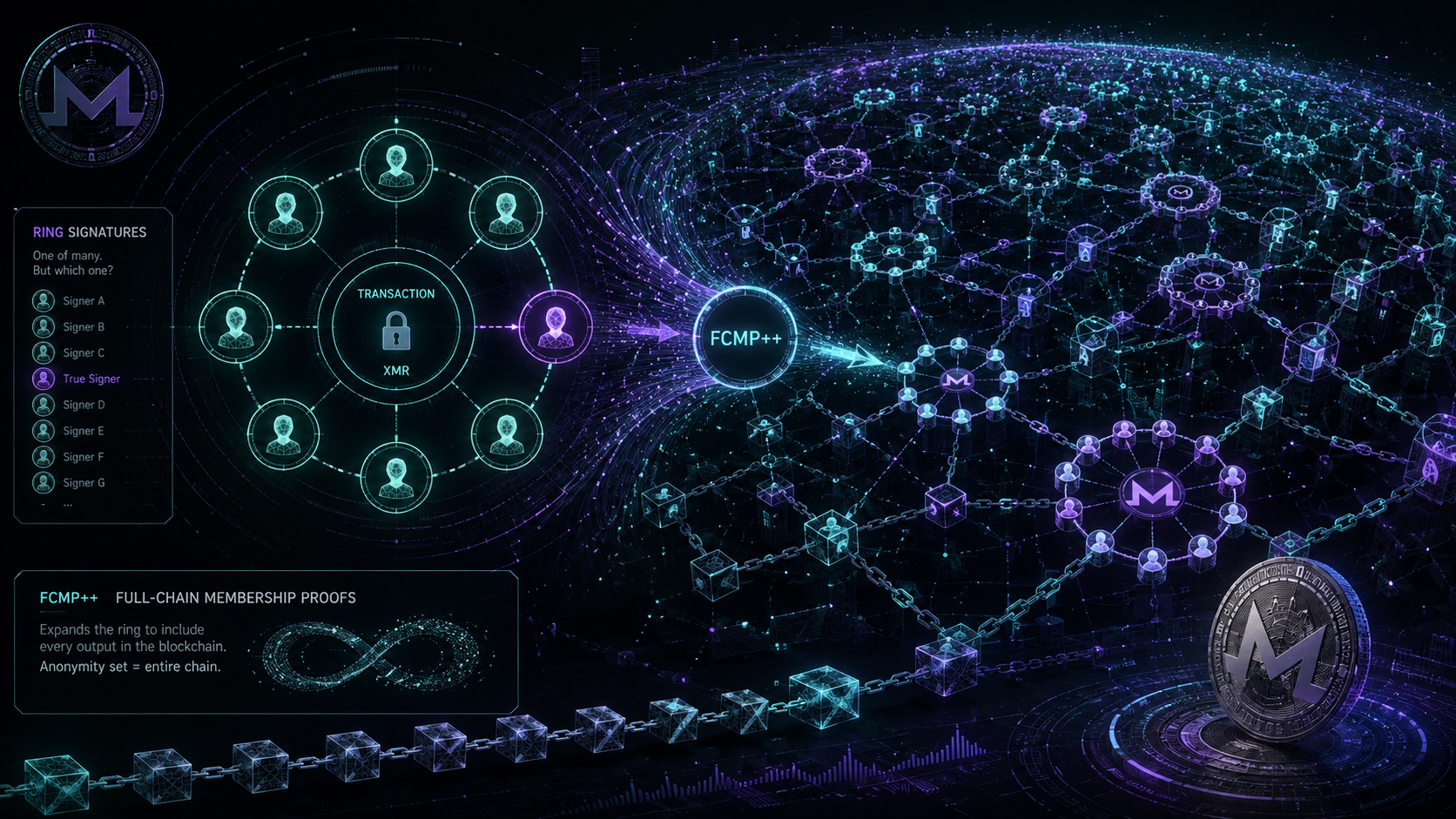
A decade after launch, Monero remains the only large-cap cryptocurrency where privacy is both mandatory and cryptographically robust by default: no transparent pool, no optional shielding, no view key requirement. The current development focus is FCMP++ (Full-Chain Membership Proofs), the most significant upgrade since RingCT. Traditional ring signatures mix a real output with 15 decoys from a recent blockchain subset. FCMP++ replaces this with a proof that uses the entire UTXO set as the anonymity set — potentially millions of decoys rather than 15. Therefore, temporal analysis attacks become computationally meaningless. The Cuprate node, a full reimplementation in Rust, is in advanced development.
Monero has been delisted from Kraken (Ireland, Belgium 2024), OKX, Bithumb, Huobi, Bittrex, and dozens of secondary exchanges. Yet XMR maintains price discovery and significant volume through P2P platforms, atomic swap protocols, and non-KYC exchanges. This resilience is structurally correlated with governance: because no company owns Monero, no company can be pressured to shut it down.
ANALYST NOTE — Monero’s Liquidity Paradox
73 exchange delistings of XMR in 2025 alone. Yet the P2P ecosystem — Bisq, Haveno successors, atomic swap infrastructure — has proven sufficient for price discovery. The IRS offered $625,000 in 2020 and $1.25M later for a working Monero tracing tool. No public evidence of successful cryptographic tracing exists. Most law enforcement successes against Monero users have relied on operational security failures, not on-chain analysis.
Pirate Chain (ARRR) — Maximum Privacy, Minimum Compromise
Pirate Chain is the maximalist answer to Zcash’s optionality problem. Launched in 2018 on the Komodo platform using Zcash’s zk-SNARKs technology, ARRR enforces 100% shielded transactions by protocol design. There are no transparent addresses. Every transaction is private. Combined with Komodo’s delayed Proof-of-Work security mechanism, ARRR achieves a notable security profile for its market cap. In 2026, the project is integrating cross-chain bridges while retaining its maximalist privacy stance.
The anonymous team, fair launch, and zero-compliance architecture make Pirate Chain ideologically coherent. The cost is obvious: no compliance pathway means progressive exclusion from regulated markets. Furthermore, ARRR has found organic adoption in Southeast Asia — Philippines, Indonesia, Malaysia — where capital controls, banking instability, and government surveillance create genuine demand for tools Western analysts dismiss as fringe. This real-world adoption in adversarial conditions is stronger use-case validation than most altcoin narratives offer.
Grin (GRIN) — The Minimalist Cypherpunk Chain
Grin belongs alongside Monero and Pirate Chain in this category. Fair launch, no premine, no ICO, no corporate entity, infinite linear emission, community governance with no legal attack surface. The Bogatyy transaction graph limitation applies to Grin and has not been architecturally resolved. But Grin’s structural resilience against regulatory pressure matches its cypherpunk peers: there is no foundation to shut down, no CEO to arrest, no treasury to freeze.
DragonX (DRGX) — The Under-Documented Outlier
DragonX combines zk-SNARKs privacy with a masternode architecture and on-chain encrypted messaging, targeting creator economies and restricted Web3 communities. I track it. I cannot yet fully verify it. The anonymous development team, insufficient public documentation, and thin trading volume make rigorous due diligence difficult. I include DragonX here not as a conviction position but as a pattern example: zk-SNARKs + masternodes + on-chain messaging is a recurrent template in the lowcap privacy space, and the critical questions are always the same — does the team exist, is the code audited, are there actual users? For DRGX, those questions remain open. See also our exclusive DragonX interview for additional context.
POSITIONING SUMMARY — Resisters
Monero (community governance, maximal cryptography, liquidity via P2P), Pirate Chain (zk-SNARKs forced, real adoption in SE Asia), DragonX (speculative, unverified, watch-list only).
2.2 — The Adaptors: Strong Privacy, Selective Compliance
Firo (FIRO) — The Academic Privacy Lab
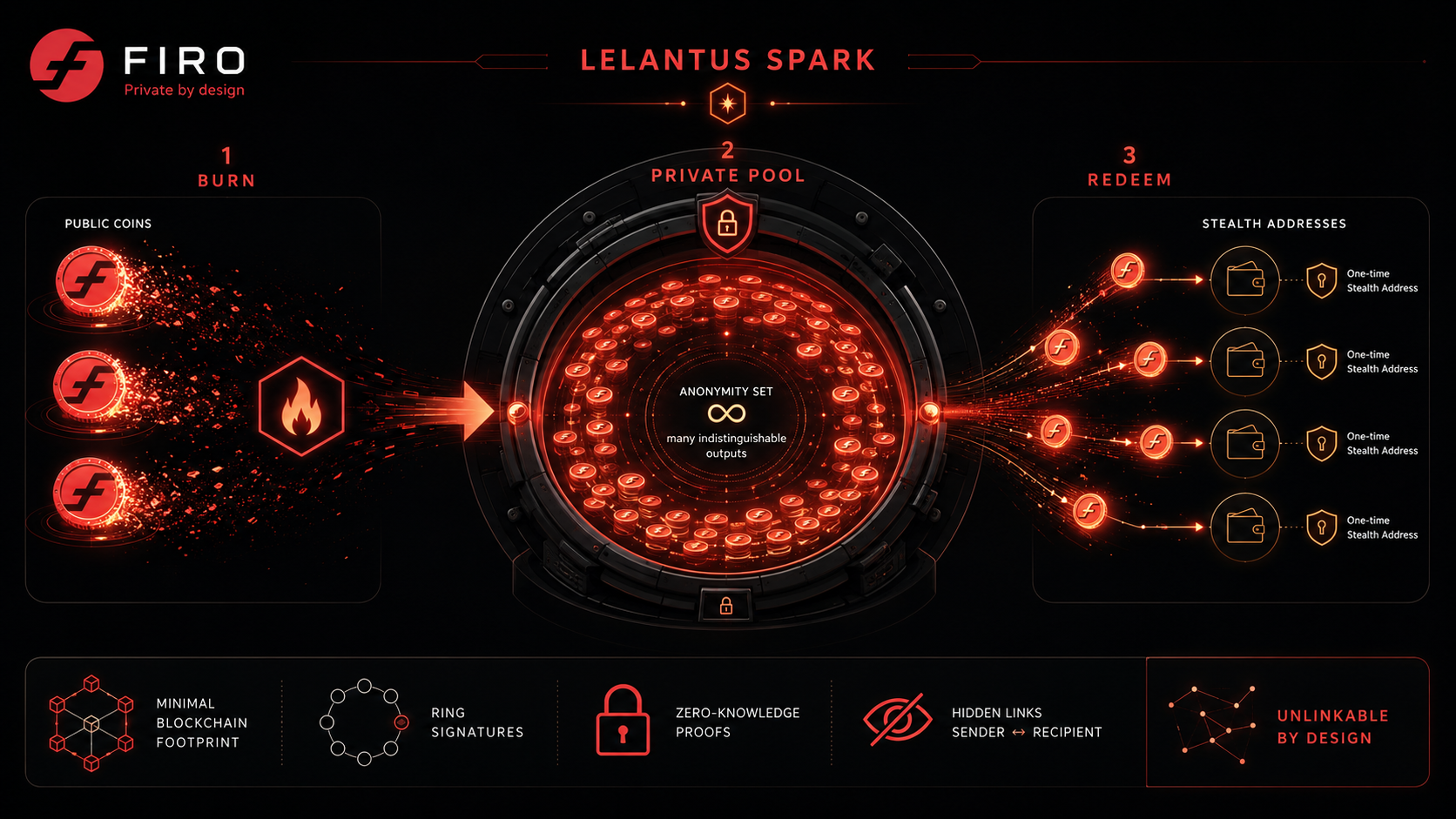
Originally launched as Zcoin in 2016, Firo has operated as one of the most academically rigorous privacy projects in the space. Its evolution is a genuine research trajectory: Zerocoin (2016, vulnerable, migrated), Sigma (2019, trustless), Lelantus (2020, arbitrary amounts), Lelantus Spark (2023–2025 — current). Spark simultaneously hides sender, recipient, and amount with no trusted setup, supports multi-signature, view keys for selective auditability, and Spark Assets (private tokens sharing the anonymity pool). Firo also integrates Dandelion++, which obfuscates the IP address of the broadcasting node — network-layer privacy that most projects neglect.
The risk profile is significant: liquidity is thin (Gate.io, MEXC, Binance select markets), the team is small, and the Firo Foundation’s governance introduces a legal attack surface that pure community projects do not have. As a result, the cryptographic trajectory from Zerocoin through Spark is one of the most coherent in the sector — but this coherence comes with a governance cost.
Zano (ZANO) — The CryptoNote Architect’s Second Act
Zano has a founding credential no other team can claim: its lead developer Andrey Sabelnikov wrote the original CryptoNote reference implementation — the codebase Monero was built from. Zano (previously Boolberry, launched 2014) is his evolution of that work. The consensus model alternates PoW (ProgPoWZ, ASIC-resistant) and PoS blocks via Zarcanum — described as the first PoS scheme with hidden amounts. Stakers secure the network without revealing their balances. To attack Zano, an adversary needs simultaneous majority of both hashrate and stake.
Beyond payments, Zano has built Confidential Assets (private token issuance on the Zano chain, same privacy guarantees as native ZANO), a private stablecoin ($fUSD), Ionic Swaps (atomic swaps preserving both parties’ privacy), and a private DEX. At roughly $140M market cap in early 2026, it remains technically lowcap relative to its architecture. The key risk: limited exchange access, thin liquidity, and a compliance profile similar to other CryptoNote chains under MiCA.
Beam (BEAM) — Mimblewimble’s Professional Build
Beam is the company-backed, C++ implementation of Mimblewimble with extensions: Confidential Assets, a Beam Virtual Machine for smart contracts. The only major CEXs currently listing Beam are MEXC and Gate.io. Note: the ‘BEAM’ token visible on Coinbase is the rebranded Merit Circle gaming token, with no connection to Beam privacy coin. Binance listed BEAM in early 2019 without request from the team, then delisted it in 2023. Current major CEX listings: MEXC and Gate.io. The compliance strategy is pragmatic rather than ideological — Beam provides optional auditability mechanisms for businesses requiring compliance without dismantling the core privacy architecture.
Salvium (SAL) — The MiCA-Ready Experiment
Launched in July 2024, Salvium is one of the most strategically interesting recent entries. Built on modified CryptoNote, it was designed from the start for regulatory compatibility. The SPARC protocol (2025, Salvium One) allows anonymous refundable transactions — a user can prove legitimacy and initiate a return without exposing full transaction history. This directly targets the compliance officer problem: how do you support KYC/AML without destroying privacy? MEXC and CoinEx have listed SAL where they delisted Monero. The bet is that regulatory-compatible privacy has a market. As a result, Salvium occupies a unique strategic niche — though it is too new to evaluate with high conviction.
POSITIONING SUMMARY — Adaptors
Firo (academic rigor, Lelantus Spark, governance risk), Zano (CryptoNote evolution, private ecosystem, lowcap), Beam (Mimblewimble + MEXC/Gate.io, transaction graph limitation), Salvium (MiCA-native, strategic experiment, unproven).Editorial note (May 2026): Beam’s posture has evolved significantly since the dev reward ended and governance migrated to a DAO. A reclassification toward the Resister category may be warranted in a future update of this analysis.
2.3 — Emerging Architectures: The New Technical Frontier
Xelis (XEL) — Homomorphic Encryption Meets BlockDAG
Xelis is one of the most technically ambitious recent entries in the privacy space. Launched on mainnet in mid-2024, it combines a BlockDAG architecture with Twisted ElGamal homomorphic encryption and zero-knowledge proofs via Bulletproofs. The result: wallet balances and transaction amounts are encrypted and hidden from public view, with the network verifying validity on encrypted data without ever decrypting it. Furthermore, the Xelis VM supports smart contracts on this private substrate.
What distinguishes Xelis from Dero (the other major homomorphic encryption blockchain) is its architecture decisions: the Twisted ElGamal cryptosystem combined with Ristretto points on Curve25519 provides 128-bit security with fast homomorphic operations. BlockDAG targets high TPS with 15-second block times, and the xelis-hash mining algorithm is deliberately CPU/GPU friendly with FPGA and ASIC resistance built in. Smart contracts reached testnet in late 2024 and mainnet in Q4 2025.
Xelis keeps public addresses visible while hiding amounts and asset types — a deliberate design choice balancing privacy with some degree of accountability. For a project launched in 2024, the development velocity is notable: active GitHub commits as recently as May 2026, a growing community, and a roadmap extending through smart contract improvements. See our exclusive interview with Xelis founder Slixe for the full technical context.
ANALYST NOTE — Xelis vs. Dero on Homomorphic Encryption
Both Xelis and Dero implement homomorphic encryption at the blockchain level. Dero uses full homomorphic encryption for smart contract state, meaning contract logic operates on data that is never decrypted on-chain — theoretically the strongest possible privacy for computation. Xelis uses additive HE (Twisted ElGamal) for balances and amounts, combined with zk-proofs for transaction validity. Dero’s approach is computationally heavier; Xelis targets better throughput at the cost of less complete computation privacy. Both remain very early-stage relative to their architectural ambitions.
Dero (DERO) — Homomorphic Smart Contracts and BlockDAG
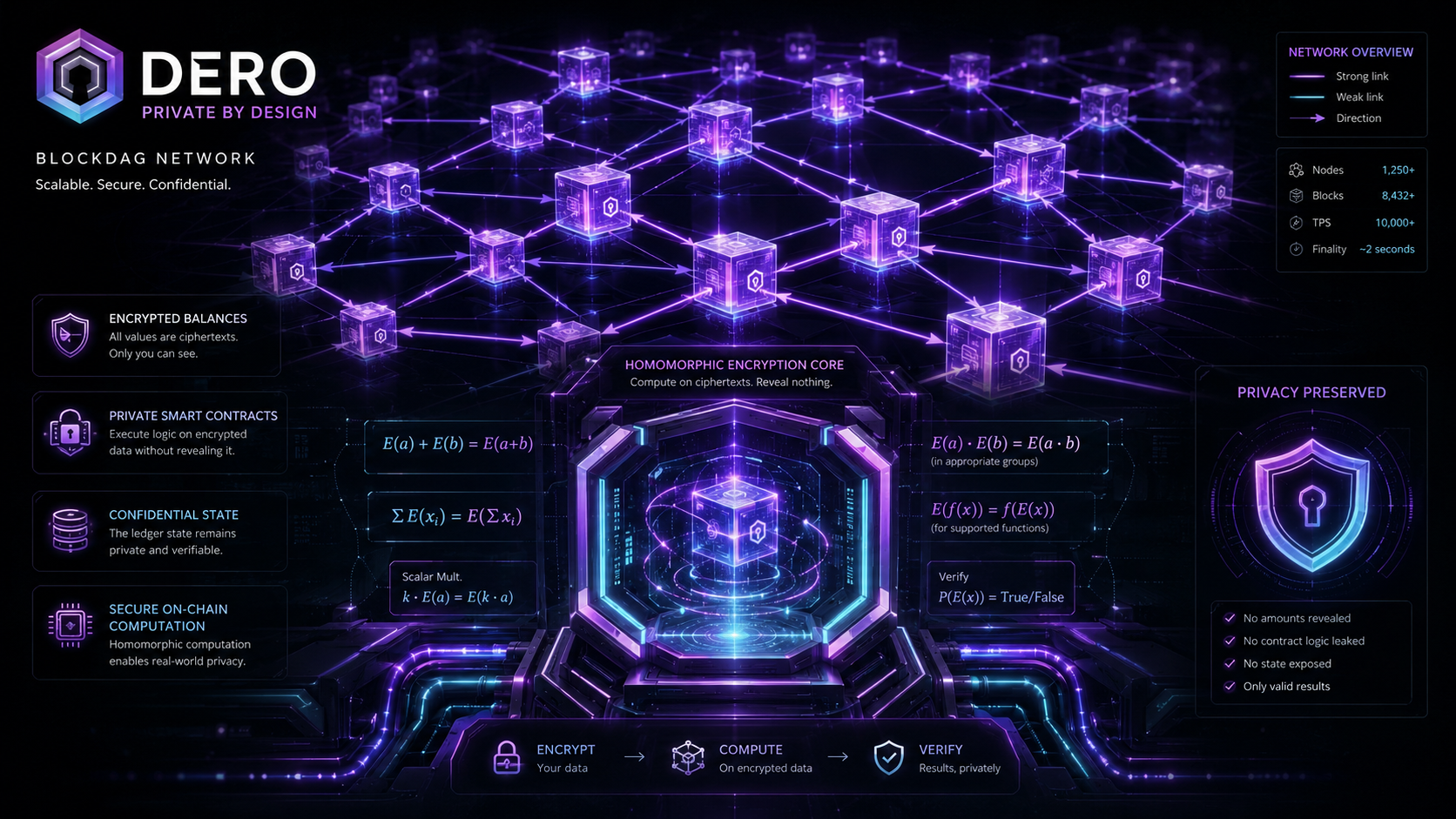
Dero occupies a unique position in the ecosystem: to my knowledge, the only live blockchain implementing homomorphic encryption at the protocol level for smart contract execution. Smart contract state, balances, and logic are never decrypted on the public ledger, even while being computed. Combined with a BlockDAG architecture and AstroBWT mining algorithm, the Dero Virtual Machine supports truly private DeFi, sealed-bid auctions, and anonymous voting systems.
In 2025–2026, Dero experienced a significant protocol-level bug that caused delays in the upgrade roadmap. For a project whose entire value proposition rests on cryptographic novelty and technical rigor, an execution failure at the protocol layer is a serious signal — not a dealbreaker, but a regression that prospective investors must explicitly factor in. The anonymous team, very limited exchange support, and small community compound the risk. In contrast to Xelis, Dero is a pure speculative moonshot: the technological differentiation is real, whether adoption follows is a different question entirely.
Railgun (RAIL) and Aztec — The DeFi Privacy Layer
A fourth-generation privacy paradigm deserves separate treatment because it operates on different premises from standalone privacy chains. Railgun deploys smart contracts on Ethereum, BSC, and Polygon, creating a shielded pool allowing any DeFi interaction to execute privately via zk-SNARKs. The distinguishing mechanism is “Private Proofs of Innocence”: users can cryptographically prove their funds do not originate from OFAC-sanctioned addresses, without revealing actual fund history. In early 2026, US Treasury clarifications implicitly validated this architecture, distinguishing it from Tornado Cash’s compliance-agnostic design.
Aztec takes a more radical approach: a zk-rollup L2 on Ethereum where privacy is a native protocol property. The Ignition Chain launched in November 2025 as the first decentralized L2 on Ethereum. As of May 2026, Aztec is in early alpha — a critical vulnerability was disclosed in March 2026, with a v5 patch targeting July 2026. Backed by Paradigm, a16z, and Vitalik Buterin with over $170M raised. The institutional thesis is 2028 and beyond; the current product is alpha-stage with known vulnerabilities.
Neither Railgun nor Aztec competes with Monero’s monetary privacy use case. As a result, they are infrastructure for DeFi confidentiality and institutional use cases — a fundamentally different market with different adoption dynamics and compliance vectors.
POSITIONING SUMMARY — New Architectures
Xelis (HE + BlockDAG + smart contracts, active development, promising), Dero (most technically ambitious HE implementation, protocol risk, speculative), Railgun (compliance-aware DeFi privacy, Treasury-validated), Aztec (programmable privacy for Ethereum, alpha stage, 2028 thesis).
PART 3
The Regulatory Vice: Global Fragmentation, Not Harmonization
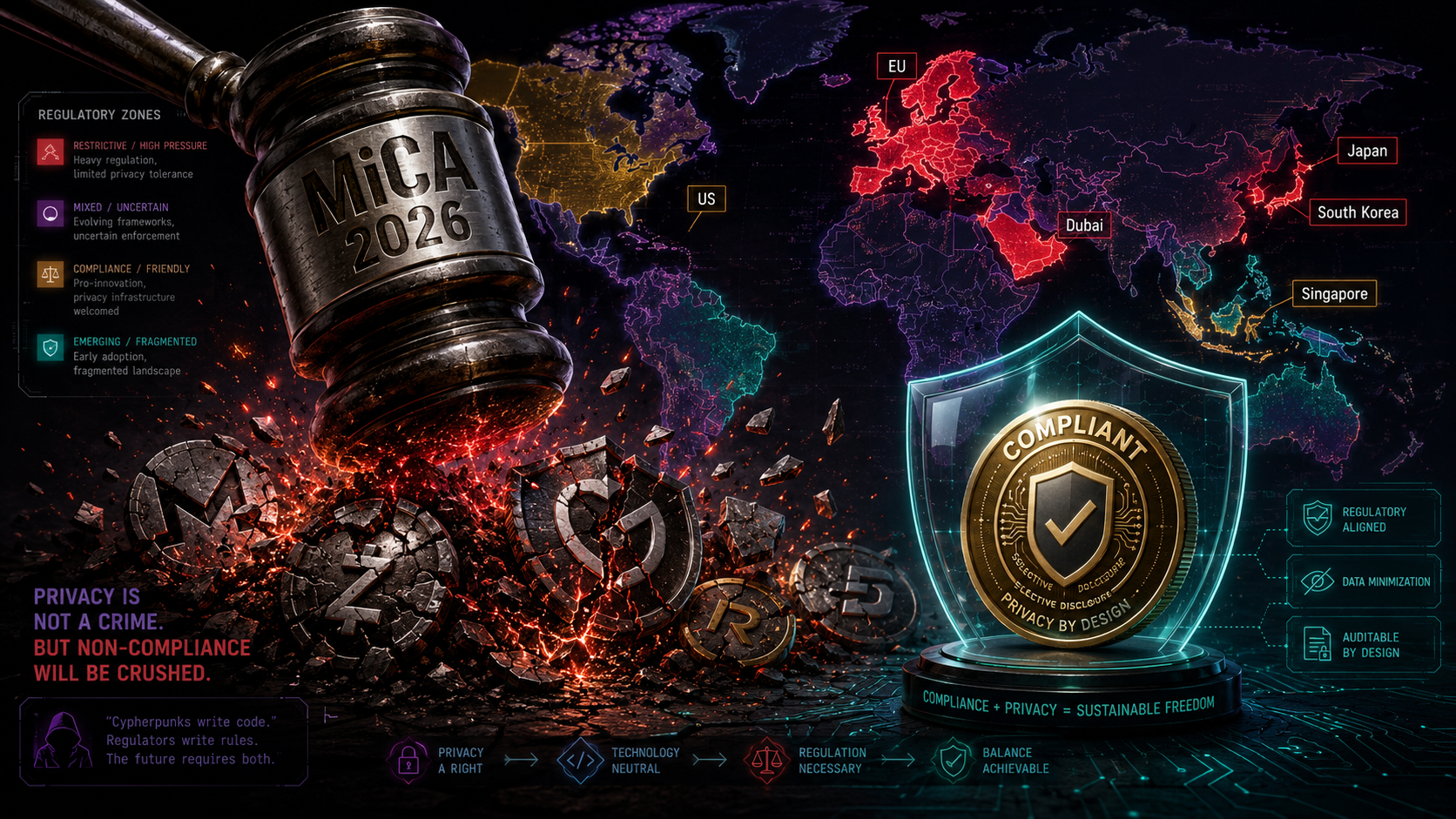
The regulatory analysis for privacy coins is commonly framed as a Western story: MiCA in the EU, FinCEN in the United States, FATF as the global baseline. This framing obscures what is actually happening: global regulatory fragmentation that creates a patchwork of jurisdictions with radically different incentives, enforcement capacities, and political economies. Geography determines where privacy coin adoption persists, where it grows, and where it is extinguished.
3.1 — The European Framework: MiCA and De Facto Exclusion
Between 2024 and 2026, the regulatory environment went from uncomfortable to existentially threatening in major Western markets. The numbers are stark: 73 exchange delistings of Monero in 2025 alone, and 60 privacy tokens delisted across all categories in 2024 according to Kaiko Research. MiCA’s full implementation as of July 2026 creates legal exposure for any CASP (Crypto Asset Service Provider) servicing EU customers while listing non-compliant privacy coins.
It is important to be precise about what MiCA actually does: it does not create a textual ban on all privacy coins. Rather, the combined effect of MiCA’s AML requirements and the 2024 EU AML package — which explicitly introduces the category of “anonymity-enhancing coins” — creates a de facto exclusion from regulated exchange listings for coins with mandatory privacy. The regulation targets the intermediaries, not the assets directly. The FATF Travel Rule, requiring sender and beneficiary data transmission for VASP transfers, is structurally incompatible with any coin where recipient addresses are hidden or amounts are concealed.
3.2 — The Gulf: From Crypto Hub to Privacy Ban
Dubai spent 2022–2023 positioning itself as the world’s most permissive major crypto jurisdiction. On January 12, 2026, the DFSA (Dubai International Financial Centre regulator) aligned with VARA and formalized a comprehensive prohibition on anonymity-enhanced cryptocurrencies across both jurisdictions. Monero and Zcash are explicitly prohibited. Firms face license revocation and fines in the tens of millions of dirhams. Mixers and tumblers are similarly banned.
Dubai’s ban is instructive precisely because it arrived from a jurisdiction that had been positioning as privacy-friendly. The FATF removal process required demonstrable AML compliance, which in practice meant conforming to the global consensus that anonymity-enhancing cryptocurrencies are incompatible with regulated financial infrastructure. The lesson: even permissive jurisdictions are not structurally insulated from global compliance harmonization when they depend on integration with traditional financial rails.
3.3 — Southeast Asia: Adoption Under the Radar
The Philippines, Indonesia, and Malaysia present the most compelling evidence that privacy coins have real-world utility beyond speculation. Pirate Chain in particular has built organic adoption communities driven not by ideological conviction but by practical necessity: capital controls, remittance friction, currency instability, and in several countries, financial surveillance by governments not constrained by Western rule-of-law protections.
P2P exchange infrastructure — local trading communities organized on Telegram and WhatsApp, using atomic swap protocols to convert between ARRR and Bitcoin or USDT without a custodian — has developed in ways that Western exchanges cannot replicate and Western regulators cannot easily reach. The ARRR/PHP and ARRR/VND pairs have among the highest non-USD volumes in the project’s P2P ecosystem. This is not a use case Western financial commentary takes seriously. It is precisely the use case privacy advocates have always described as the genuine value proposition.
3.4 — Latin America: Monetary Sovereignty Under Inflation
In Argentina and Venezuela, privacy coins intersect with chronic hyperinflation and state-imposed currency controls. The use case is not primarily anonymity from surveillance — it is monetary sovereignty: the ability to hold value in an asset that cannot be devalued by government policy and cannot be seized through bank freezes.
Survey data from 2025 suggests Latin American small business adoption of privacy coins reached 26% in Argentina and Venezuela specifically, with Monero dominant at 55% of privacy coin users surveyed. The key concern is not anonymity per se but the permanent public record that Bitcoin’s transparent ledger creates — a record that future governments or tax authorities can access. Monero does not create that record.
ANALYST NOTE — The Illicit Use Framing Problem
Regulatory discourse about privacy coins consistently frames them through illicit use: darknet markets, ransomware, sanctions evasion. This framing is not entirely wrong. However, a 2025 analysis estimated that only 7% of global privacy coin transactions were suspected of illicit intent. The regulatory pressure is disproportionate to the documented harm, and the populations bearing the cost — Venezuelan small businesses, Filipino remittance workers, Argentinian savers — have the least political leverage to push back on it.
3.5 — Singapore: The Institutional Privacy Exception
Singapore’s MAS represents the most sophisticated regulatory approach to privacy technology outside the United States. Unlike Dubai, the EU, Japan, or South Korea (all with some form of prohibition or severe restriction), Singapore has approached privacy-preserving technology as a legitimate infrastructure question distinguishing privacy from anonymity.
The institutional logic: large financial institutions conducting blockchain-settled transactions do not want counterparties seeing their position sizes, trading strategies, or liquidity conditions. This is standard commercial confidentiality — the same reason traditional financial transactions occur through intermediaries not obligated to make order books public. Aleo’s integration of USDCx (Circle) and USAD (Paxos) stablecoins for privacy-preserving settlement is being watched in Singapore as a model for regulated institutional privacy. The MAS has not endorsed specific protocols, but the regulatory posture is receptive rather than prohibitive.
PART 4
The Strategic Framework: What Survives?
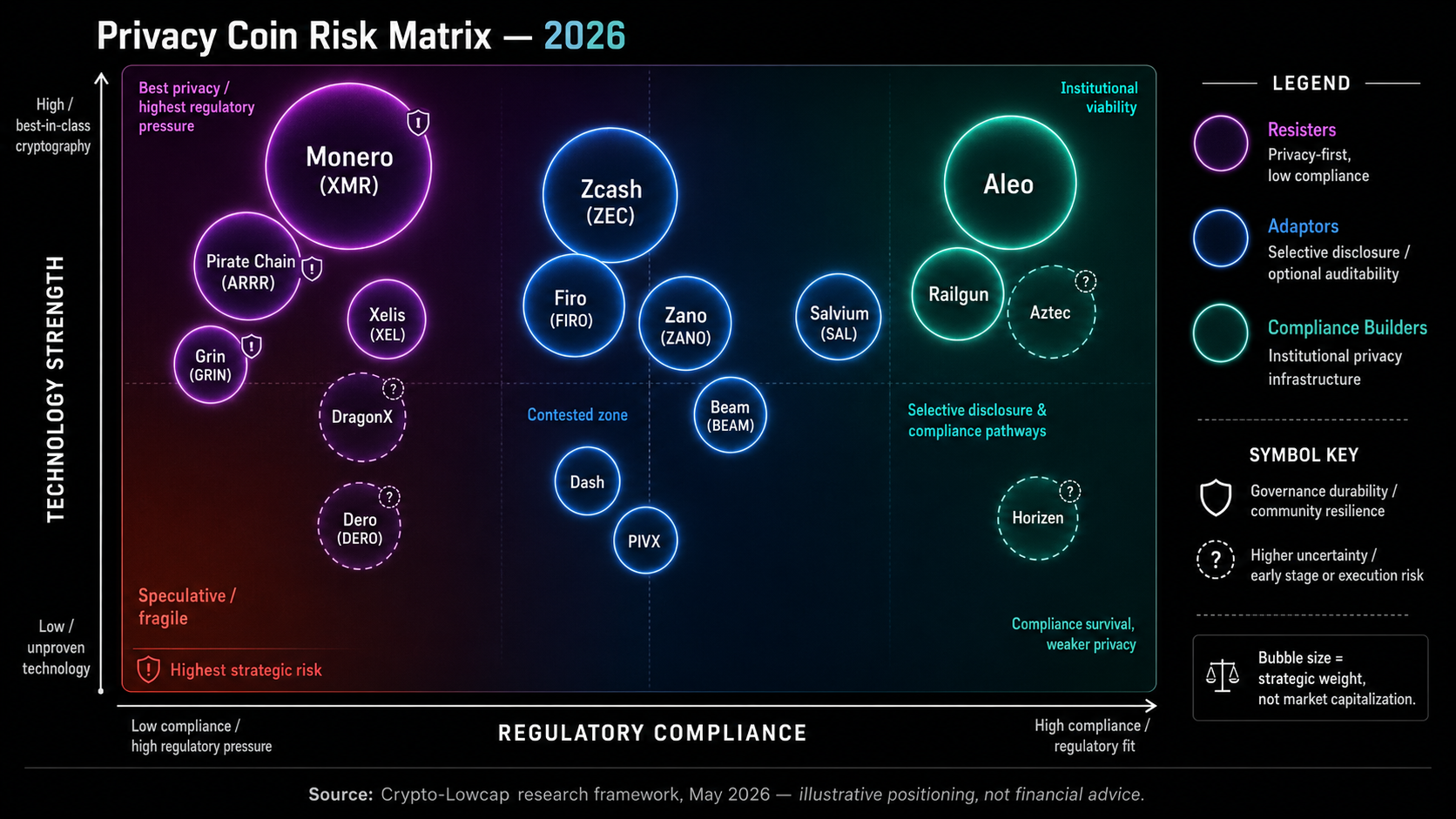
4.1 — Three Strategic Postures
The Resisters
Monero, Pirate Chain, Dero, Grin, Xelis, DragonX. These projects refuse to compromise their cryptography for regulatory acceptance. The most durable resisters are those whose governance makes them legally unattackable: Monero and Grin have no registered foundation to pressure. The systemic risk is liquidity destruction — but resistance to governance attack partially compensates for market vulnerability. A registered foundation can receive a legally enforceable regulatory order requiring surveillance backdoors. A volunteer-run community with no legal entity cannot.
The Adaptors
Zcash, Dash, PIVX, Firo, Beam, Zano, Salvium. These projects maintain strong privacy technology but provide voluntary compliance pathways. Zcash’s view keys allow selective disclosure. Salvium’s SPARC protocol builds compliance into the cryptographic layer. These projects retain exchange access in most jurisdictions. The governance tradeoff is real: maintaining a foundation provides compliance credibility at the cost of a legal attack surface.
The Compliance Builders
Aleo, Railgun, Aztec, and formerly Horizen. These projects have either built regulatory compliance directly into the protocol or abandoned privacy as a default feature. Horizen’s lesson is permanent: when a foundation had to choose, it chose survival. Aleo and Railgun are attempting something more sophisticated — building privacy infrastructure that institutional actors can use precisely because it satisfies regulatory requirements. Whether this model threads the needle between regulatory viability and genuine privacy remains to be demonstrated.
4.2 — The Governance Durability Variable
Governance is the least discussed and most consequential variable in privacy coin analysis. Technical excellence can be reproduced. Community can be rebuilt. However, governance determines whether a project can be killed by a single legal action, a regulatory order, or an internal corporate dispute.
The Tornado Cash precedent (OFAC 2022, partially reversed 2025) demonstrated that even code without a legal entity can face sanctions pressure. However, the outcome was different: because Tornado Cash had no CEO to arrest and no foundation to shut down, the protocol itself could not be stopped. The developers were prosecuted as individuals — a very different attack surface. Community governance does not make a project immune, but it substantially raises the cost of regulatory attack.
Zcash’s 2025 governance crisis — Bootstrap Foundation vs. ECC, $25M in development resources locked in dispute — represents a failure mode that pure community projects cannot experience. No Monero contributor dispute has ever threatened the protocol’s ability to produce blocks. This structural resilience is not an accident; it is a design choice that carries real long-term value.
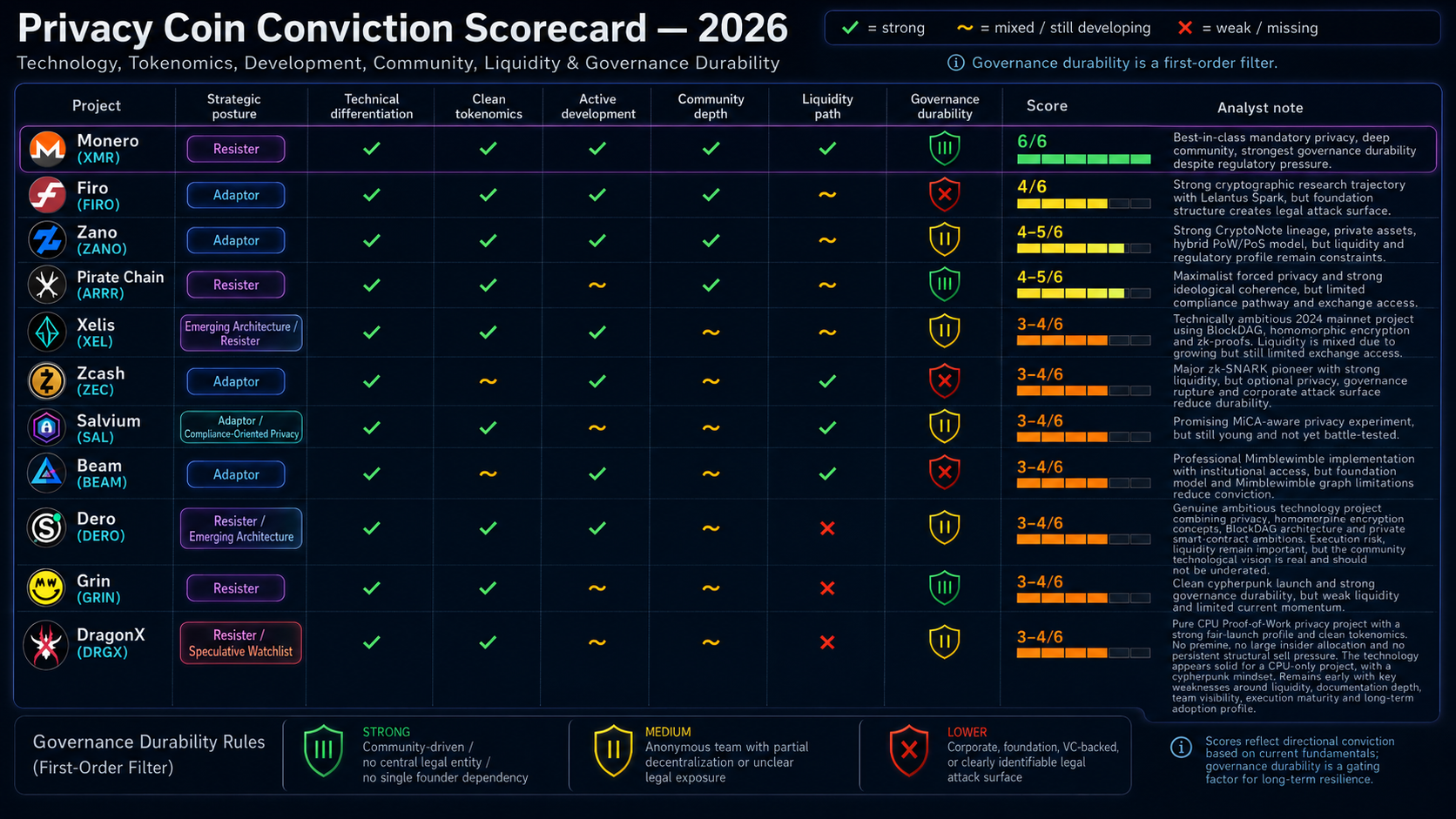
4.3 — The Conviction Scorecard
I evaluate projects on six criteria: Technical differentiation (cryptography novel or best-in-class), Clean tokenomics (no large premines or persistent sell pressure), Active development (public repository commits in the last 30 days), Community depth (contributors independent of price action), Liquidity path (current exchange access or plausible path), and Governance durability (structural resilience against regulatory or corporate attack). Furthermore, governance durability is treated as a first-order filter.
Conclusion: The Long Game
Financial privacy is not a feature. It is a condition for human autonomy. The ability to transact without surveillance is as fundamental as the ability to speak without being monitored. The current trajectory of global financial regulation is toward total visibility: MiCA, FATF Travel Rule, the EU’s planned 2027 ban on anonymous accounts, CBDC programs that will make every euro programmable and traceable. In this context, the projects building cryptographic privacy infrastructure are not fringe actors. They are building the technological foundations of financial sovereignty.
The decade 2012–2026 shows that privacy crypto has not been destroyed — it has been resegmented. Projects that are purely monetary and resistant have kept their cryptographic integrity at the cost of growing exclusion from regulated rails. In contrast, hybrid projects have shifted toward a subtler idea: not “make money totally opaque,” but “reveal only what must be revealed, to whom it must be revealed, when it must be revealed.”
My view after a decade in this space: the survivors will be either those with communities so deep, governance so resilient, and values so coherent that no delisting or legal order can extinguish them — Monero, and to a lesser extent Grin and Pirate Chain — or those who successfully navigate the compliance tightrope without destroying their core value proposition — Firo, Zano, and potentially Salvium if the SPARC protocol delivers. New architectures like Xelis deserve close monitoring: their BlockDAG + homomorphic encryption combination, if it matures into production-grade infrastructure, represents the next technical generation of the privacy coin thesis.
The speculative opportunity in this sector remains real and asymmetric. However, asymmetric upside requires accepting the very real possibility of zero on individual positions. Sizing accordingly is not optional advice. It is risk management.
This article was produced independently by Rowenta01 for crypto-lowcap.com. No project mentioned has paid for coverage or influenced editorial direction. The information contained here is purely informational and does not constitute financial advice.
crypto-lowcap.com | Revealing Privacy. Defending Sovereignty. | @CryptoRowenta01