Defending Financial Privacy on the Blockchain in 2026

ANALYSIS & DEEP DIVE · MAY 2026
On-chain surveillance, KYC choke points, MiCA, and what a serious financial privacy blockchain 2026 operational stack actually looks like.
By Rowenta01 | crypto-lowcap.com | Est. reading time: ~25 min
#Privacy #MiCA #Monero #Zcash #Salvium #Zano #FHE #ZK #TravelRule #Cypherpunk
Before we start
This article on financial privacy blockchain 2026 does not constitute investment advice. These are personal observations from a fundamental analyst who has been covering the privacy crypto space since 2016. The legal frameworks discussed evolve quickly, and readers should use the described operational practices to protect a legitimate right to financial privacy, not to evade legal obligations. Micro-cap and low-cap projects carry significant risk. Do your own research.
QUICK MAP — Five layers covered in this article
Layer 1 — Identity & email · Layer 2 — Network & browser · Layer 3 — Wallets & compartmentation · Layer 4 — On-chain tooling & venues · Layer 5 — Operational discipline
New in this version: Layer 0 — Entering the system without a KYC anchor (Section 9)
Skip to Section 10 for the five-tier profile matrix. Background context (Sections 2–8) is worth reading even if you consider yourself informed.
1. Why I am writing this blockchain privacy guide in 2026, and not in 2017
I have been writing about financial privacy blockchain 2026 — and earlier — on this site. Back then, the conversation was mostly philosophical. Cypherpunks would argue with bitcoin maximalists, regulators were still trying to figure out what a blockchain even was, and most users honestly believed that an address starting with 1 or bc1 made them anonymous. We had time to be wrong.
That window has closed.
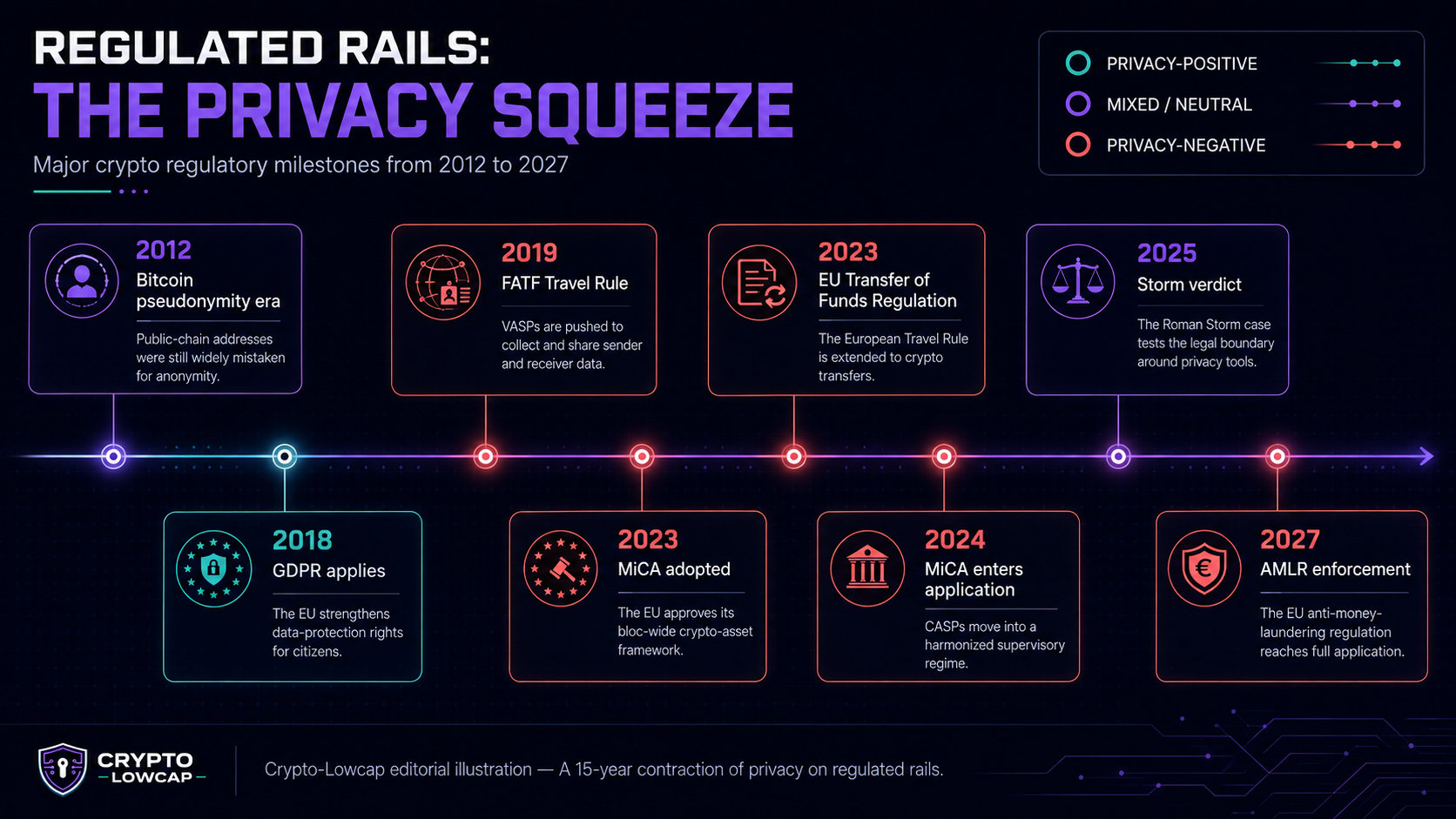
In 2026, three things have happened at the same time, reshaping every assumption we held about financial privacy on the blockchain. First, the European Markets in Crypto-Assets regulation (MiCA) is now fully in force, and its article 76(3) effectively forbids regulated trading venues from listing assets whose default mechanics prevent identification of holders. Second, the Transfer of Funds Regulation has removed every minimum threshold for transmitting identity data on crypto transfers, including those involving self-hosted wallets. Third, on-chain surveillance has stopped being a niche industry of three or four firms and has become an AI-powered infrastructure layer of the financial system.
Financial privacy blockchain 2026: the surveillance revolution
As a result, the combination is brutal. On-chain analytics now systematically breaks pseudonymity at the on-ramp, at the off-ramp, and increasingly in the space between — a property most retail users still confuse with true anonymity. Each interaction with a regulated venue is a re-identification anchor. Shared addresses on social media are OSINT vectors. Reused stealth patterns become clustering opportunities for Chainalysis or TRM Labs.
However, let me be honest about something. I am not writing this article to romanticize the cypherpunk era, and I am not writing it to scare anyone. I am writing it because the privacy debate has been hijacked by two camps that are both wrong in the same way: the maximalists who claim that any tool of confidentiality is criminal contraband, and the anonymity absolutists who promise their followers that a single VPN and a Monero wallet are enough to vanish. Neither position survives contact with how the 2026 stack actually works.
This article is an attempt to give a serious operator — an investor, a journalist, a researcher, or anyone who believes financial intimacy is a legitimate right — a clear-eyed map of where surveillance stands, where the technical countermeasures stand, and where the regulatory frontier is moving. I will name the projects I find serious. I will also name the patterns I find naive. And I will draw a line between protecting a legitimate right to privacy and trying to evade legal obligations, which is a line every reader of this site should refuse to cross.
2. The four pillars: privacy, confidentiality, pseudonymity, anonymity
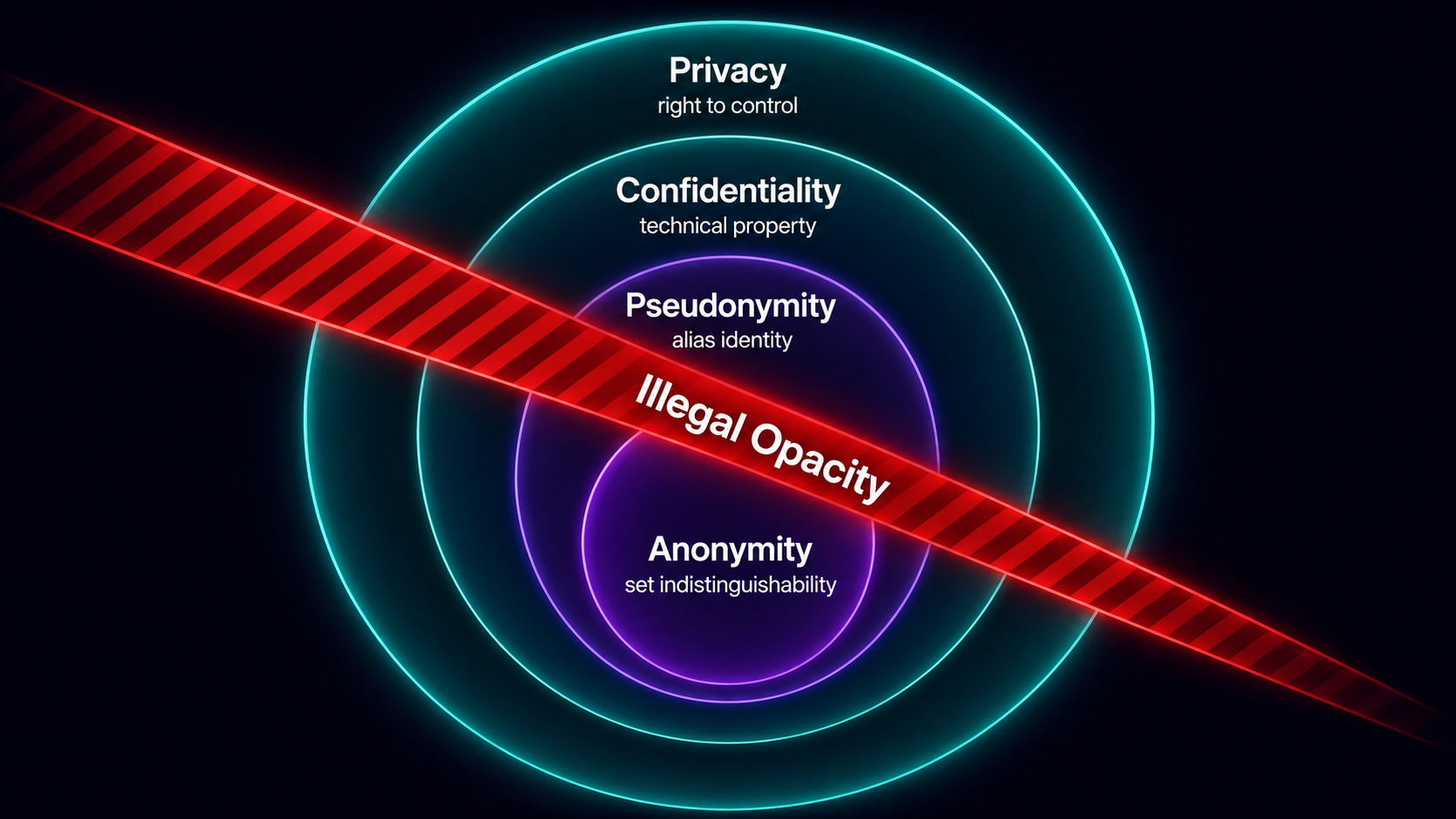
Indeed, most of the confusion in this debate comes from a single failure of vocabulary. The four words are not interchangeable, and treating them as if they were is the fastest way to design a bad threat model.
Privacy is the right to control which information about yourself reaches which observers. It is a relational concept, not a binary state. A user with a Zcash shielded transaction who hands a view key to their auditor still has privacy — they have simply chosen to grant selective disclosure.
In contrast, confidentiality is a technical property of a message, an amount, an asset, or a transaction. RingCT on Monero hides the amount. zk-SNARKs in Zcash hide sender, receiver, and amount inside a shielded pool. Confidentiality is what cryptography delivers.
Furthermore, pseudonymity is the state of operating under an identifier that is not your civil identity. Every Bitcoin and Ethereum address is pseudonymous. That property is fragile by construction: the link to civil identity only needs to be established once for the entire history to be retroactively de-anonymized.
Finally, anonymity is the state of being indistinguishable inside a set of plausible candidates — the anonymity set. Monero achieves anonymity by default with mandatory ring signatures over decoys. Zcash achieves it conditionally inside its shielded pool, when used correctly.
The red line: privacy versus opacity
And then there is a fifth term — the one regulators conflate with all of the above and which we have to refuse: opacity for illegal purposes. Dissimulating proceeds of crime, evading tax obligations, or circumventing sanctions is not privacy. It is opacity, and it is criminal. The cypherpunk position is not that opacity should be tolerated. It is that privacy must remain accessible to citizens even when bad actors also exist, because the alternative is a financial panopticon.
3. The Observatory: anatomy of blockchain on-chain surveillance in 2026
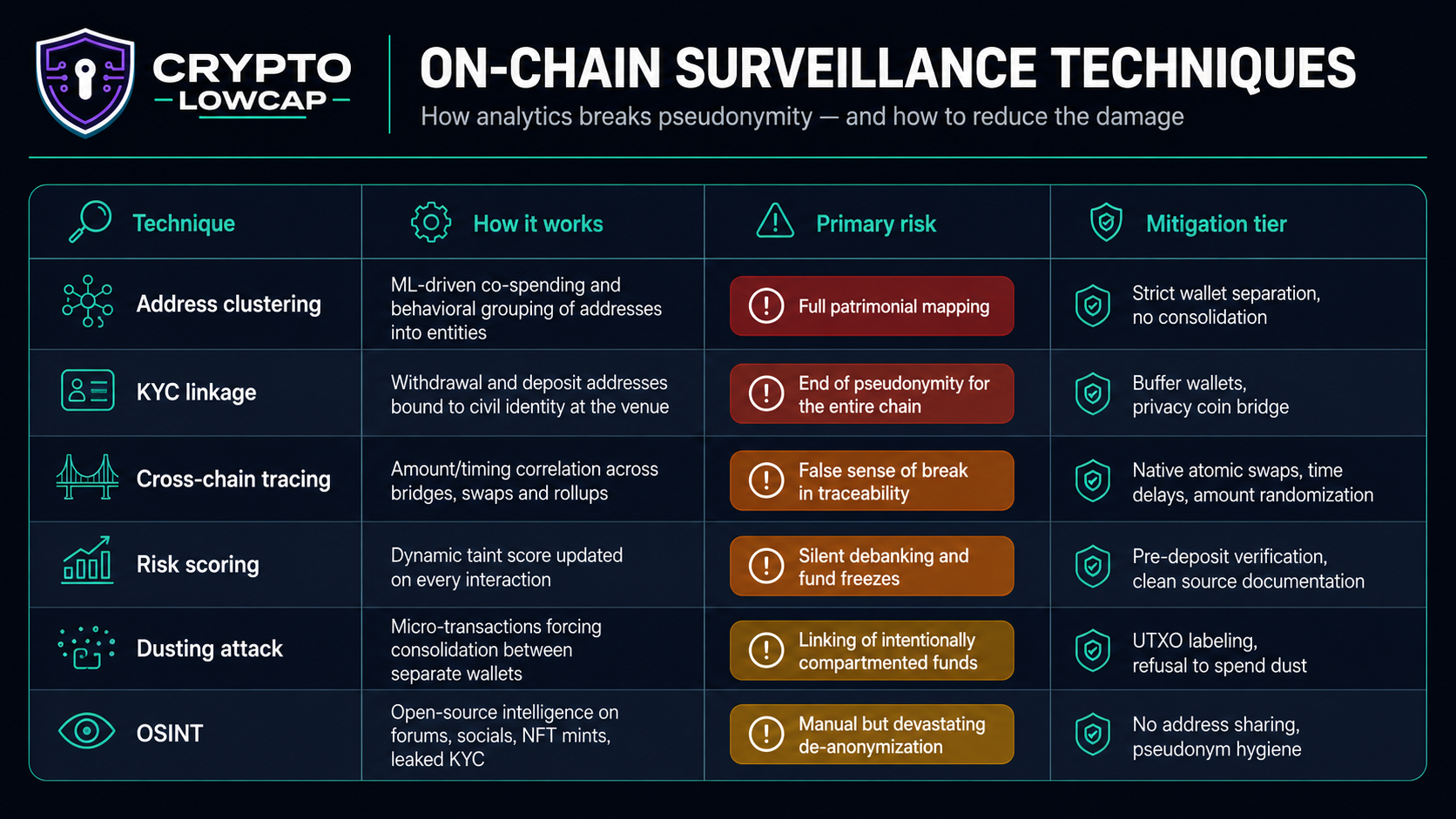
Notably, the blockchain analytics industry has stopped being a forensics niche and has become a financial intelligence layer that runs in real time, with machine learning on top, and with privileged access to every regulated venue on the planet. Understanding these techniques is a prerequisite for defending against them.
Blockchain address clustering and graph analysis
In practice, clustering is the foundational technique. By analyzing co-spending heuristics, change address patterns, timing correlations, and behavioral signatures, vendors like Chainalysis, TRM Labs and Elliptic group hundreds of addresses into a single entity profile. In 2026, these heuristics have been augmented by machine learning models trained on millions of labeled wallets — the system now learns the operational style of a user the same way fraud detection learns a card-spending pattern. Two addresses you believed were separate, used at the same time of day, with similar transaction sizes, on the same chain, will be clustered.
KYC linkage and the identity anchor problem
Additionally, every regulated exchange operates as an identity anchor. The moment you withdraw from a KYC venue, that withdrawal address is permanently linked to your civil identity inside the analytics graph. Inbound deposits are even more damaging: they tie the entire pre-existing history of the source address to you retroactively. This is the single most underestimated vector in retail privacy hygiene, and it is why compartmentation matters more than any single tool.
Cross-chain tracing
In 2026, bridge surveillance is mature. Vendors do not just track funds through wrapped tokens — they follow swaps across atomic swap protocols, through DEX aggregators, and across rollups, using amount-and-timing correlation. The naive assumption that swapping BTC for an EVM token through a bridge breaks the trail is no longer defensible. The trail is reconstructed in seconds with a moderate confidence score, and that score is what regulated venues use to gate deposits.
Risk scoring and the silent gate
As a result, every address that touches a regulated venue is scored. The score is dynamic, opaque, and consequential. Touching a sanctioned mixer — even indirectly — can taint an address for weeks. The user does not know they have been scored until a withdrawal stalls, a deposit is frozen, or an account is closed without explanation. This is the modern equivalent of debanking, and it is happening at scale.
Dusting attacks and OSINT
Furthermore, dusting is the practice of sending micro-amounts of tokens to thousands of addresses to force consolidation events and break wallet separation. Between 2022 and 2024, over 270 million dusting attempts were detected on Ethereum and BSC alone, with 17 million addresses targeted. OSINT, furthermore, is the slowest but often most effective method: a pseudonymous address that has been publicly posted, shared in a Discord screenshot, tipped on a forum, or claimed by an NFT mint is one Google query away from full re-identification.
4. Off-chain privacy surveillance: where the real leak happens
Here is the part most articles on this topic skip. In fact, the blockchain is rarely the weakest link. The weakest link is the operational stack around it. A perfect ring signature does not help if your IP address, your browser fingerprint, or your email account betrays you the moment you open your wallet.
The four planes of off-chain surveillance
Off-chain surveillance in 2026 operates on four planes simultaneously. On the network plane, IP addresses are captured through RPC endpoints, wallet telemetry, and frontend services — which is why most MetaMask users have unknowingly leaked their address-to-IP mapping to a single Infura backend for years. Users are fingerprinted on the browser plane through resolution, fonts, installed extensions, WebRTC, and clock drift, producing identifiers more stable than any cookie. Meanwhile, the identity plane collects email addresses, phone numbers, and device IDs at every signup, then cross-references them with the data broker market and with leaked KYC databases. Operating subtly beneath these, the behavioral plane learns the operator’s habits, login times, and typical session durations to flag deviations.
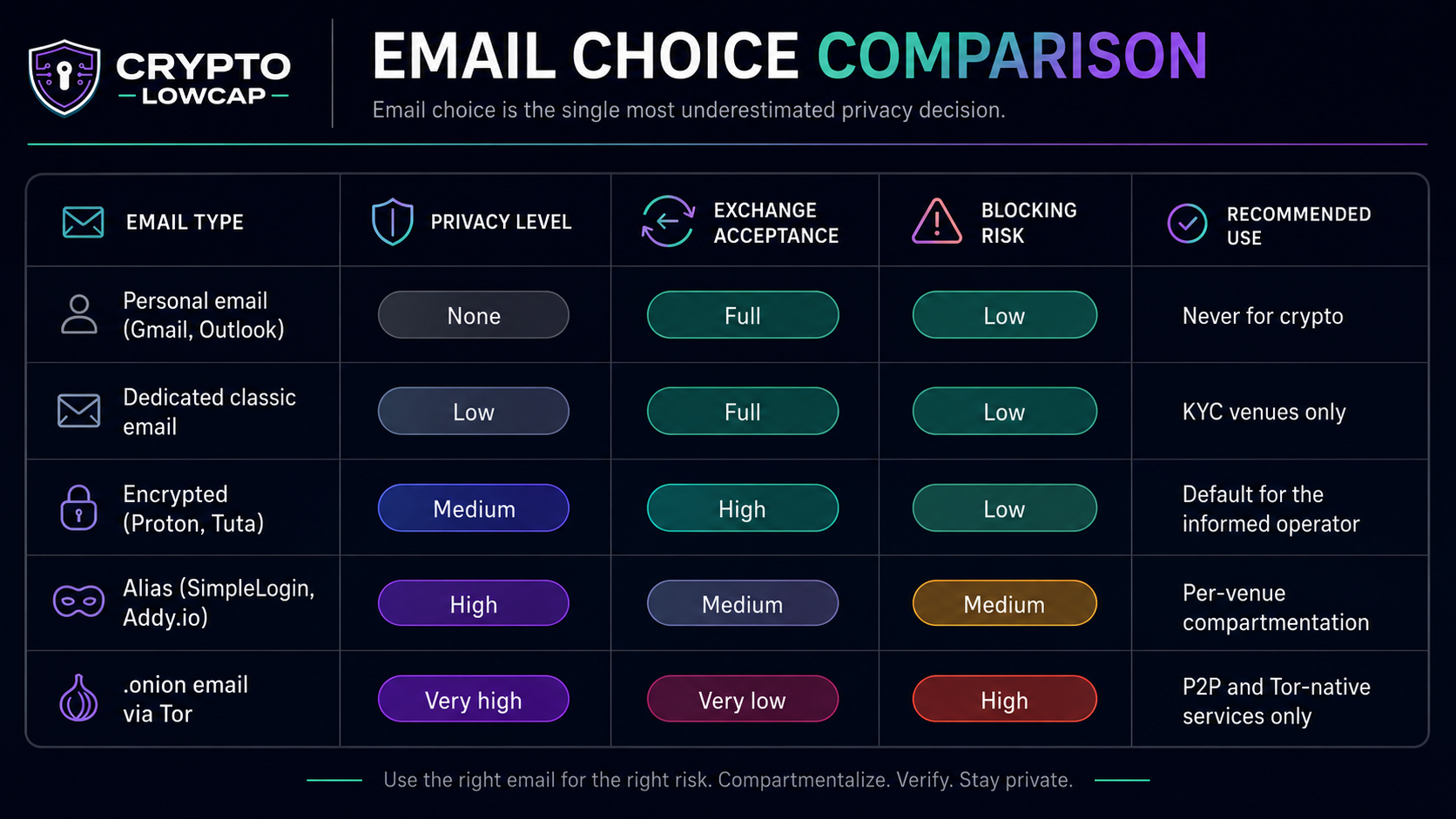
Of these four planes, the most underappreciated is the email plane. The same Gmail address used to register at Kraken, to log into a DeFi frontend, and to receive an NFT airdrop newsletter is a permanent correlator across every event in the user’s crypto life. Email reuse is the single most common operational failure I see when reviewing the setups of new readers. Chainalysis explicitly states in its own documentation that cross-referencing timestamps, address behaviors, transaction patterns, email addresses, and IP logs allows investigators to reveal hidden connections between activities.
5. The risks of total financial traceability for the individual
Notably, surveillance is not an abstract debate. It has concrete consequences for the users I correspond with. The regulatory rhetoric focuses exclusively on the state’s needs and largely ignores the costs imposed on citizens.
First, patrimonial doxxing. Address transparency turns wealth into public information. A wallet revealed once on social media or in a Discord screenshot becomes a permanent target for harassment, ransom demands, and increasingly, physical attacks. France has documented a surge in so-called wrench attacks — kidnappings of identified crypto holders — since 2023.
Moreover, targeted phishing is now highly personalized. Knowing exactly which protocols you use and how much you hold lets attackers build tailored social-engineering campaigns, frequently augmented by AI-generated voice and video, that bypass generic spam filters.
Furthermore, silent debanking represents a systemic risk. A risk score that crosses a threshold leads to account closures with no explanation and no recourse. Banks and venues simply offboard the user. The funds, if not seized, become very difficult to deploy.
Finally, price discrimination is an emerging concern. On-chain wealth signals are starting to be used in commercial pricing, insurance underwriting, and even loan terms, in jurisdictions where data brokers can lawfully access the analytics graph.
In summary, none of these risks require the user to have done anything illegal. They require only that the user be visible. That is the asymmetry the modern privacy debate has to address.
6. The blockchain privacy regulatory frontier in May 2026
If 2016 was the year of regulatory fog, 2026 is the year of regulatory contact. The frameworks are no longer drafts — they are in force, being interpreted by courts, and the operational practices of every regulated venue are being rewritten in real time.
MiCA and the article 76(3) line
The EU Markets in Crypto-Assets regulation harmonized rules across the 27 member states. Article 76(3) prohibits regulated trading venues from admitting to trading any crypto-asset with built-in anonymization features, unless the venue can identify holders. The operational interpretation by most large European venues since 2024 has been precautionary delisting of Monero and similar default-private assets. Projects with selective disclosure mechanisms — Zcash and Salvium chief among them — are arguing for a different treatment, and the outcome of that argument will reshape the listing map of the entire privacy sector across 2026 and 2027.
The Transfer of Funds Regulation
Similarly, the Transfer of Funds Regulation — often called the European Travel Rule — imposes that every crypto transfer between regulated venues carries the identity of sender and receiver, with no minimum threshold. Withdrawals above €1,000 to a self-hosted address trigger ownership verification, and in practice many venues now apply this verification at any threshold. That era of casual cold-wallet transfers is now definitively over.
The United States after the Storm verdict
Across the Atlantic, the August 2025 partial verdict in the Tornado Cash Storm case clarified that writing privacy-protecting code is not, by itself, criminal money transmission. This ruling was narrow, however, and it did not absolve operators of sanctions exposure. Both the SEC and CFTC have continued to classify several major privacy-relevant assets as commodities rather than securities, which simplifies investor exposure but tightens market-manipulation surveillance.
The window between Storm and AMLR
In conclusion, my personal reading — stated as opinion, not fact — is that we are inside a strategic window that closes in July 2027 when the EU Anti-Money Laundering Regulation enters full application. Between now and then, the regulatory positions of individual member states on privacy coins, ZK-selective-disclosure, and self-hosted wallets are still in flux. The operator who positions their stack now, with the right tools and the right documentation, will have a much smaller adjustment cost when the window closes.
7. The Workshop: privacy coins of the new generation
I used to believe, around 2017 and 2018, that the privacy coin debate would resolve into a single dominant chain. I no longer believe that. The 2026 landscape has fragmented into at least three distinct philosophies, and I want to treat them honestly rather than pretend one of them is obviously right.
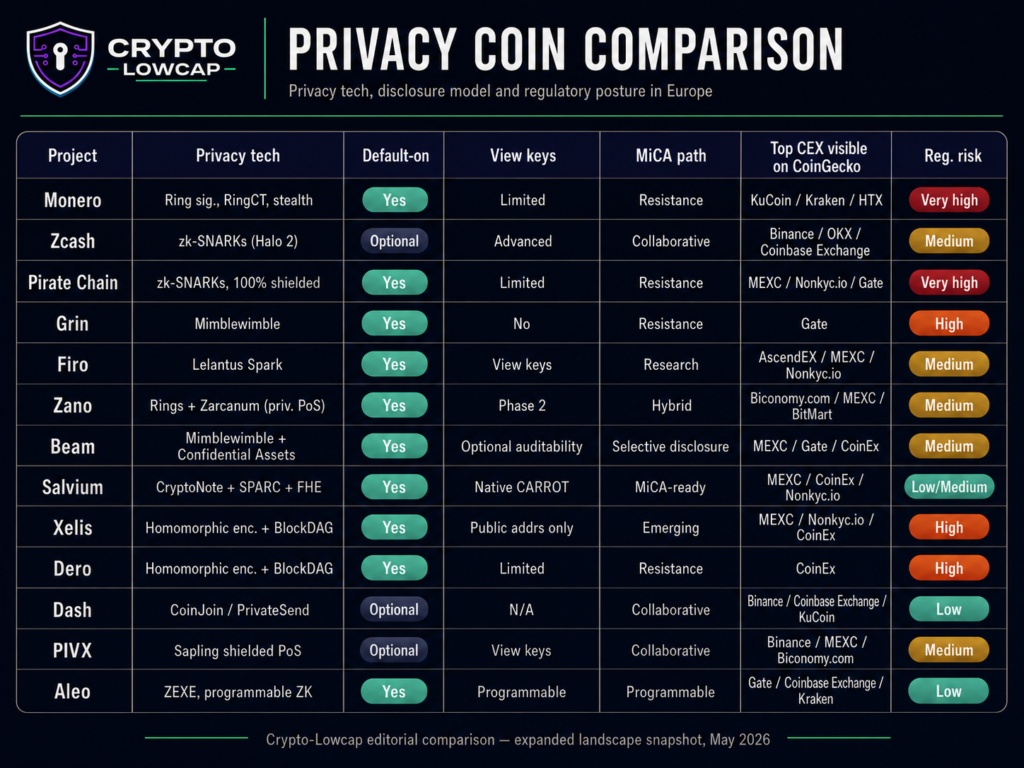
Monero (XMR): the community fortress
Indeed, Monero remains the gold standard for default-on privacy. Ring signatures, RingCT confidential amounts, stealth addresses — all mandatory, all the time. The result is the largest practical anonymity set in the market and a degree of fungibility that no optional-privacy chain can match. The upcoming FCMP++ activation — validated on testnet — will materially improve resistance against ring-signature heuristics. That is the strong case.
However, the honest counterweight is that Monero has been delisted from most major European regulated venues. Its liquidity has shifted to peer-to-peer venues like Haveno and RetoSwap, where February 2025 monthly volumes hovered around two million dollars. The investor who buys XMR today is buying a thesis that the cypherpunk rails will keep functioning at the margins of the regulated system.
Zcash (ZEC): the institutional arbitrage
In contrast, Zcash chose the opposite path: optional shielding via zk-SNARKs with selective disclosure through view keys. In 2026, roughly thirty percent of the supply is held in shielded pools, a number that has crept up steadily as wallet UX has improved. The view key mechanism is the central feature for the institutional pitch: a regulated counterparty, an auditor, or a tax authority can be granted one-way visibility into a specific scope without exposing the rest of the wallet. The weakness is that an optional-privacy chain has a smaller effective anonymity set than a default-private one, and the bridge between transparent and shielded pools remains a known vector of analysis.
Salvium (SAL): the MiCA-native bet
For its part, Salvium is the most ambitious attempt I have seen to build a privacy coin natively engineered for MiCA. The combination of CARROT for deposit attribution and SPARC for spend authority proof allows a regulated venue to identify its customers without exposing the on-chain transactions of those customers to the public. The February 2026 independent legal opinion from Gunnercooke confirming MiCA compatibility is a real document, though not yet stress-tested in court. For a detailed project breakdown, see our earlier analysis of Salvium alongside Xelis and Nonos.
Risks are equally real here. While the team is identified — a regulatory advantage but a centralization vector — throughput claims around the underlying Zama FHE technology remain declared rather than measured in production. Additionally, the CEX listing pipeline announced for 2025 has not yet translated into the broad listings the project was banking on. Salvium is the project I find most intellectually interesting in this cycle, and the one I would urge readers to evaluate with the most discipline.
Zano (ZANO): confidential proof-of-stake
Similarly, Zano solved a genuinely hard cryptographic problem with Zarcanum, the confidential proof-of-stake mechanism that lets users participate in consensus and earn rewards without revealing stake amounts. That is a real engineering advantage, not a marketing claim. The phase 2 view key roadmap adds selective auditability. The weakness is liquidity and adoption — classic lowcap constraints that the team has not yet broken through. Like Salvium, Zano sits in a zone of high technical ambition and limited market penetration.
Firo, Aleo, Iron Fish, Beam, and the wider field
In addition, the rest of the field deserves mention because the reductive narrative that there are only two or three privacy projects is wrong. Firo’s Lelantus Spark is a genuinely innovative anonymous payment system. Aleo’s programmable privacy via ZEXE opens a smart-contract surface that Monero and Zcash do not have — and Aleo has actual CEX availability in Europe, which gives it a practical advantage at this moment. Iron Fish brings institutional-grade tooling around Sapling zk-SNARKs. Beam continues to refine Mimblewimble with optional audit keys. None of these are Tier 1 in my conviction framework, but several deserve serious analytical attention as the regulatory landscape continues to shift.
8. Privacy compliant: real promise or marketing oxymoron?
The phrase privacy compliant raises eyebrows in cypherpunk circles, and rightly so. The fear is that any backdoor for the regulator becomes an exploitable vulnerability for an attacker or an authoritarian state. I take that fear seriously, and I share part of it. However, the binary framing is wrong.
There is a meaningful difference between a hardcoded master view key controlled by a single entity and a selective disclosure mechanism where the user — and only the user — chooses to share a scoped view key with a specific counterparty. In practice, one is a backdoor. The other is a delegation. A hardcoded master key is a single point of catastrophic failure. By contrast, the delegation approach is a tool that respects user agency and can be refused. Zcash and Salvium implement variants of the second model. Whether the regulators of 2027 and beyond will accept that distinction is the open political question of the next two years.
Beyond selective disclosure, fully Homomorphic Encryption, championed by Zama and reflected in protocols like Salvium, adds another dimension. zama.ai” target=”_blank” rel=”noopener noreferrer”>Zama and reflected in protocols like Salvium, adds another dimension. Its promise is computation on encrypted data without decryption — which in principle reconciles confidentiality with compliance. However, production-grade FHE throughput in 2026 remains a declared metric rather than a battle-tested benchmark — an honest caveat. Underlying technology is real. Marketing is simply ahead of deployment at this stage. I will revise that assessment the moment Zama publishes independent stress tests under sustained load.
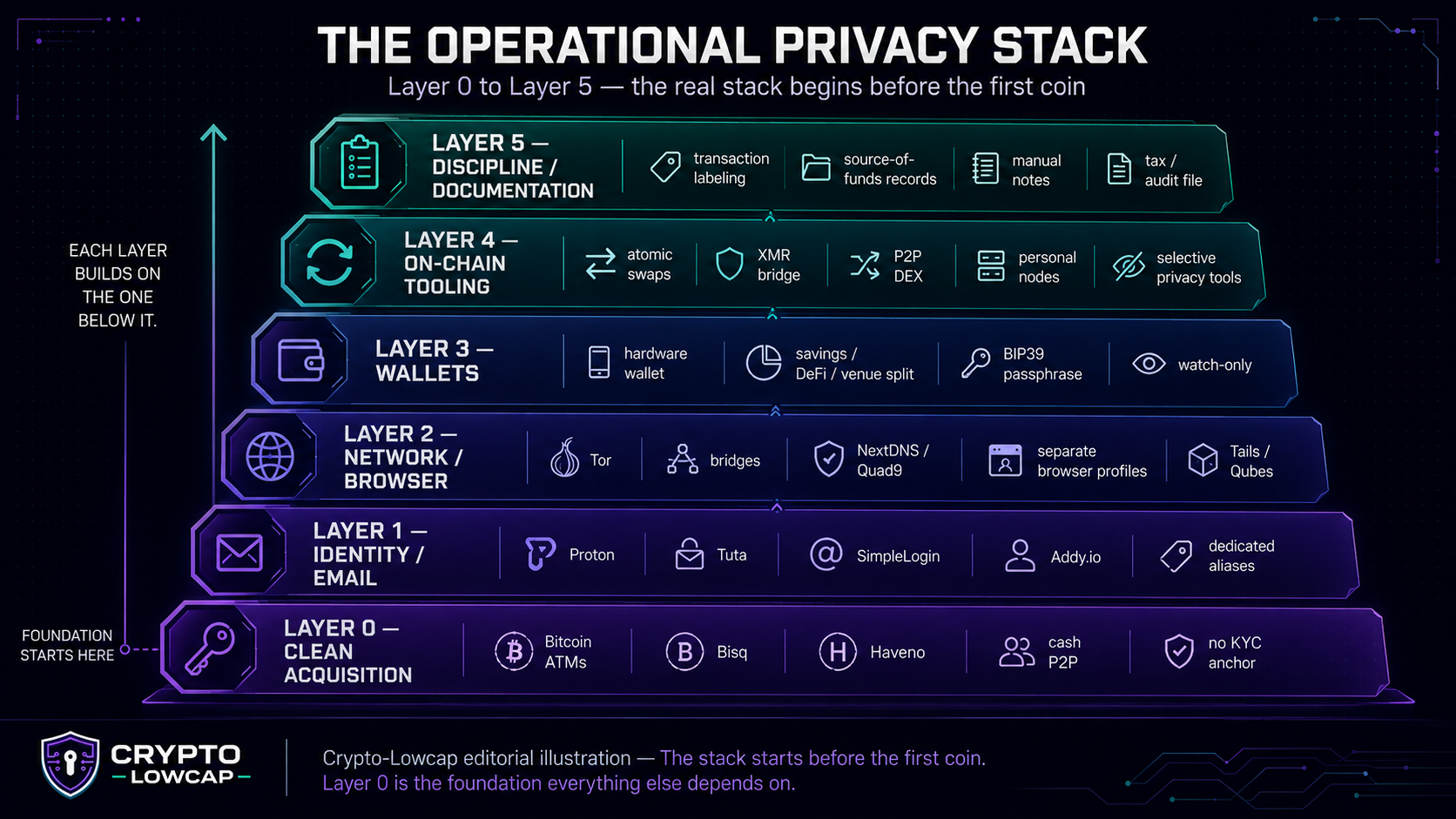
9. The operational privacy stack in 2026
Too many financial privacy blockchain 2026 guides end with a vague injunction to use Tor and a privacy coin. That is not a stack. A stack has layers, and each layer addresses a different threat. I have ordered them from the most foundational to the most advanced. This version adds a Layer 0 that was missing from most analyses I have read: how to enter the system in the first place without immediately becoming a KYC anchor.
Layer 0: entering the system — the first clean acquisition
This is the layer every operational privacy guide glosses over, and it is the one that actually determines whether the rest of your stack is built on solid ground or on sand. If your first purchase of BTC or XMR was through a KYC exchange tied to your civil identity, you already have an identity anchor in the analytics graph. Everything downstream of that anchor is at best compartmentalized pseudonymity, not clean acquisition.
Specifically, there are three realistic paths to a first clean acquisition in 2026, each with its own risk and friction profile.
Bitcoin ATMs with low thresholds
First, several networks still operate without identity requirements below certain transaction amounts, which vary by country and operator. The friction is geographic, and the fees are punishing — often five to ten percent above spot. However, for a first small acquisition, the privacy premium is real. The important discipline: never reuse the same ATM twice in a short window, and move the acquired coins to a clean wallet before any other activity.
P2P venues without central custody
Bisq and its next-generation successor Haveno — the most robust examples — allow trades directly between counterparties using on-chain escrow, with no central operator to subpoena. The onboarding friction is significant for a first-time user: Bisq requires a security deposit, a local Tor installation, and patience. Haveno, built on Monero’s native privacy, adds the additional layer that the coins received are already private by default.
Cash-based local trades
Finally, the oldest method in the space remains viable in dense urban areas where local crypto communities are active. This method requires the highest trust calibration between counterparties and carries the most physical-world risk, but it leaves the smallest possible digital trace. The broader point: without a clean first acquisition, every privacy layer above it is damage limitation, not genuine compartmentation.
On anonymous prepaid cards and SEPA: the fiat last mile
Additionally, cash-loaded prepaid cards (the Paysafecard model, or over-the-counter card codes available through retail networks) provide a genuine untraceable payment mechanism for services that accept them, including certain VPN providers and domain registrars. Crypto-linked debit cards from non-KYC or light-KYC issuers have largely disappeared from the European market after MiCA and the 5th AML Directive. The concept of the “last mile fiat” problem — converting crypto back to spendable fiat without triggering a financial intelligence report — is real and structurally unsolved for large amounts. For smaller amounts, cash-out via P2P or via regulated venues with documented source-of-funds is the cleanest path.
Layer 1: identity and email
For layer 1, per-venue dedicated emails, ideally encrypted (Proton, Tuta) and combined with alias services like SimpleLogin or Addy.io for full compartmentation. Strip metadata from every document submitted to a KYC venue. Never reuse a Gmail address that was used for anything else in your life. Consider owning a personal domain and creating purpose-specific aliases — this increases exchange acceptance while preserving compartmentation. This single discipline eliminates roughly seventy percent of the cross-correlation surface that off-chain analytics depends on.
Layer 2: network and browser
For network security, Tor is essential for sensitive interactions, with bridges if the threat model requires concealing Tor usage from the ISP. Encrypted DNS (DoH or DoT) via NextDNS or Quad9 to prevent ISP-level domain logging. Compartmentalized browser profiles — separate instances for CEX, DeFi, and general browsing — prevent cookie and fingerprint merging. For the most exposed operations, a live OS like Tails or a compartmentalized one like Qubes OS leaves no persistent trace on the local disk. A standalone VPN, by itself, is not a privacy layer in 2026. It is a single-hop routing change that an analytics vendor sees through in seconds when correlated with on-chain timing.
Layer 3: wallets and compartmentation
For wallets, the non-negotiable rule is this: KYC funds and non-KYC funds never share a wallet. The minimum setup is a savings wallet (cold, ideally hardware with BIP39 passphrase), a DeFi wallet for active protocols, and a venue wallet for CEX interactions. Watch-only wallets let you monitor balances without exposing private keys on any internet-facing device. The BIP39 passphrase functions as a coercion-resistant duress wallet by allowing a decoy. Multisig setups add a layer of protection for significant holdings.
Layer 4: on-chain tooling and venues
On-chain, native atomic swaps between BTC and XMR break custodial trust assumptions and reset the analytics graph for the receiving side. P2P venues like Bisq and Haveno operate without central servers and are the principal off-ramp option when fiat-via-CEX is undesirable. Lelantus Spark on Firo provides a true anonymous send that erases transaction history at the protocol level. For example, a note on instant swap services like Godex or ChangeNOW: they present themselves as no-KYC, but have been known to apply surprise verification on larger amounts. Do not treat them as equivalent to a P2P atomic swap.
Layer 5: operational discipline and documentation
This is the layer almost everyone underestimates. Specifically, transaction labeling, source-of-funds documentation, manual annotation of every meaningful movement — these are what allow a user to justify their position to a bank, an auditor, or a tax authority when the moment comes. Privacy is not the same as having nothing to show. A serious operator can be both private and instantly justifiable. That combination is the real goal.
One concrete discipline worth internalizing: before any significant deposit to a regulated venue, run your source address through a publicly available risk-scoring check. Knowing your address is clean before it touches a KYC venue is far better than discovering a risk flag after the fact.
10. The five gradations of privacy strategy
Given this complexity, no two operators face the same threat model, and there is no honest one-size-fits-all answer. I have found it useful to think about five tiers, each corresponding to a profile and a level of operational discipline. The tier is not a value judgment. A serious investor who values regulatory comfort may rationally sit at Tier 2 and never go further. A journalist working on cartel finance may need Tier 5 by next Wednesday.
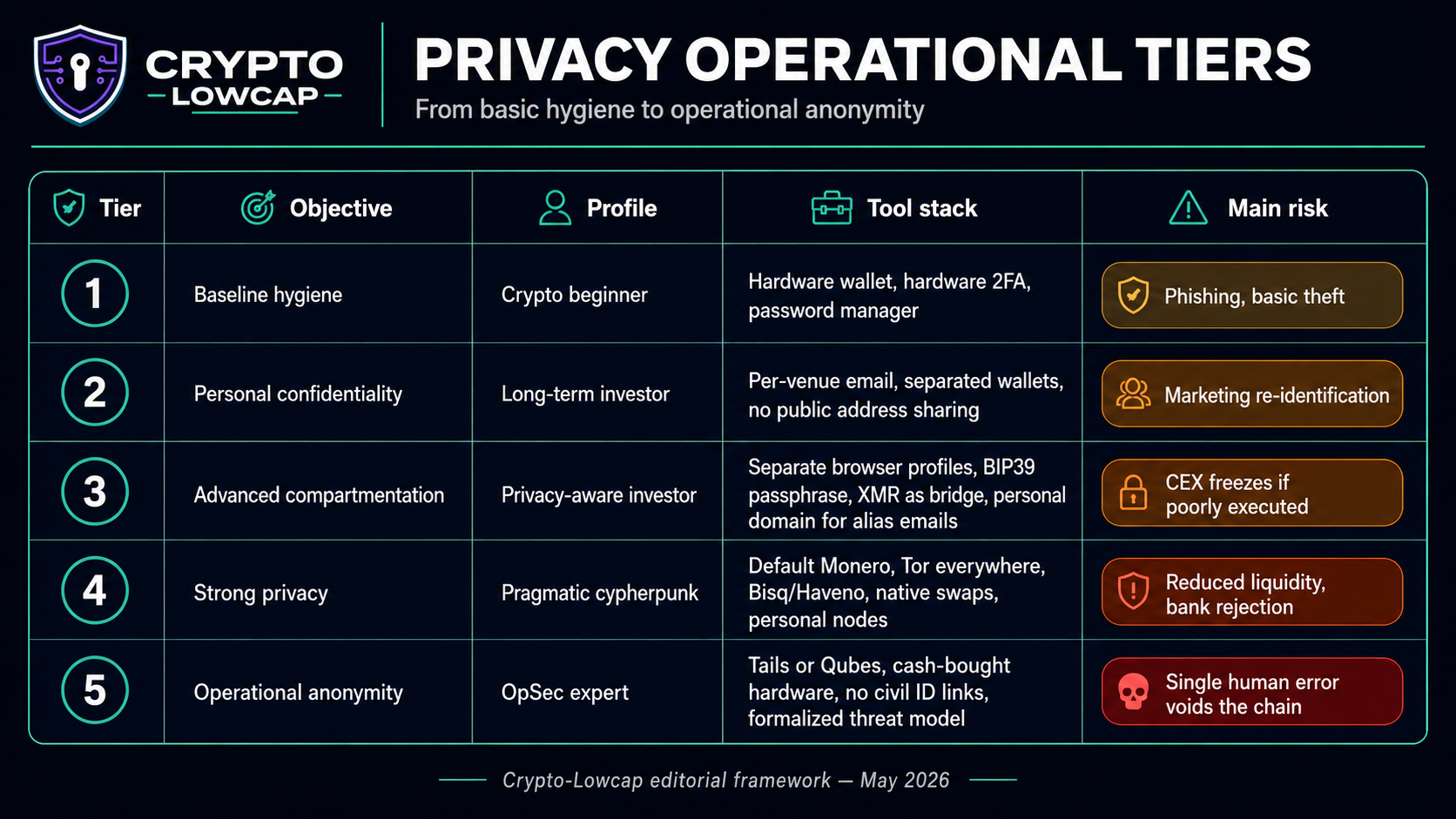
Recommended checklists for Tier 2–3 migration
Email & identity
- Dedicated encrypted email (Proton/Tuta) per major platform
- Alias service (SimpleLogin/Addy.io) for remaining signups
- Encrypted DNS (NextDNS/Quad9) configured on all devices
- Metadata stripped from all KYC documents before submission
Wallets & compartmentation
- Separate hardware seeds for KYC and non-KYC funds
- BIP39 passphrase activated, stored separately from seed
- Watch-only wallet for daily balance monitoring
- Transaction labeling and source-of-funds log maintained
Pre-exchange
- Source address risk-scored before deposit to any CEX
- Origin-of-funds documentation prepared and accessible
11. Risks, false beliefs, and the limits of every solution
Importantly, this is the section that separates a serious analysis from a piece of crypto marketing. Every tool described above has limits. Every solution carries costs. Let me be explicit about the most dangerous false beliefs I encounter in this space.
Common false beliefs about blockchain privacy tools
A VPN is not anonymity. A VPN replaces your ISP with the VPN provider. VPN usage does not hide on-chain activity. Moreover, it does not defeat browser fingerprinting. At best, a VPN is a useful single layer, not a comprehensive solution.
Additionally, a non-custodial wallet is not anonymous. It is pseudonymous. The distinction is the entire point of this article.
Furthermore, non-KYC centralized exchanges are not safe. A platform without KYC does not eliminate risk — it shifts it. The exchange can apply surprise verification on larger amounts. It can disappear overnight. The category has shrunk significantly between 2024 and 2026 and will keep shrinking.
Moreover, a privacy coin is not legal immunity. Using it to evade tax or sanctions is a crime regardless of how good the cryptography is.
Finally, total anonymity is a fiction. Given enough resources and time, almost everything can be correlated. The realistic goal is reduction of traceability and preservation of justification capacity, not vanishing.
Case pattern observed more than once
A DeFi wallet linked to an ENS public address was used to consolidate funds before a CEX deposit. The ENS name had been mentioned in a Discord server three months earlier. The clustering model linked the address back to the Discord handle within minutes. Six months of careful wallet hygiene were undone by one post. The chain is only as strong as its weakest moment of fatigue.
Moreover, there is the most insidious failure mode: the single human error. A single reused address. An impulsive late-night transfer to a personal bank account from a wallet that was supposed to stay separate. A screenshot with metadata not stripped. The mental discipline matters as much as the cryptography.
12. Four scenarios for privacy in crypto, 2026 to 2030
Honestly, I will not pretend to predict the next five years. However, four scenarios strike me as the most plausible, and I will indicate the signal that would tell us which one is materializing.
Scenario A: normalized surveillance
On-chain analytics, augmented by AI agents, becomes accurate enough to cover ninety-nine percent of retail users. Privacy retreats into a peer-to-peer niche. The signal to watch is the generalization of CBDCs combined with the disappearance of cash thresholds. Probability: moderate to high.
Scenario B: compliant privacy mainstreaming
Selective-disclosure tokens (ZEC, SAL, programmable ZK chains) become the regulated standard. Privacy is protected by law with regulator access via view keys. The signal is mass listing of compliant privacy assets on tier-one European venues. Probability: moderate — this is my central scenario for the EU.
Scenario C: cypherpunk resurgence
Decentralized off-ramps (Haveno, atomic swaps) mature into usable mainstream alternatives. A parallel privacy economy thrives at the edge of the regulated system. The signal is sustained P2P volume growth into the tens of millions monthly. Probability: low to moderate, with significant regional variation.
Scenario D: aggressive criminalization
Use of Monero or any default-private chain is treated as prima facie criminal across the OECD. Privacy users migrate to riskier offshore jurisdictions. The signal is OFAC-style sanctions against individual privacy protocol developers. Probability: low in the EU, moderate in the United States, varies elsewhere.
Therefore, my base case is a hybrid of B and a softer version of A. In the EU, the regulated mainstream will normalize compliant privacy via view keys. Meanwhile, default-private chains will survive at the cypherpunk margin, with reduced liquidity but intact philosophy. For investors, positioning today should be barbell: exposure to compliant-privacy infrastructure on one side, smaller positioning in the resistant default-private leader on the other.
13. Recommendations by user profile
The cautious long-term investor
For this profile, the priority is securing capital and avoiding patrimonial doxxing. Hardware wallet with BIP39 passphrase, dedicated encrypted email per major venue, rigorous tax documentation. Privacy coin allocation is optional and should not exceed a small percentage of the book. The bank relationship must remain clean.
The privacy-aware investor
In this case, the priority is reducing profiling and preserving an intimate zone. Strict wallet compartmentation is essential. Monero serves as a pragmatic bridge between KYC fiat in and clean wallets out, with full documentation of the path. Selective use of view-key chains for portfolio positions is also recommended.
The pragmatic cypherpunk
Here, the priority is technical independence and refusal of mass surveillance. Tor by default, peer-to-peer DEXs as the primary venue, personal nodes for major chains, atomic swaps as the standard rebalancing tool. CEX usage is limited to a small clearly-justified fiat conduit. Acceptance of reduced liquidity is a deliberate cost.
The regulated investor and the compliance professional
For these users, the priority is protecting business secrets while remaining auditable. Selective-disclosure chains like Zcash and Salvium are preferable. View key delegation to auditors, strict adherence to the Travel Rule, and careful documentation are essential. Moreover, the privacy here is between the institution and its competitors, not between the institution and its regulator.
14. Verdict: a window that is closing, and a discipline that endures
Let me return to where I started. In the financial privacy blockchain 2026 era, casual pseudonymity is over. The era of total opacity was never available to legitimate users in the first place. What remains is the era of deliberate operational privacy, where every layer is chosen, every interaction is conscious, and every counterparty is mapped.
Therefore, that is, in a way, a return to the original cypherpunk discipline. Privacy was never supposed to be a free property of the system. It was supposed to be a chosen practice of the user, supported by cryptography and protected by code. The 2026 environment — with its analytics, its regulations, and its choke points — has merely revealed how lazy our assumptions about financial privacy had become.
The investor of 2026 has to accept a dual reality. Financial confidentiality remains a right. However, exercising that right now requires a level of competence, discipline, and compartmentation that most of the market will not pay. That asymmetry is, paradoxically, what makes privacy a serious investment thesis again — not as a moral position, but as a structural property of a market where the cost of protection is rising faster than the willingness to pay for it. For historical context on how we arrived here, see our decade-long retrospective on privacy coins.
Coming next: The Anonymous Crypto Stack (2026 edition)
This article has mapped the threat landscape and outlined the principles of a serious privacy stack. What it has deliberately not done is hand you a step-by-step operational playbook. That playbook is the subject of the next piece in this series.
The Anonymous Crypto Stack will cover — with the level of procedural detail this article intentionally omitted — how to acquire BTC and XMR without a KYC anchor in 2026, the fiat interface on both sides, and the full Layer 0-to-5 stack in executable form, with tool versions, configuration notes, and the failure modes I have personally observed. The goal is not to produce a guide for evading legal obligations. It is to produce the guide that a serious, law-abiding operator who believes in financial privacy deserves to have.
Subscribe to the newsletter or follow @CryptoRowenta01 on X to be notified when it publishes. [INTERNAL LINK: The Anonymous Crypto Stack — coming soon]
This article was produced independently by Pierre (Rowenta01) for crypto-lowcap.com. No project mentioned has paid for coverage or influenced editorial direction. The information contained here is purely informational and does not constitute financial advice.
crypto-lowcap.com | Revealing Privacy. Defending Sovereignty. | @CryptoRowenta01