DragonX (DRGX): The Most Advanced Privacy Protocol You’ve Never Heard Of
ANALYSIS & DEEP DIVE | May 2026 | crypto-lowcap.com
zk-SNARKs by default, custom RandomX, Sietch metadata obfuscation, and a 21M supply — A technical masterpiece with a $210,000 market cap.
By Rowenta01 | crypto-lowcap.com | @CryptoRowenta01
#DragonX #DRGX #privacy #zk-SNARKs #Sietch #RandomX #lowcap #privacycoins
⚠ Important disclaimer: This analysis is purely informational and reflects my independent opinion as an editor and researcher. Nothing written here constitutes financial advice. DragonX represents an extreme high-risk, highly speculative micro-cap asset. It could go to zero. Always do your own research.
zk-SNARKs by default, custom RandomX, Sietch metadata obfuscation, and a 21M supply. A technical masterpiece with a $210,000 market cap, almost non-existent trading volume, MiCA standing squarely in its way, and a communication strategy so minimal it borders on self-sabotage.
I’ve been covering privacy coins since 2016. I’ve analyzed Monero’s Ring Signature evolution, tracked the slow erosion of Zcash’s anonymity set, followed Pirate Chain through its maximalist positioning, and watched countless projects claim to be the next frontier in financial sovereignty. DragonX is different — not because it hypes itself, but precisely because it doesn’t.
This project lives on the edge of the crypto map. Its market cap barely exceeds $210,000. Its daily trading volume fluctuates between $95 and $236. It trades exclusively on Nonkyc.io, a no-KYC exchange the average DeFi user has never heard of. By any conventional investment metric, this is a micro-cap so extreme it borders on unlisted.
And yet, when you look at the technology underneath, DragonX may be the most cryptographically coherent privacy coin ever launched. That tension — between technical excellence and economic marginality — is what makes it worth a serious, honest analysis.
Disclaimer: this is not financial advice. A micro-cap can go to zero at any time. The thesis here is technical, not speculative. Manage your risk accordingly.
1. Origins: A Cypherpunk Experiment from the HUSH Ecosystem
DragonX is not a product of a venture-backed startup or a foundation. It was born from a frustration. Its creator, operating under a pseudonym in the crypto space since 2013, grew disillusioned with both Bitcoin maximalism and Monero’s community insularity. After nearly two years of research, he landed on HUSH as the technical foundation.
HUSH is a communication and transaction privacy blockchain that integrates Zcash’s zk-SNARK protocol for end-to-end encrypted messaging. From HUSH emerged the concept of Arrakis Chains, named after the fictional desert planet in Frank Herbert’s Dune universe. An Arrakis Chain is a sovereign, independent blockchain that inherits all of HUSH’s cryptographic infrastructure while giving its creators full control over emission, consensus parameters, and economic model. DragonX became the first live Hush Arrakis Chain (HAC), launched on November 5th 2022, with a genesis block mined to the minute, no pre-mine, no developer tax, no foundation allocation.
“If it fails, at least we’re not a scam.”
— DragonX creator, exclusive interview (December 2024)
That sentence encapsulates the ethos of this project better than any whitepaper paragraph. The philosophy is openly Bitcoinist in its launch approach and cypherpunk in its privacy stance. No seed round, no VC, no influencer partnerships. Just code, a genesis block, and a community.

2. Technology: Three Layers of Privacy, One Coherent System
Most privacy coins solve one piece of the puzzle: they hide transaction amounts, or sender addresses, or receiver addresses. DragonX attempts to solve all three simultaneously, and adds a fourth dimension that most projects overlook entirely: metadata obfuscation.
2.1 — zk-SNARKs by Default: The Zcash Architecture, Without Its Fatal Flaw
The core cryptographic foundation of DragonX comes from Zcash: Zero-Knowledge Succinct Non-Interactive Arguments of Knowledge (zk-SNARKs). This cryptographic primitive allows one party to prove to another that a transaction is valid without revealing any of its parameters, including sender address, receiver address, and amount.
Zcash pioneered this technology but made a critical strategic error: it kept transparent transactions (t-addresses) as the default. The result? Over 90% of Zcash transactions have historically been transparent, which reduced the anonymity set of shielded transactions to near zero. If you’re one of the few users sending shielded transactions, you’re conspicuous.
DragonX eliminates this problem by design. All standard peer-to-peer transactions are z-to-z (from shielded address to shielded address). Transparent addresses exist technically but are deliberately marginalized. Every single transaction flows through the shielded pool, which means the anonymity set is the entire network, not a fraction of it. This is the fundamental lesson Monero understood early: mandatory privacy is the only privacy that works.
Key distinction: DragonX takes Zcash’s superior cryptography (zk-SNARKs) and applies Monero’s superior philosophy (privacy by default). No other project combines both.
2.2 — Custom RandomX: CPU Mining Against ASIC Centralization
The consensus mechanism is Proof of Work, and the choice of algorithm is deliberate. DragonX uses a modified version of RandomX, the same algorithm developed by the Monero team and specifically engineered to be optimized for general-purpose CPUs rather than specialized hardware.
The modification is strategically important. DragonX’s RandomX variant uses 5 Argon2d iterations versus Monero’s 3, a custom salt, programs that are twice as long (512 versus 256), twice the number of VM executions (4096 versus 2048), and double the chained VM executions per hash (16 versus 8). These changes mean a hypothetical RandomX ASIC built for Monero would be entirely non-functional on DragonX.
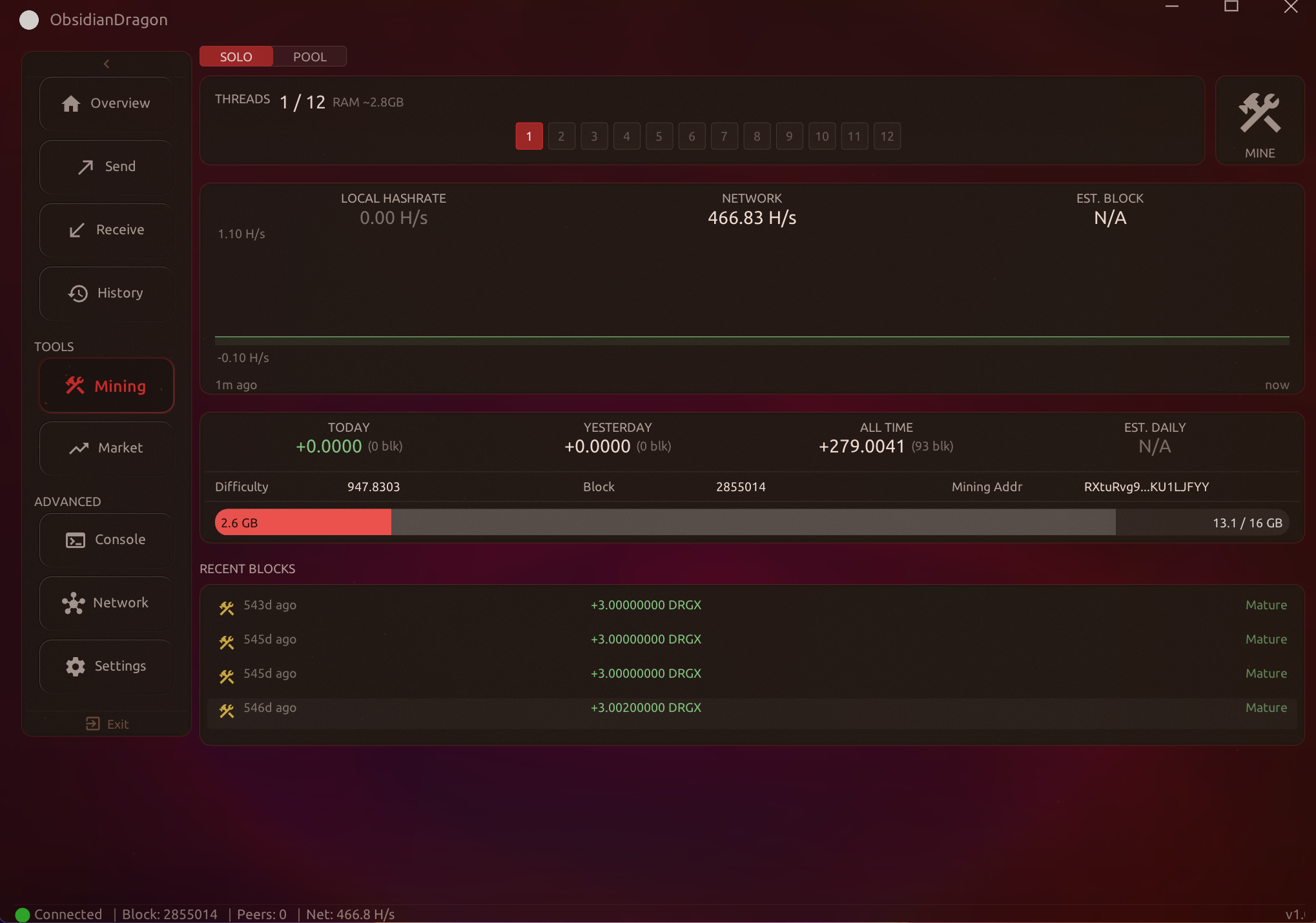
This creates an asymmetric early warning system: if someone invests in an ASIC for the cheaper standard RandomX flavor, it signals the algorithm is under commercial attack before anyone has the financial incentive to target DragonX’s more resource-intensive variant. CPU mining lowers the barrier to participation significantly. Anyone with a laptop can mine DRGX. The ObsidianDragon wallet integrates a one-click mining interface with sensible defaults.
Block parameters reinforce accessibility: 36-second block time, 4MB block size, 3 DRGX reward per block. The fast block time was initially designed to accelerate HushChat message delivery, though protocol improvements have since made this less critical.

2.3 — Sietch: The Innovation That Changes the Privacy Calculus
2.3 — Sietch: The Innovation That Changes the Privacy Calculus
This is where DragonX departs from every other privacy protocol currently in production.
Blockchain analytics firms — Chainalysis, Elliptic, and others — have developed attack methodologies that go beyond reading transaction data. The most sophisticated is the Intersection Tree Method (ITM), also called the Metaverse attack. It works by exploiting the deterministic behavior of wallets: the same wallet software, given the same inputs, always generates the same output structure. By analyzing the number of inputs and outputs across transactions over time, analysts can correlate behavior even when individual transactions appear opaque.
The HUSH ecosystem’s response is called Sietch, and DragonX has fully implemented it. Sietch operates at the RPC level within the hushd daemon, modifying the z_sendmany function to introduce mandatory non-determinism.
The mechanism is called the Rule of Seven: every transaction must produce a minimum of seven shielded outputs (zouts). For a standard z-to-z transaction, Sietch automatically generates up to six decoy outputs sent to additional addresses controlled by the sender’s wallet. These addresses are dynamically generated, and their private keys are never written to disk, neutralizing the attack vector of wallet file theft.
The combinatorial effect is mathematically brutal for analysts. To deanonymize a chain of just 10 transactions, an ITM analyst faces 7! = 5,040 possibilities at each node. Across 10 nodes, the search space reaches 5,040^10, approximately 10^36 permutations. No current supercomputer can brute-force this. The economics of surveillance collapse.
Sietch also applies encryption at the transport layer: all P2P traffic between DragonX nodes uses TLS 1.3 natively, preventing IP-level association of broadcasted transactions.
Honest tradeoff: Sietch is computationally expensive. Generating 7 shielded outputs per transaction takes several seconds on standard consumer hardware. It also inflates blockchain size faster than transaction volume alone would suggest. These are real costs that must be acknowledged.
3. Tokenomics: Bitcoin’s Scarcity, Without Bitcoin’s Liquidity
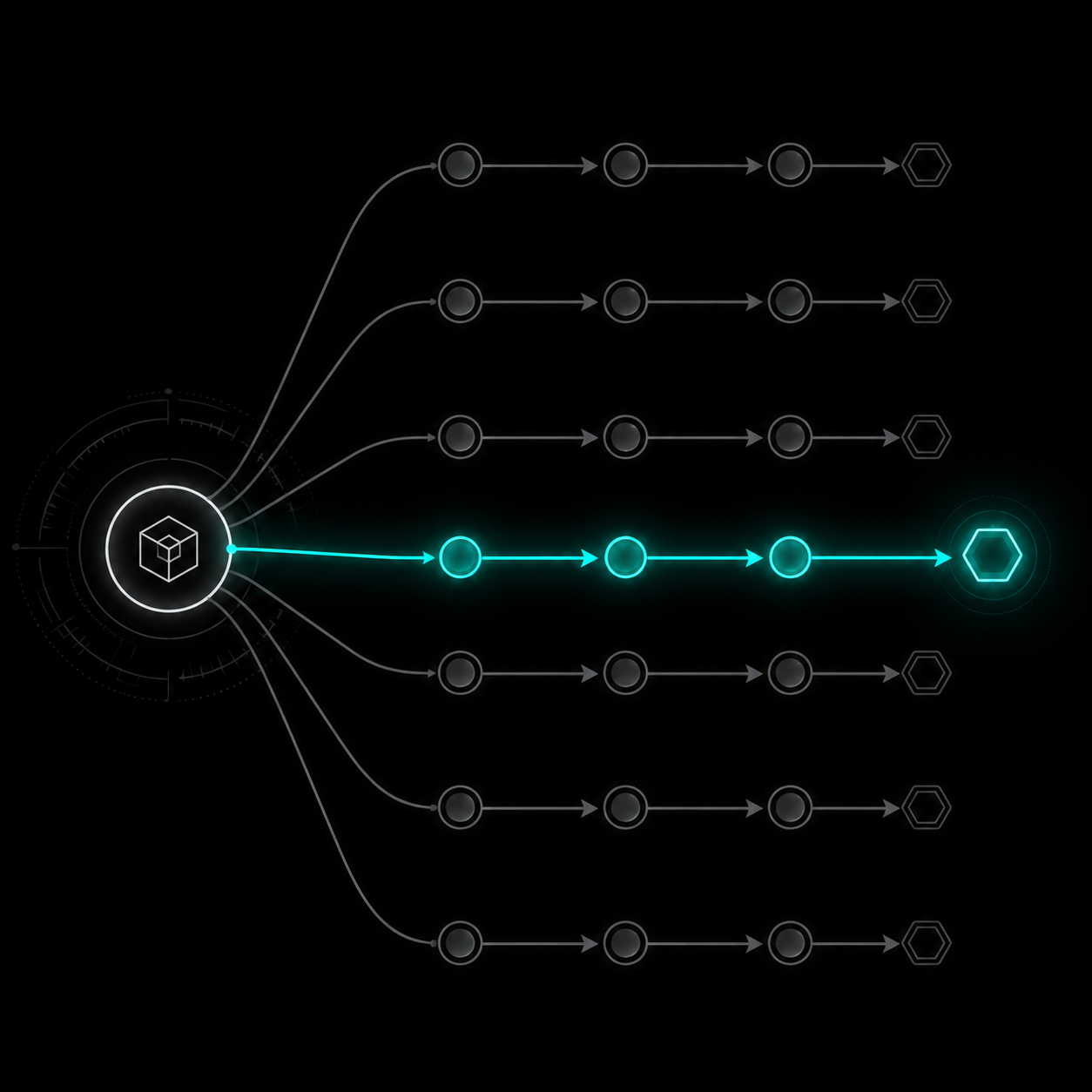
The economic model of DragonX is deliberately Spartan. There is nothing novel here, and that is a feature, not a bug. The emission curve mirrors Bitcoin’s with an accelerated schedule appropriate for the faster block time.
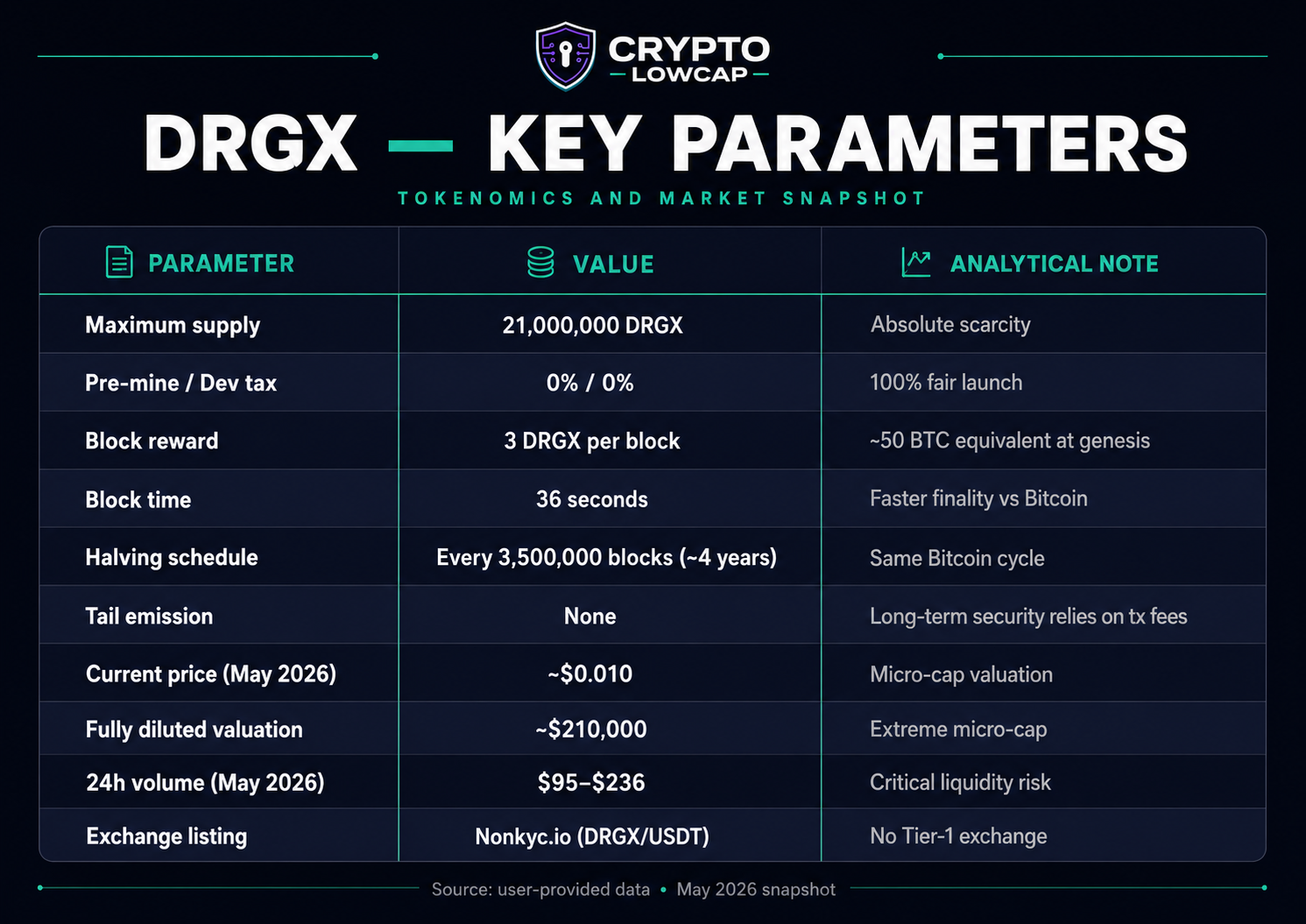
The absence of tail emission deserves specific attention. Unlike Monero, which maintains a perpetual 0.6 XMR block subsidy to guarantee a minimum security budget indefinitely, DragonX follows the Bitcoin model: once all 21 million DRGX are mined, miner revenue depends entirely on transaction fees. On a network with this level of transaction volume, this is a genuine long-term concern. The project’s bet is that utility will drive enough transaction density to sustain mining incentives. This is plausible but unproven.
4. Competitive Landscape: How DragonX Compares to Established Privacy Coins
To situate DragonX honestly, the comparison must be objective. The three benchmarks that matter for a privacy-focused fundamental analysis are: the cryptographic approach, the privacy enforcement model, and the metadata resistance.
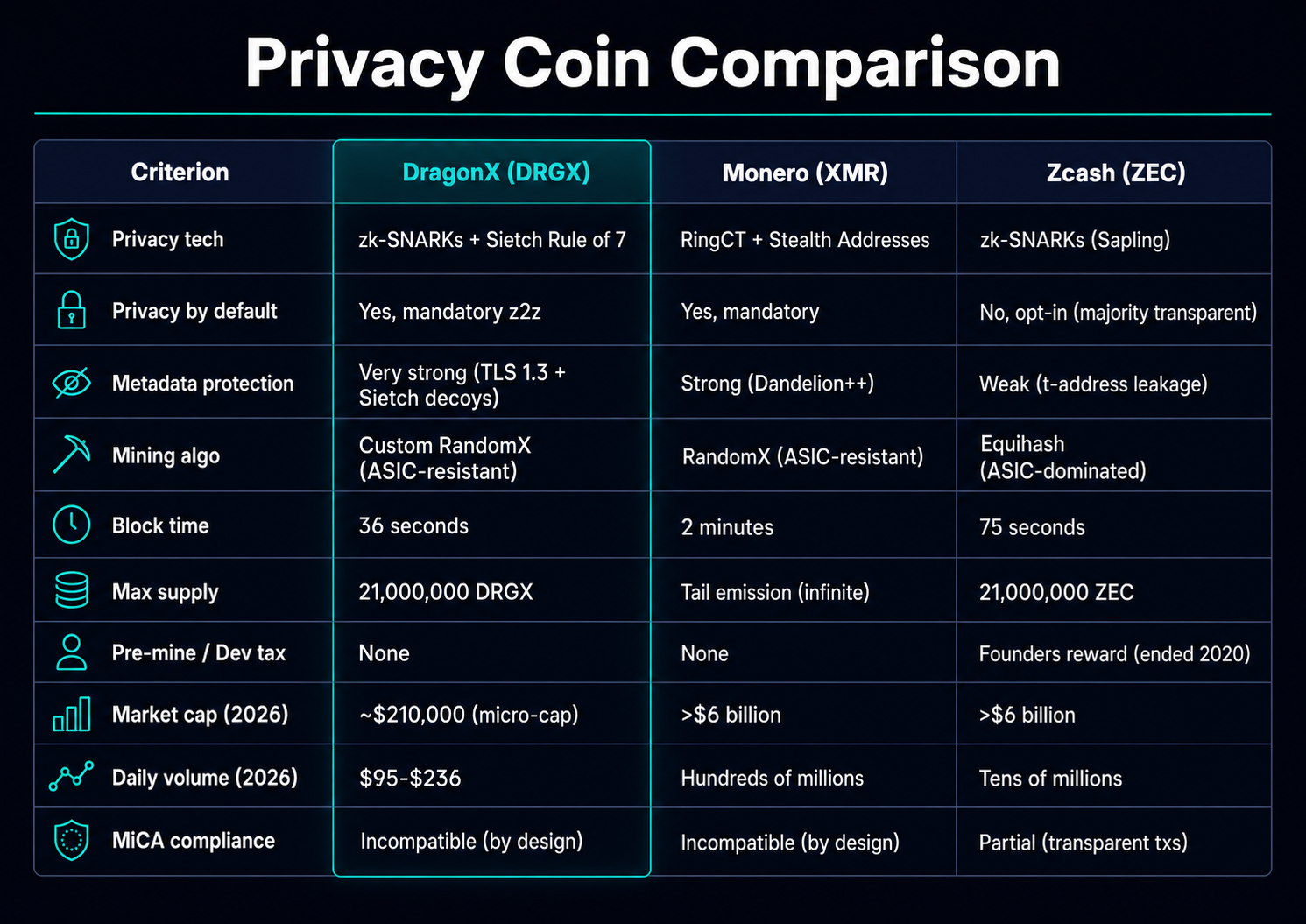
The verdict from a purely technical standpoint is clear: DragonX resolves what I call the Zcash-Monero paradox. Zcash built the most mathematically rigorous privacy architecture but failed in practice because optional privacy creates a toxic anonymity set dynamic. Monero understood the social dimension of privacy — it must be mandatory to be meaningful — but relies on Ring Signatures that are probabilistic rather than zero-knowledge, creating a different class of vulnerability.
DragonX takes the best from each side: Zcash’s zero-knowledge proofs applied with Monero’s mandatory enforcement, then amplifies the result with Sietch’s combinatorial metadata obfuscation. On paper, this is the most complete privacy stack in the market.
Commercially, the picture inverts entirely. Monero and Zcash have market caps above $6 billion each, deep liquidity, and ecosystem integrations. DragonX has $210,000 in fully diluted valuation and $100-200 in daily volume. Technical excellence does not automatically translate into market adoption.
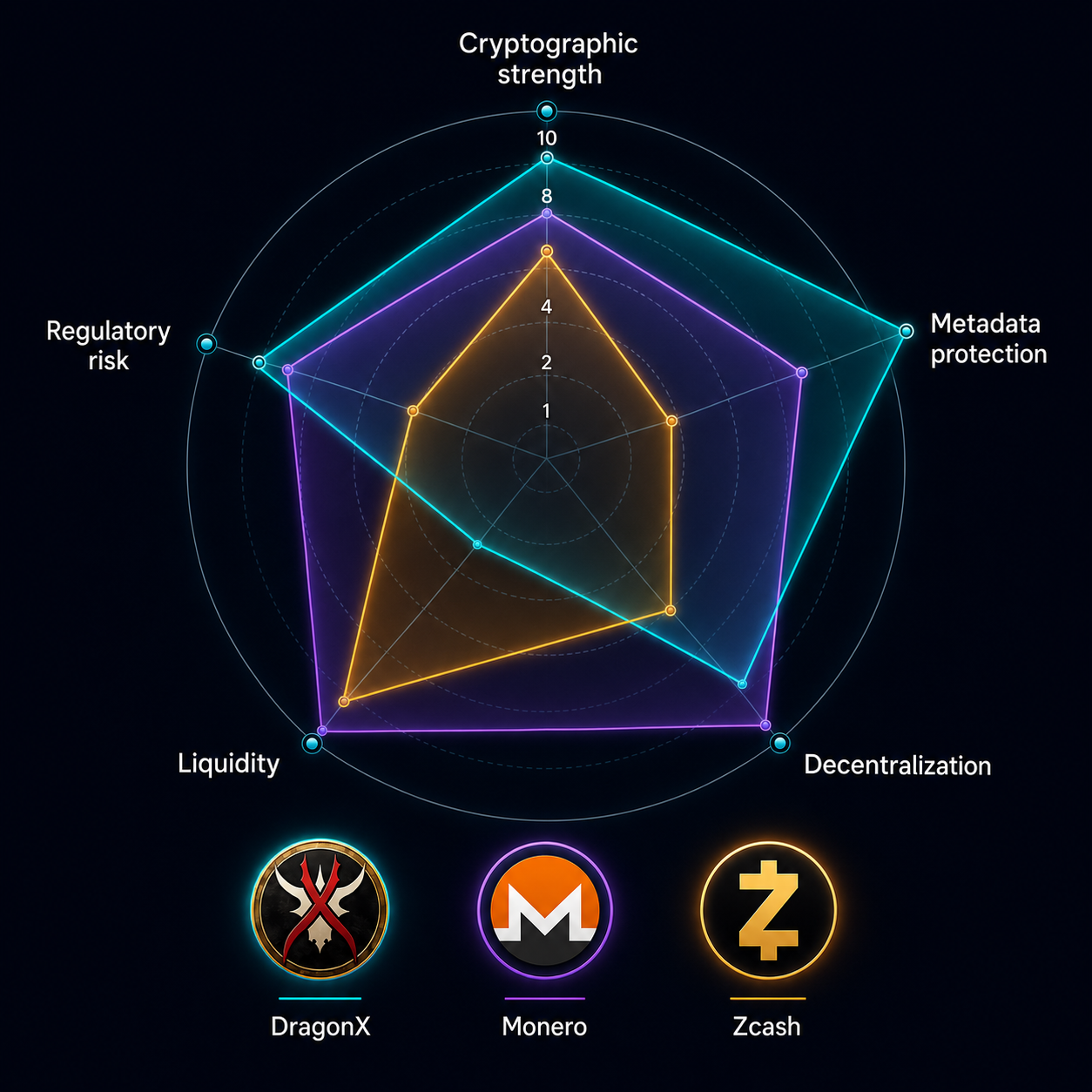
5. Risk Assessment: A Candid Look at What Can Go Wrong
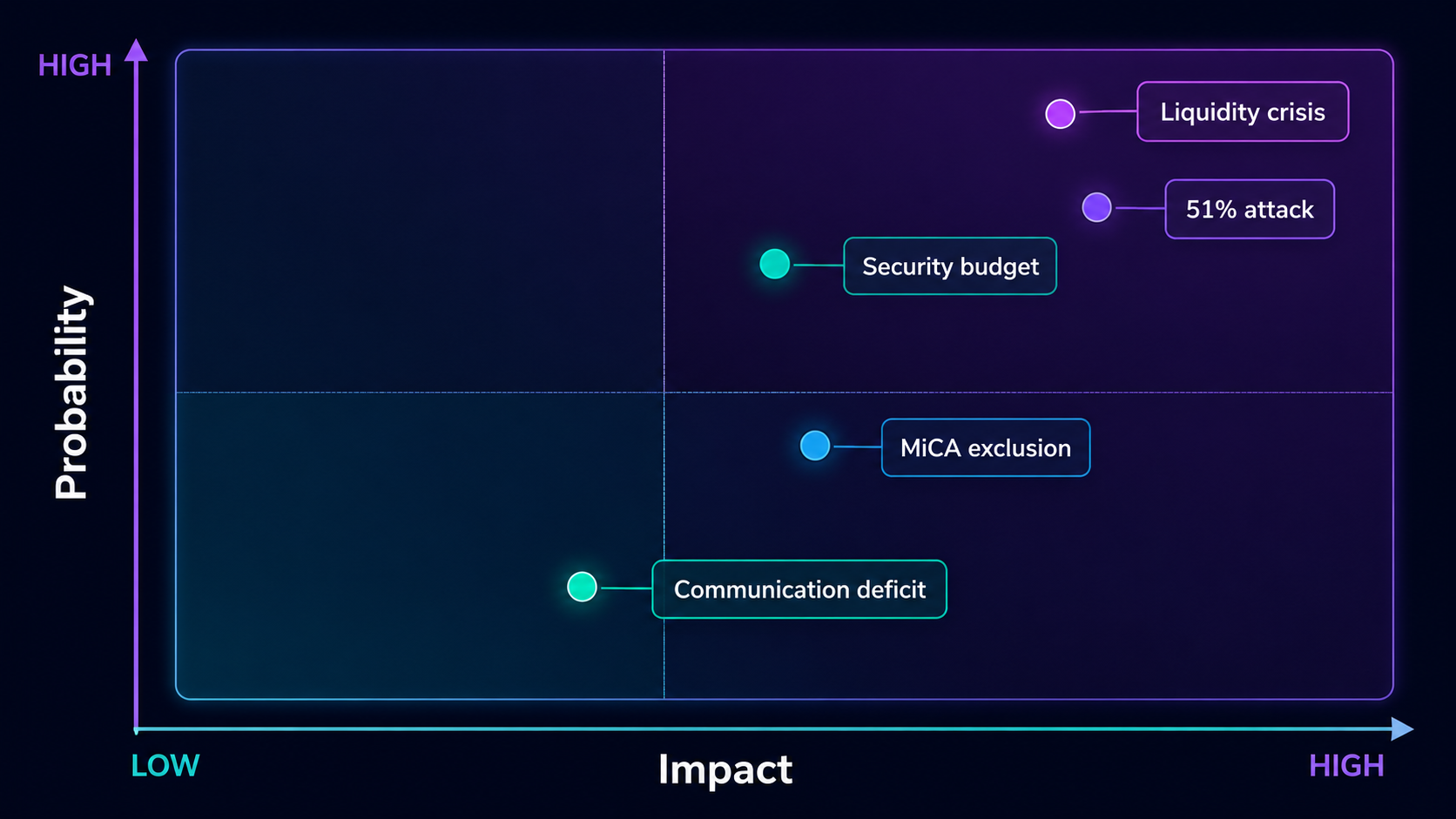
Any responsible analysis of a micro-cap project must spend as much time on risks as on opportunities. In the case of DragonX, the risk profile is asymmetric in the classical sense: the downside scenarios are multiple, interconnected, and realistic. The upside scenarios are concentrated and require specific external conditions to materialize.
5.1 — The 51% Attack Vulnerability
This is the most immediate structural risk. RandomX’s ASIC-resistance is a defense against hardware-based mining centralization, but it simultaneously means the network’s total hashrate is composed of general-purpose CPU servers. Any actor with access to a large cloud computing fleet — renting AMD EPYC instances on AWS or Azure — could theoretically outpace the legitimate miner network and execute double-spend attacks.
The network currently survives this threat because the financial incentive to attack a $210,000 market cap asset is essentially non-existent. An attacker would spend more on compute rental than they could extract through double-spending. But this equilibrium is fragile. If DRGX price appreciated sharply, the attack-incentive window could open faster than the hashrate could respond.
5.2 — The MiCA Compliance Wall
The regulatory environment in 2026 is unambiguous. The EU’s MiCA regulation, fully in effect since summer 2026, classifies privacy coins as Anonymity-Enhanced Crypto-Assets (AECAs). Any CASP operating under an EU license and seeking to list, custody, or facilitate transactions in AECAs faces severe compliance exposure.
DragonX is structurally incapable of complying with MiCA’s Travel Rule, which requires sender and receiver identification on all transfers with no minimum threshold. By design, the zk-SNARK protocol makes this information mathematically inaccessible, and Sietch adds decoy outputs that make tracing attempts computationally impossible. This is not a bug that can be patched: it is the core feature.
The consequence is straightforward: no regulated European exchange will list DRGX. The project is confined to peripheral unregulated venues that operate under constant threat of enforcement pressure, DNS blocking, or forced closure.
5.3 — Liquidity Risk and Price Discovery
A 24-hour trading volume of $95-$236 is not a market. It is an illiquid OTC desk. Any participant trying to acquire or exit a position of even a few thousand dollars would move the price catastrophically. This means the market cap figure of $210,000 is theoretical: there is no mechanism to convert that number into reality at scale.
For a long-term investor with a small position and high conviction, this is manageable. For any serious portfolio allocation, this is a disqualifying factor.
5.4 — The Security Budget Problem (Long Term)
Without tail emission, the network’s miner incentives will eventually depend entirely on transaction fees. Given current volumes, this transition — several halvings from now — would likely trigger miner exodus, hashrate collapse, and consequent 51% attack exposure. This is a problem shared with Bitcoin, but Bitcoin has the luxury of an enormous and growing fee market. DragonX does not yet have that luxury.
5.5 — The Visibility Problem: When Cypherpunk Ethics Become Self-Defeating
There is a fifth risk that is harder to quantify but arguably as consequential as any of the above: DragonX is too invisible for its own good, and that invisibility is a strategic mistake.
The project’s communication footprint is minimal to the point of counterproductive. The Telegram channel is the primary — and essentially only — active public venue. The X account (@DragonXchain) exists but has never been developed into a real communication tool. There is no blog, no regular development update, no visible roadmap, no community call. The git repository at git.dragonx.is shows 9 active repositories with the most recent commit on May 5th 2026 (ObsidianDragon, C++), confirming that development is alive. But that information is invisible to anyone who is not already a dedicated follower.
I understand the instinct. The cypherpunk tradition is hostile to marketing, and there is a meaningful philosophical argument that a project should be evaluated on its code, not its communications team. The absence of FOMO campaigns and influencer-driven pumps is one of the things I respect about DragonX.
But there is a critical difference between refusing to hype and refusing to exist. A project that builds the most sophisticated privacy stack available and then fails to communicate its existence is not making a principled stand — it is making an own goal. Privacy as a cause requires adoption to have any real-world impact. Financial sovereignty is not a solo sport. You cannot defend the privacy rights of people who have never heard of you.
A project that remains confidential to the extreme is ultimately a selfish project — an ego trip. The cause of financial privacy is not served by a technically superior tool that nobody knows exists. Smart, cypherpunk-aligned communication is not a compromise of principles: it is the execution of them.
The absence of communication also has a direct economic consequence. Price discovery, however imperfect, is a signal that reaches people outside the existing community. A rising DRGX is not just a speculative event — it is visibility. It is the mechanism through which new users encounter the technology, through which HushChat finds the journalists, dissidents, and activists it was built for. Treating price and visibility as irrelevant is an intellectual luxury that only projects with existing adoption can afford.
The recommendation is not to pivot to influencer marketing. It is to publish a monthly technical update. To maintain an active X presence that documents development progress in plain language. To write about Sietch, to explain publicly why this specific approach to metadata obfuscation matters, to make the case for the Arrakis Chain model. Cypherpunk communication is possible — Monero has been doing it for a decade, and it has not compromised the project’s values. The tools exist. The willingness has to follow.
6. Opportunity Thesis: Where the Value Could Emerge
6. Opportunity Thesis: Where the Value Could Emerge
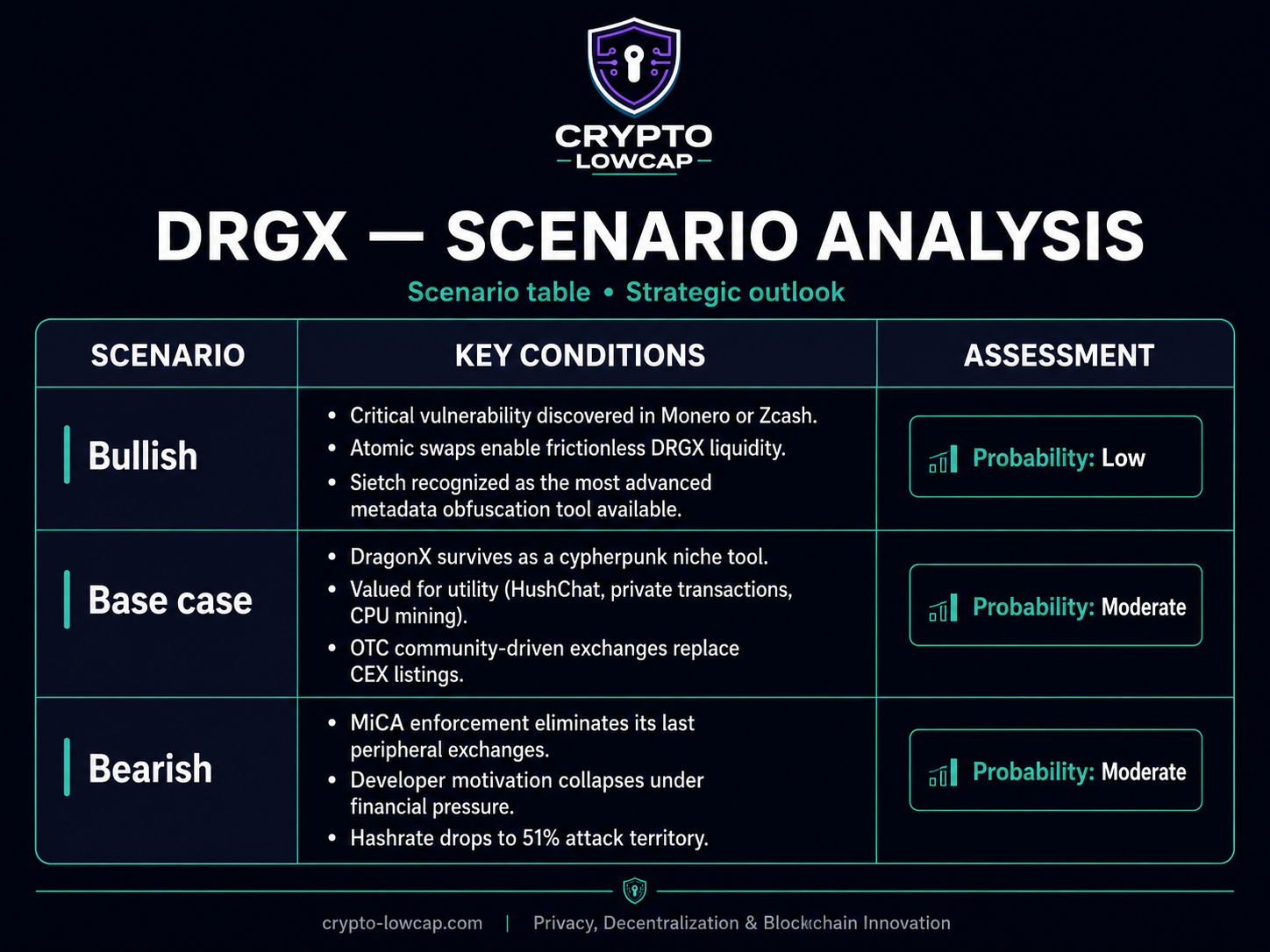
I would not have written this analysis if I did not think there was a genuine — if speculative and minority — thesis to consider. Let me be direct about the conditions under which DragonX could outperform.
A critical vulnerability emerges in Monero or Zcash. If Ring Signature limitations are formally exploited at scale, or if Zcash’s trusted setup assumptions are compromised, DragonX’s architecture would benefit from a credibility windfall it cannot currently manufacture.
Atomic swap infrastructure matures for UTXO-based privacy coins. Cross-chain peer-to-peer swaps between Bitcoin, Monero, and DRGX without KYC intermediaries would solve the liquidity problem by routing around the regulated exchange system entirely. The technical pathway exists; the ecosystem has not built it at scale yet.
Increased surveillance pressure drives demand for more capable privacy tools. CBDCs, financial surveillance expansion, and the slow elimination of cash in major economies increase the addressable population for HushChat and private DRGX transactions. Journalists, dissidents, NGOs operating in hostile jurisdictions are not speculative users — they are the project’s natural use case.
The Arrakis Chain model attracts builders. If additional Arrakis Chains launch using DragonX’s codebase as proof-of-concept, this validates the underlying technology and directs developer attention toward the ecosystem.
7. Ecosystem and Infrastructure: What Actually Works Today
One area where DragonX exceeds expectations for its size is functional infrastructure — and for once, this is verifiable rather than asserted.
The self-hosted git repository at git.dragonx.is shows 9 active repositories across C++, Kotlin, Rust, and Go. The most recent commit is dated May 5th 2026 on the ObsidianDragon wallet codebase. The Android SDK and ObsidianDragonLite repos were updated in late March 2026. The project is actively maintained. That information is publicly accessible and almost entirely unknown outside the immediate community.
The ObsidianDragon wallet suite is production-ready across three clients. ObsidianDragon (full node) is a desktop wallet with full blockchain verification, solo mining, integrated mining pool support, and asset issuance capabilities. ObsidianDragon Lite (SDL) is a light client for Windows, Linux, and macOS that manages shielded transactions without downloading the full chain, implements Sietch natively, generates dynamic z-addresses from seed phrases, and never writes private keys to disk. Mining pool capabilities are actively being developed for SDL (coming soon). ObsidianDragon Android (SDA) handles on-the-go private transactions.
Beyond pure payments, HushChat is a fully asynchronous encrypted messaging protocol designed to be integrated directly into the full node wallet — this integration is actively in progress and not yet complete. HushChat operates through transaction memo fields with no phone number, no email, and no centralized server. Messages are transmitted as part of shielded transactions and clear with each new block. For users operating in environments where Signal or Telegram are banned or surveilled at the infrastructure level, this is a meaningfully different threat model. HushList extends this to broadcast-style encrypted communications: decentralized mailing lists resistant to censorship by design.
The infrastructure is real. The code is current. The irony is that a project building tools specifically designed for people who need communication privacy has almost no visible public communication of its own.
8. Fundamental Verdict: Conviction Tier and Position Sizing
Let me structure the conclusion the way I approach any lowcap analysis: separated by three distinct registers — the technological assessment, the economic assessment, and the speculative positioning.
Technology: Strong Conviction
The architecture is coherent and non-derivative. The combination of mandatory zk-SNARKs, custom ASIC-resistant PoW, and Sietch metadata obfuscation represents a genuine advance over every competing protocol in the privacy coin space. There are no smoke-and-mirror tokenomics, no governance theater, no marketing budget. The code is production-grade (built on Zcash’s audited cryptographic implementation), the fair launch is verifiable on-chain, and the development activity through May 2026 confirms the project is not abandoned.
Economics: Weak, with Structural Constraints
The liquidity risk alone disqualifies DragonX from any standard portfolio sizing framework. The MiCA compliance wall is permanent, not temporary. The 51% vulnerability is real under adverse market conditions. The no-tail-emission model is a long-term question mark. I rate the economic profile as high-risk, dependent on niche ecosystem development that may never materialize at scale.
Speculative Positioning: Asymmetric Micro-Bet
If you believe that the trajectory of financial surveillance will create a sustained and growing demand for genuinely private monetary tools, DragonX is the most technically credible instrument to express that thesis at micro-cap valuation. The position sizing must reflect the binary nature of the outcome: either the ecosystem finds a pathway to sustainable liquidity and developer growth, or it slowly fades into a maintained-but-dormant chain.
The missing variable is not technical. It is communicational. DragonX already has everything it needs to be taken seriously. What it lacks is the willingness to tell anyone.
This is not a project I recommend to anyone looking for a 2026 bull run trade. It is a project I recommend to anyone who wants exposure to the most sophisticated privacy technology currently deployed on a live blockchain, with full awareness that this technology may never reach the market it deserves. Always remember: a lowcap can go to zero. Never invest more than you can afford to lose entirely. This analysis reflects my personal research and does not constitute financial advice.
Useful Links
Official website: dragonx.is
Whitepaper: dragonx.is/whitepaper.pdf
DragonX Explorer: explorer.dragonx.is
Git repository: git.dragonx.is
ObsidianDragon Lite releases: github.com/MyHush/SilentDragonLite
HUSH ecosystem: hush.is
Sietch protocol: github.com/MyHush/sietch
Exchange: nonkyc.io (pair DRGX/USDT)
CoinGecko: search ‘DragonX-2’
X / Twitter: @DragonXchain
Exclusive interview with the DragonX team (December 2024): crypto-lowcap.com/dragonx-cpu-mineable-zk-snarks-privacy-coin-interview/
crypto-lowcap.com | Revealing Privacy. Defending Sovereignty. | @CryptoRowenta01