Kerrigan Network (KRGN): First Look
FIRST LOOK · PROJECT FOCUS · MAY 2026
A Dash fork that ships a real cryptographic innovation, hobbled by tokenomics designed to disappoint its own miners
By Rowenta01 | crypto-lowcap.com | Est. reading time: ~4 min
#FirstLook #Privacy #PoW #ZkSNARKs #Lowcap #Microcap
Before we start: This article does not constitute investment advice. These are purely personal observations from a fundamental analyst who has been covering the privacy crypto space since 2016. Micro-cap and low-cap projects carry significant risk. Kerrigan Network is a nano-cap with extreme illiquidity. Do your own research.
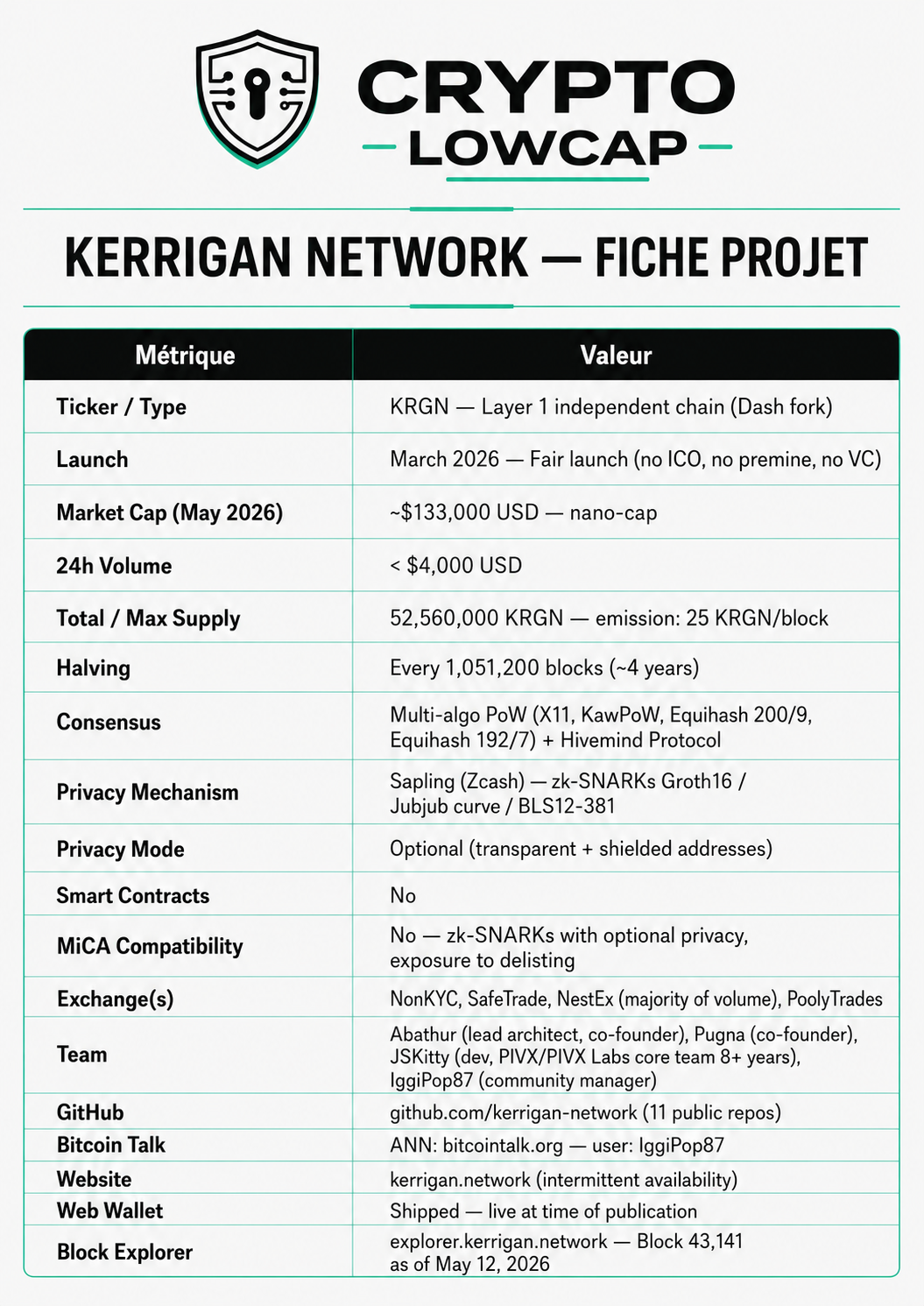
1. Project Snapshot
2. What Caught My Attention
I have seen hundreds of Dash forks over the years. The overwhelming majority are copy-paste jobs with a renamed ticker and a recycled whitepaper. Kerrigan Network (KRGN) is not that.
What stopped my scroll was a specific piece of engineering: the Hivemind Protocol, a secondary consensus layer built around aggregated BLS signatures and a cryptographic reputation system for miners. The claim is that it addresses one of the oldest unsolved problems in small-cap PoW, namely the vulnerability of low-hashrate chains to 51% reorganization attacks. That is a real problem, and this is a non-trivial attempt to solve it.
The second signal came from the GitHub. The build system is deterministic, Rust dependencies are version-locked and SHA256-checked across 200+ crates, and the code includes explicit memory sanitization for Sapling spending keys. For a $133,000 market cap project, that level of rigor is unusual enough to warrant a first look.
3. Technical Edge — or Lack Thereof
The Hivemind Protocol is the only genuine innovation here. Here is what it actually does:
- Standard PoW determines which miner submits a block. That part is unchanged.
- Active network daemons then collectively sign and seal the block using aggregated BLS signatures, creating what the whitepaper calls a “pheromone” — a cryptographic fingerprint of collective validation.
- Daemons accumulate reputation through an aging system (UNKNOWN, NEW, ELDER tiers). A miner renting hash via NiceHash cannot participate in sealing because their BLS keys have not completed the mandatory 10-block maturation window. This structurally neutralizes opportunistic reorg attacks.
This is a real engineering contribution for chains that cannot attract enough raw hashrate to defend themselves through brute force alone. It does not reinvent privacy cryptography, but it addresses a security gap that most small PoW projects ignore entirely.
Update — May 2026: The Kerrigan team reports that V2 testing is already underway with real users, approximately ten months ahead of the originally announced schedule. A web-wallet has also shipped. These developments post-date the initial data collection for this article and represent positive signals for development velocity.
The technical weakness is the Sapling integration itself. Coupling Zcash’s Rust-based cryptographic library to a Dash C++ codebase via FFI bindings is architecturally complex. The project already logged critical thread crashes, wallet reload state corruptions, and chain sync instabilities resolved across multiple hotfix releases (v1.0.3, v1.0.5, v1.1.2). More latent issues are plausible in a codebase of this complexity maintained by one person.
3b. The Optional Privacy Problem
I need to address something directly, because my audience will notice if I don’t. Kerrigan’s privacy is optional. Users choose between transparent and shielded addresses. This is the same architectural decision Zcash made in 2016, and Zcash’s experience with it has been studied in depth. The conclusions are not flattering.
Optional privacy creates a structural anonymity set problem. When the majority of transactions flow through transparent addresses, the shielded pool shrinks. A smaller shielded pool means each shielded transaction is statistically more identifiable, not less. The cryptography is sound. The game theory is not. Zcash spent years grappling with the fact that most users never used shielded transactions at all, even when freely available. The protocol was private. The network, in practice, was not.
Compare this to privacy-by-default protocols covered on this site, which enforce privacy at the protocol level. Every transaction is private. The anonymity set is the entire network. There is no opt-in, no opt-out, no two-tier system that leaks behavioral signals to on-chain observers. Pirate Chain went further, disabling transparent addresses entirely. Monero never offered them. Their respective choices reflect a philosophical position: privacy that can be skipped is privacy that will be skipped.
Kerrigan’s optional model is not necessarily wrong for what it is trying to build. A project targeting miners first, with an AI inference marketplace as a V2 goal, has different adoption pressures than a pure privacy coin. However, the project’s own website describes itself as “Privacy-First.” That claim sits awkwardly next to a design where transparent transactions are the path of least resistance. The team will need to close that gap, in words or in code, before the privacy framing holds up under scrutiny.
4. Quick Risk Radar
Regulatory risk: zk-SNARKs with optional privacy means near-zero probability of CEX listing under MiCA. Kerrigan Network KRGN is confined to NonKYC and similarly niche venues. Any regulatory pressure on NonKYC severs the only exit route.
Liquidity risk: ~$133K market cap, sub-$4K daily volume. A $500 sell order creates significant slippage. Entry and exit at any meaningful size are practically impossible without self-defeating the position.
Team / centralization risk: IggiPop87 is the community manager, not a developer. Lead architect is Abathur (co-founder); second developer is JSKitty, with 8 years on PIVX and PIVX Labs core team — a materially stronger structure than initially assessed. Both founders remain pseudonymous and no formal legal structure is documented.
Tokenomics / governance risk: Only 20% of block reward goes to PoW miners. The remaining 80% is split between masternodes (20%), a Growth Fund (40%), treasury (15%), and dev allocation (5%). At current prices, a BroodNode costs approximately $4,930. A well-funded actor could therefore capture a BroodNode majority for well under $50,000. That is a structural vulnerability priced in dollars, not theory.
Adoption / competition risk: On-chain activity is essentially zero beyond coinbase transactions and Hivemind sealing events. The V2 roadmap targeting distributed AI inference is entirely speculative, with no code shipped. For context on how similar lowcap privacy projects navigate these challenges, see our coverage of Xelis and Salvium.
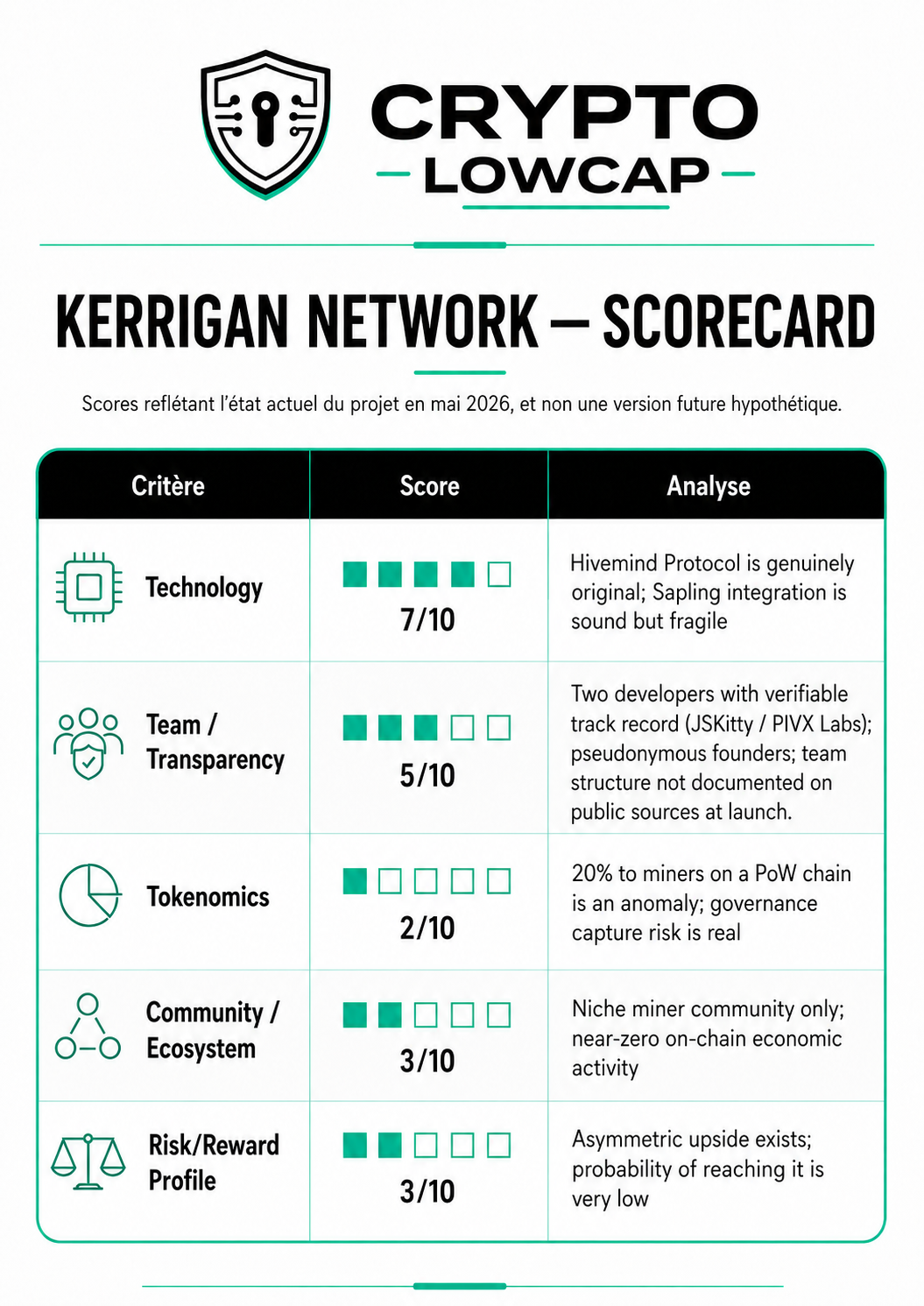
5. Analyst Rating
6. Rowenta’s Take
I will be direct: this is not something I would put money into today, and I will tell you exactly why.
The Hivemind Protocol is the kind of small innovation that matters in this space. It solves a real problem elegantly and it is implemented with uncommon rigor for a project this size. That deserves acknowledgment. IggiPop87, whoever they are, can write serious cryptographic software.
However, the tokenomics are a contradiction the project cannot explain away. Calling yourself a Proof-of-Work cypherpunk project and then routing 80% of your block emission away from miners is not a neutral design choice. It concentrates economic control in the hands of whoever holds the masternode majority. At $133,000 in market cap, a BroodNode with its 4x governance weight runs around $4,930. A well-funded actor could therefore capture a BroodNode majority position for well under $50,000. The burn mechanism for undistributed Growth Fund tokens after 12 months does nothing to address the core governance capture risk.
KRGN sits as a Tier 3 Speculative position in my framework, not a Watchlist. There is enough data, enough code, enough on-chain history to make an assessment. If the V2 AI inference layer ships verifiable code, if a second developer appears in the commit history, and if the team addresses the tokenomics criticism publicly, the tier can move. Until then, this is a project with genuine engineering merit and genuine existential risk in equal measure.
A First Look is not the place to settle the deeper question: whether Kerrigan Network KRGN’s optional privacy model can ever provide meaningful cover given what we know about anonymity set dynamics from Zcash’s eight-year history. I intend to return to that question in a full Deep Dive, with a direct comparison against Monero and Pirate Chain. In the meantime, explore our privacy coin coverage, subscribe to the newsletter, or follow on X.
CONVICTION TIER: TIER 3 (Speculative)
Rationale: Genuine engineering innovation in the Hivemind Protocol and a rigorous codebase justify Tier 3 over Watchlist. Critical weaknesses in tokenomics (governance capture quantifiable at under $50K), team structure (single anonymous developer), optional privacy model, and near-zero liquidity prevent a higher tier.
Bull case: V2 AI inference ships verifiable code; second active developer joins; tokenomics reformed in a governance vote.
Bear case: IggiPop87 goes dark; NonKYC delisted; masternode majority captured; chain dies quietly.
Conditions for upgrade to Tier 2: Second contributor with verifiable commits + V2 code shipped + tokenomics reform passed via governance vote + one additional exchange listing on a regulated venue.
7. Links & Resources
- Official website: kerrigan.network
- Whitepaper: github.com/kerrigan-network — whitepaper.md
- GitHub: github.com/kerrigan-network
- Bitcointalk ANN: bitcointalk.org — ANN thread
- Block explorer: explorer.kerrigan.network
- Mining pools (KawPoW): miningpoolstats.stream/kerrigan-kawpow
- Mining pools (Equihash 192/7): miningpoolstats.stream/kerrigan-equihash192
- Exchange: nonkyc.io (KRGN/USDT)
EDITOR’S NOTE
Editor’s Note — Team Response (May 2026)
Following publication of this First Look, the Kerrigan Network team provided corrections and context. Team structure: IggiPop87 is the community manager, not a developer. Lead architect is Abathur (co-founder). Second developer is JSKitty, a core contributor to PIVX and PIVX Labs for over eight years. Exchanges: SafeTrade, NestEx (majority of volume), and PoolyTrades are active in addition to NonKYC. Development velocity: A web-wallet has shipped and V2 testing is underway with real users, approximately ten months ahead of schedule. On tokenomics: The team argues that the Growth Fund model is structurally distinct from ICO or premine approaches. All funds are locked at the consensus layer, released only by community vote, and burned if unused within 12 months. The 15% treasury reflects operational costs of building the V2 inference marketplace, not passive dev allocation. The Beldex comparison (37.5% governance allocation via ICO) is offered as a reference point. The analytical conclusions and conviction tier in this article remain the editorial position of crypto-lowcap.com based on publicly available data at the time of writing. A revised analysis will be considered as the project develops.
crypto-lowcap.com | Privacy, Decentralization & Blockchain Innovation
Follow @CryptoRowenta01 on X | Subscribe to the newsletter