The Anonymous Crypto Stack in 2026: A Practical Field Guide
How to buy, store, spend, and exit crypto while managing your privacy trail — real tools, hard limits, cross-verified data, and legal status across every channel
Author: Rowenta01 | crypto-lowcap.com | Est. reading time: ~28 minutes
Tags: #Privacy #Bitcoin #Monero #Zcash #CoinJoin #MiCA #AMLR #P2P #Wallets #SelfCustody #ATM #SEPA #Bisq #RoboSats #Haveno #Feather #Sparrow

I have been covering the privacy coin space since 2016. In that time, I have watched Monero get delisted across every major European exchange, Samourai Wallet’s founders get convicted and sentenced, Tornado Cash go from sanctioned to partially rehabilitated to forgotten, and LocalMonero quietly close its doors in November 2024. I have watched regulation compress this space from every direction while simultaneously watching the community adapt, fork, and rebuild.
This article is not a manifesto. It is a field guide — the kind I wish existed in 2024 when I started auditing these tools systematically.
For this edition, I have cross-verified data from three independent research reports published in May 2026 alongside my own operational testing. Where sources conflict, I flag it. Where data has changed since earlier guides, I say so explicitly. My goal is verifiable precision, not reassuring vagueness.
Let me be honest about something upfront: total anonymity is no longer achievable in any practical sense within European regulatory boundaries. The architecture of MiCA, the Travel Rule, and the forthcoming AMLR has closed most institutional doors. What remains — and what this guide is about — is meaningful, legally defensible privacy hygiene. That distinction matters.
| BEFORE WE START — DISCLAIMER This article does not constitute investment advice. These are purely personal observations from a fundamental analyst who has been covering the privacy crypto space since 2016. The regulatory landscape described reflects research as of May 2026 but evolves rapidly — always verify the current status of any service before use. Nothing here constitutes legal or tax advice. Consult a qualified professional for your jurisdiction. |
1. What Broke Between 2024 and 2026: The Landscape Reset
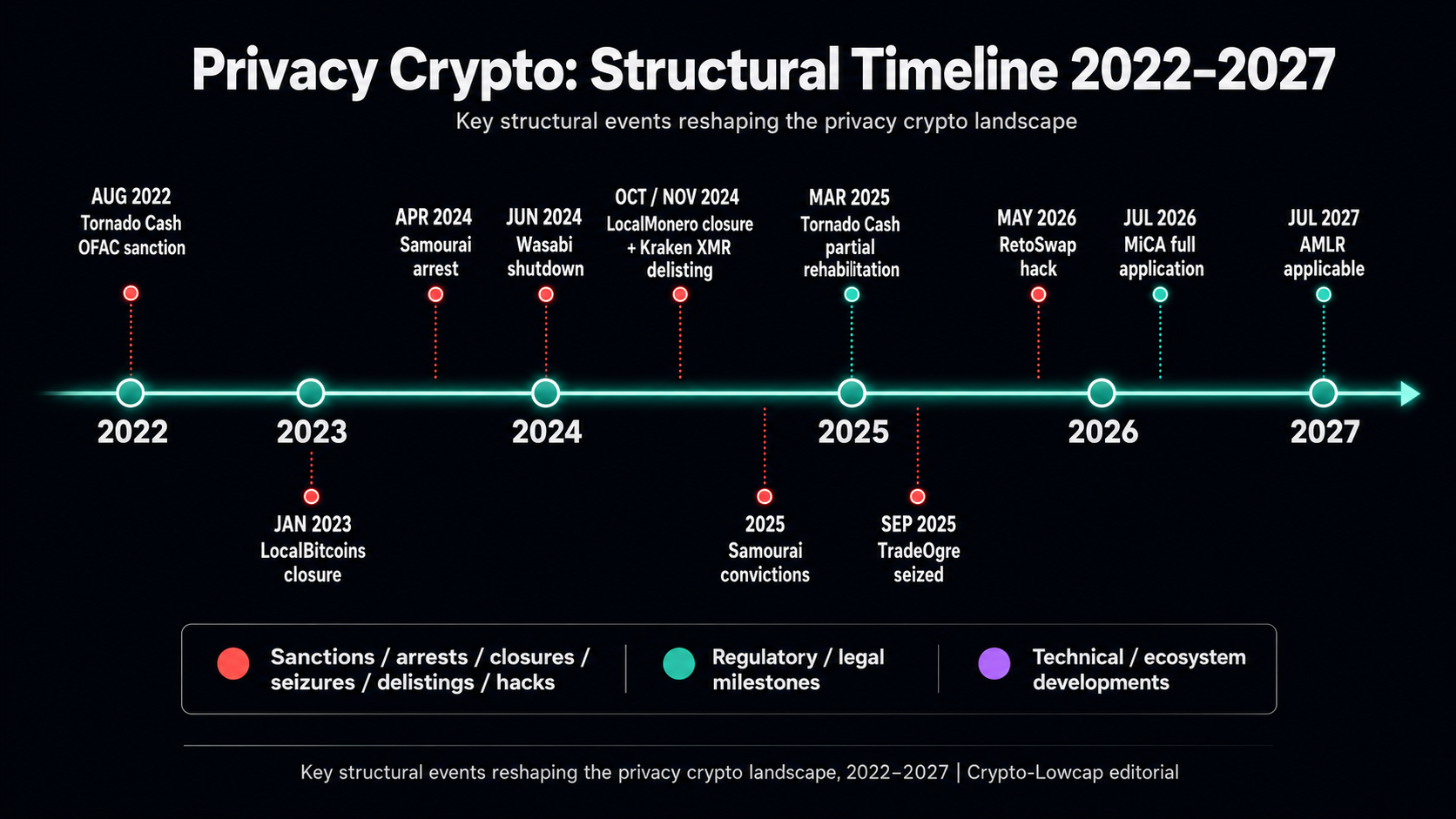
Before evaluating any tool, you need an honest inventory of what no longer exists. The past two years were not a gradual tightening — they were a series of structural ruptures. Here is what actually died.
The Regulatory Layer Hardened
MiCA entered full application on July 1, 2026. Every exchange, card issuer, off-ramp provider, and custodial wallet operating in the EU now operates under a mandatory KYC/AML regime. No exceptions, no grace periods. The Travel Rule requires full identity data transmission for all transfers between CASPs — with enhanced verification above €1,000 for transfers to or from self-hosted wallets. DAC8, operational since January 1, 2026, routes automatic fiscal reporting to national tax authorities. In France, the DGFiP now shares data with Tracfin for any flow above €8,000 deemed atypical.
The most consequential instrument is still incoming: Regulation EU 2024/1624 (AMLR), fully applicable July 10, 2027. Article 58 creates an explicit prohibition on anonymous accounts and on listing assets that structurally prevent AML compliance. Monero is the primary target. The clock is running.
The Mixing Infrastructure Collapsed
Samourai Wallet founders Keonne Rodriguez and William Hill were arrested in April 2024. Both pleaded guilty in 2025. Rodriguez received five years, Hill four years. The service is dead. zkSNACKs, the company behind Wasabi Wallet’s CoinJoin coordinator, shut down its coordination service on June 1, 2024, citing US legal risk. The dominant European CoinJoin infrastructure of 2022 is gone as organized services. What replaced it is decentralized, but requires more technical rigor — more on this in Section 4.
P2P Monero Access Contracted Dramatically
LocalMonero closed in November 2024, following its sibling LocalBitcoins (January 2023). These were the dominant no-KYC on-ramps for XMR specifically. Their absence is felt by anyone trying to acquire Monero without a centralized exchange.
RetoSwap (Haveno-Reto) — the most liquid Haveno network instance — suffered a critical infrastructure attack in May 2026. Approximately 7,000 XMR ($2.7M at the time) were stolen via a multisig escrow manipulation vulnerability. The attack exploited a logic flaw allowing the attacker to compromise escrow wallets before deposits were made. The platform was effectively suspended. This is covered in detail in Section 2.4.
Exchange Access to Privacy Coins Closed in Europe
Kraken delisted XMR across the EEA in October 2024. Binance, Coinbase, and essentially all MiCA-compliant exchanges no longer list Monero or Zcash for EU users. TradeOgre, long considered a no-KYC refuge for privacy coin trading, was dismantled in September 2025 by the Royal Canadian Mounted Police with Europol support. $40M in user funds were seized. The absence of any KYC/AML procedure made it a magnet for illicit flows — which justified the strike and made user recovery legally impossible.
2. The First Buy: Entering Without a Permanent KYC Anchor
This is the most consequential privacy decision you will make. A KYC purchase on a regulated exchange creates a permanent, legally binding link between your civil identity, your bank account, your withdrawal address, and every UTXO in your future transaction chain. Sending those funds to a so-called privacy wallet does not break that link. It reduces downstream visibility — it does not erase the anchor. Privacy-first acquisition is not optional if privacy is the goal.
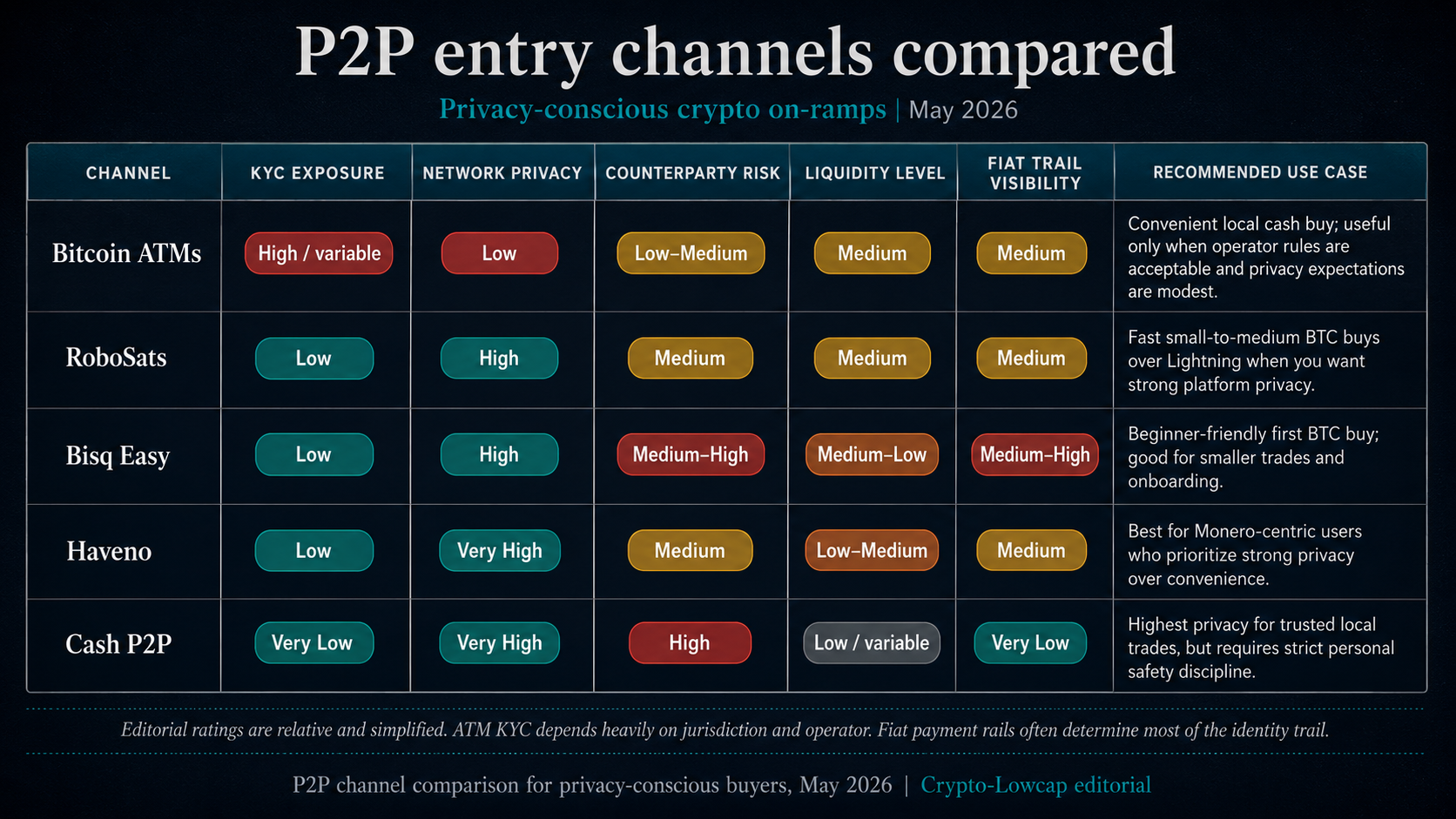
2.1 Bitcoin ATMs — Partial and Expensive
ATMs were once the default answer for anonymous first buys. In 2026 they are a nuanced, jurisdiction-dependent tool — not a clean solution.
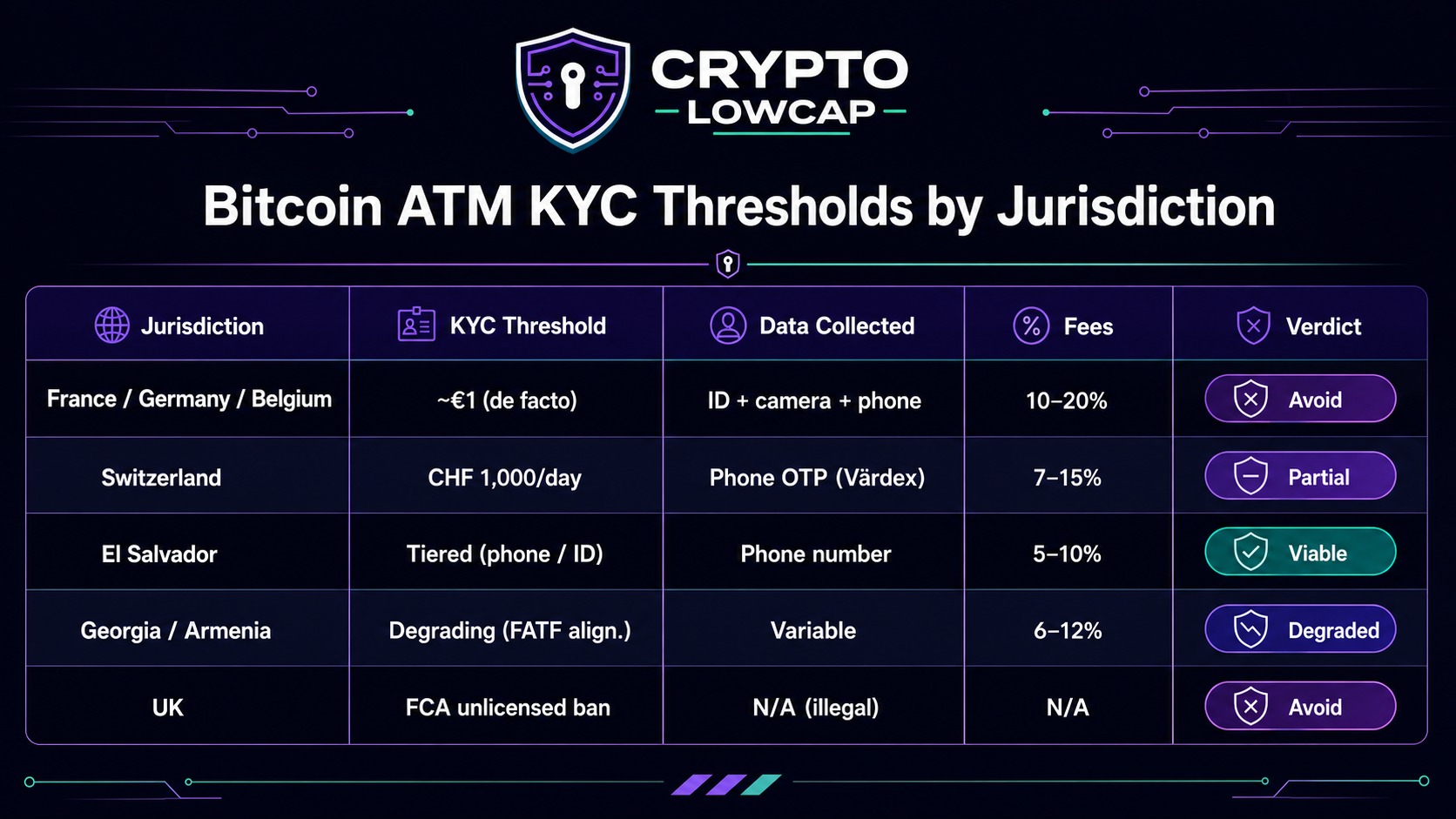
The EU situation. Under MiCA-harmonized frameworks, France, Germany, and Belgium have moved to KYC from the first euro in practice. Operators have found it simpler to impose blanket verification than to manage the liability of simplified due diligence at low amounts. Switzerland maintains a CHF 1,000 daily ceiling for purchases without full identity document, but Värdex Suisse — the dominant Swiss ATM operator — now requires an OTP SMS verification on every transaction, linking the purchase to the SIM card owner’s identity.
Below the KYC threshold does not mean below the data collection threshold. Even where no ID document is scanned, operators routinely capture HD camera footage, device fingerprints, IP addresses of nearby phones, and wallet addresses in their logs. The operational surveillance footprint of a cash ATM purchase in 2026 is larger than most users expect.
Where ATMs remain viable. El Salvador (Bitcoin legal tender; Athena Bitcoin operates with Lightning Network integration and tiered KYC — phone number for small amounts, ID for larger), Georgia and Armenia (traditionally permissive, though aligning progressively with FATF standards), and specific operators in non-EU European corridors. Coin ATM Radar (coinatmradar.com) remains the authoritative directory with KYC-filter options. Fees range from 5–20% depending on operator and jurisdiction.
2.2 RoboSats — The Standard for Lightning P2P
RoboSats is the most privacy-native P2P Bitcoin marketplace currently operational. It runs natively on Lightning Network, is accessible via Tor (.onion address), generates ephemeral robot pseudonyms for each session, and uses Lightning hold invoices as escrow. No account. No KYC. Platform fees: approximately 0.2% total (maker: 0.025%, taker: 0.175%).
What makes it genuinely superior. The Tor-native architecture masks your IP by design. Each session identity is discarded — no persistent profile accumulates. The Lightning-based escrow eliminates custodial risk. For European users buying Bitcoin against SEPA Instant, Revolut, or other fiat transfer methods, this is the cleanest on-ramp available.
The honest friction. RoboSats requires you to already hold a functional Lightning wallet capable of handling hold invoices. Phoenix (self-custodial, automated channel management) and Blixt (full LND node on mobile, handles concurrent HTLCs) are the recommended wallets as of May 2026. Zeus is viable for advanced users with their own remote node. A true beginner with zero crypto faces a bootstrapping problem here — see Section 2.3 for the solution.
The fiat leg of any trade — your SEPA transfer, your Revolut payment — remains visible to your bank regardless of Lightning’s privacy. The platform protects the Bitcoin layer; it does not eliminate the fiat trail. Trade sizes are structurally limited to around 5 million satoshis (~0.05 BTC) to preserve Lightning channel liquidity.
How to Make Your First RoboSats Trade — Step by Step
If you have not used Lightning Network or Tor before, the following eight steps are exactly what Monday morning looks like if you decide to start today. Read them once before doing anything.
- Download Tor Browser. Official download only: torproject.org/download. Available for Windows, macOS, Linux, Android. iOS users: Tor Browser for iOS does not exist officially. Use ‘Onion Browser’ (App Store, open-source) as the closest functional equivalent — but note it is not the official Tor Browser. Install, open, confirm the ‘Connected to Tor Network’ screen.
- Install a Lightning wallet that handles hold invoices. This is the step most guides skip, and it is where most failures happen. Standard Lightning wallets (Wallet of Satoshi, Strike, etc.) do not reliably handle hold invoices — the HTLC-based escrow mechanism RoboSats uses. Two choices: (a) Phoenix Wallet (iOS/Android — phoenixwallet.app): self-custodial, automated channel management, requires no manual configuration. Best choice for beginners. One note: as order maker, set order duration under 10 hours for bond compatibility. (b) Blixt Wallet (Android — blixtwallet.com): runs a full LND node on your phone, handles concurrent HTLCs reliably. Steeper setup, higher privacy ceiling. Recommended for users who want full node sovereignty on mobile.
- Solve the fidelity bond problem if you have zero sats. RoboSats requires a bond (~3% of trade value) locked in Lightning before any trade can proceed. Zero-crypto users cannot create maker orders. The solution: use Bisq Easy first (Section 2.3 above) to acquire a small amount of BTC — 0.001–0.003 BTC is sufficient for a standard trade bond. Once you have those sats in your Phoenix or Blixt wallet, you are ready. Alternative for the absolute beginner: find a trusted person who can pay a tiny Lightning invoice to seed your wallet.
- Access RoboSats via Tor Browser. Paste this .onion address into Tor Browser: `robosatsy56bwqn56qyadmcxkx767hnabg4mihxlmgyt6if5gnuxvzad.onion` — this is the main coordinator. The RoboSats project also maintains coordinator-specific .onion addresses accessible from the same interface. Do not use the clearnet URL (unsafe.robosats.org) for actual trades — your privacy cannot be guaranteed outside Tor.
- Generate your robot avatar. Each visit to RoboSats generates a unique cryptographic token creating a temporary pseudonymous identity. One robot = one trade. Copy this token to a secure location before starting — you cannot recover it from memory if Tor disconnects mid-trade. Your robot avatar has no persistent identity and leaves no account behind.
- Browse the order book and select a EUR/BTC offer. Filter by currency (EUR), payment method (SEPA Instant, Revolut, etc.), and check the premium above or below market. A 0–3% premium is normal; higher premiums indicate tighter liquidity. Select a maker’s offer that matches your fiat method. Confirm you are buying (as taker).
- Lock your bond and send the fiat. Scan the hold invoice QR code with Phoenix or Blixt — this locks your bond without spending it. Submit your Lightning payout invoice (where you want the sats to arrive). The trade escrow opens. A PGP-encrypted chat window with the seller opens. Ask for their payment details. Send the fiat (SEPA Instant, Revolut, etc.) via your banking app. Do NOT mention crypto or RoboSats in the transfer reference. Confirm in the RoboSats interface that you sent the fiat. You have a 24-hour window to complete this step.
- Receive your sats and verify. Once the seller confirms fiat receipt, RoboSats automatically releases the sats to your payout invoice in Phoenix or Blixt. Your bond is simultaneously unlocked and returned. Check your Lightning wallet for confirmation. The entire trade leaves no persistent account, no email, and no username.
| NOTE Trade size is capped at approximately 5,000,000 satoshis (~0.05 BTC / ~€4,000) per trade to preserve channel liquidity. For amounts above this, use Bisq v1 (Section 2.3) where larger SEPA trades are routinely executed with multisig on-chain escrow. Time limits are strict: 3 hours to lock escrow after selecting a trade, and 24 hours to complete the fiat leg. Missing these windows forfeits your bond. |
2.3 Bisq Easy — The Correct Entry Point for Beginners
This is the answer to the bootstrapping problem that RoboSats cannot solve. Bisq Easy — introduced in Bisq 2, with dedicated Android and iOS mobile apps launched in April 2026 — allows a user with literally zero crypto to purchase Bitcoin for the first time without any security deposit.
Unlike Bisq v1 (which requires a BTC security deposit of 15–50% of trade value), Bisq Easy operates entirely on seller reputation. The buyer downloads the app, accesses an order book, and communicates with the seller via end-to-end encrypted P2P chat routed through Tor. The seller, motivated by reputation maintenance, releases Bitcoin upon confirmed fiat receipt. Platform fees: zero. The tradeoff is a structural limit on trade size — sellers cap early trades at roughly 0.01 BTC to manage counterparty risk.
Bisq v1 remains the more battle-tested channel for larger amounts — it has been operating since 2014, has never been shut down, and uses multisig escrow as a security mechanism rather than reputation alone. For amounts above ~0.05 BTC, v1 is the more credible option.
A significant note for May 2026: Bisq v1 experienced a critical protocol vulnerability in May 2026 that resulted in the theft of 11.59 BTC from security deposits. The team patched the exploit promptly in version 1.10.0 and reimbursed affected users. Verify you are running the latest version before transacting.
2.4 Haveno — The XMR-Native Option (With a Major Caveat)
Haveno is the first functional P2P exchange natively built on Monero: no KYC, Tor-integrated, escrow in XMR, multisig-secured. For users whose goal is to acquire XMR directly from fiat without any KYC anchor, this is theoretically the most relevant channel.
The operational reality in 2026 requires honesty about what happened in May 2026.
| CRITICAL SECURITY WARNING — RETOSWAP / HAVENO-RETO, MAY 2026 The most liquid Haveno network instance (RetoSwap) was exploited in May 2026 via a logic vulnerability in the multisig trade protocol. An attacker manipulated clients into updating the arbitrator node address to a controlled address, compromising escrow wallets before deposits. Approximately 7,000 XMR ($2.7M) were stolen. The exploit targeted primarily crypto-crypto pairs. Fiat trades were less directly affected, but the underlying multisig architecture was compromised. Trust in the Haveno infrastructure has been severely damaged. Status as of May 2026: RetoSwap suspended. Other Haveno instances (Mondial DEX, main Haveno fork) continue operating with patched code but reduced liquidity. Editorial recommendation: Do not use Haveno for significant amounts until the codebase has been independently audited post-patch. Monitor community channels for audit results before re-engaging. |
For small amounts and informed users willing to accept the current risk profile, lighter Haveno forks with the patched code remain an option. The structural advantage of Haveno — the buyer does not need to hold XMR upfront, the seller provides the escrow — remains architecturally sound once the underlying vulnerability is confirmed patched.
2.5 Cash P2P — Underground, Legal for Small Amounts
LocalMonero is gone. LocalBitcoins was gone before that. The organized cash P2P infrastructure no longer exists as platforms.
What remains: community Matrix rooms (notably instances linked to monero.social), closed Telegram groups, Bitcoin/Monero meetups, and direct bilateral arrangements. Advantages: no platform logs, no digital payment trail, no KYC at any level. Risks: physical safety, counterfeit cash, fraud, and the legal boundary between an occasional private transaction and unlicensed money services activity.
Specifically for France. Occasional private cash crypto purchases exist in a legal gray zone — not explicitly prohibited, but habitual activity constitutes unlicensed financial services without CASP registration. Plus-value declaration obligations apply regardless of acquisition method. The same logic holds across most EU jurisdictions.
Use Cake Wallet or Monerujo for on-the-spot receiving. Wait 10 Monero block confirmations (~20 minutes) for cryptographic irreversibility before handing over cash.
3. Wallets: The Architecture of Your Privacy Stack
Your wallet choice determines how much privacy your on-chain activity retains downstream — independent of how cleanly you bought. A perfect no-KYC entry through Bisq means nothing if you then consolidate all your UTXOs carelessly in a hot wallet shared with KYC funds. The wallet is not a detail. It is the infrastructure.
3.1 Bitcoin Wallets
Sparrow Wallet remains my primary Bitcoin wallet recommendation. Desktop, open-source, supports full node connection and hardware wallets (Ledger, Trezor, Coldcard, Foundation Passport), granular Coin Control, PayJoin (BIP-78), configurable Tor routing. The Coin Control interface allows explicit selection of which UTXOs to spend — preventing the accidental address merging that clusters your on-chain identity. Community Whirlpool coordinators (notably JoinBot) are now discoverable directly in Sparrow’s settings, partially restoring coordinated mixing functionality without depending on the legally compromised zkSNACKs infrastructure.
Configuring Sparrow Wallet with Tor — Four Steps
Tor configuration in Sparrow is the single most impactful privacy action you can take after installation. Without it, your wallet’s server queries — which reveal your Bitcoin addresses — go out over your clearnet IP address. With it, no server operator can link your queries to your location or identity.
- Download and verify Sparrow. sparrowwallet.com/download. Always verify the signature. Download the manifest file and the signature file alongside the installer. Sparrow’s releases are signed by Craig Raw (craigraw@gmail.com). Run `gpg –verify Sparrow-x.x.x-manifest.txt.asc` and confirm ‘Good signature from Craig Raw’. Do not skip verification — supply chain attacks against wallets are documented and real.
- Install and run Tor. Two options depending on your comfort level. (a) Simplest: install Tor Browser (torproject.org/download) and keep it running in the background. Its SOCKS5 proxy is available on localhost port 9150. (b) Lighter: install Tor as a background daemon — on Linux: `sudo apt install tor && sudo systemctl start tor`. The daemon proxy runs on localhost port 9050. The difference is operational: if you have Tor Browser open, use 9150. If you use the daemon, use 9050.
- Configure Sparrow’s proxy. Open Sparrow. Go to `File > Preferences` (Windows/Linux: Ctrl+P, macOS: Cmd+,). Select the Server tab. In the server selection, choose either ‘Private Electrum’ (if you have your own node) or ‘Public Server’. Enable ‘Use Proxy’. Set type: SOCKS5. Proxy URL: 127.0.0.1. Port: 9050 (Tor daemon) or 9150 (Tor Browser). Click Test Connection. You will see a green status indicator when the proxy is routing correctly.
- Optional: connect to your own node. If you run a Bitcoin Core full node or an Electrum server (Fulcrum, Electrs), you can connect Sparrow directly to its .onion address — go to the Private Electrum tab and enter the onion address and port. This eliminates any reliance on third-party servers for balance queries. If your node is local and you are not using a .onion address, the Tor proxy will not be used for the node connection itself (only for external calls) — for maximum privacy, generate a .onion address for your node.
| VERIFICATION COMMAND To confirm Tor is routing correctly from the command line before trusting Sparrow’s status indicator: curl –socks5-hostname localhost:9050 https://check.torproject.org/api/ip If the returned IP is a Tor exit node, the proxy is working. Use port 9150 if running Tor Browser. |
JoinMarket is the most technically rigorous CoinJoin implementation currently operational. Fully peer-to-peer — no central coordinator. Makers offer liquidity, takers pay fees (~0.3% range), no single point of control or legal liability. The architecture that made Samourai and zkSNACKs vulnerable to prosecution (centralized coordination as a money services business) does not apply here. The tradeoff is real: command-line configuration, technical overhead, not for casual users.
Wasabi Wallet — the zkSNACKs coordinator shut down June 1, 2024. The wallet itself continues to function. Community-run WabiSabi coordinators (Wabisator, Liquisabi) are now discoverable via Nostr relays, partially restoring coordinated mixing. These independent coordinators charge approximately 0.3% and handle significant volume. Usable, but dependent on third-party community infrastructure whose reliability varies. Not the 2022 benchmark, but not dead.
Samourai Wallet. Do not use Samourai in 2026. The founders were convicted. The server infrastructure is compromised. Whirlpool coordination depends on backend servers that are no longer reliably operational. Using Samourai exposes you to taint association with a legally sanctioned service. Community fork efforts exist but carry deep uncertainty.
Electrum. Mature, lightweight, widely supported. Reasonable privacy if configured with a custom server and Tor. Not privacy-first by design, but acceptable as a general-purpose wallet with careful UTXO discipline.
3.2 Monero Wallets
Feather Wallet is the desktop benchmark for XMR. Written in C++ with the Qt framework, it routes all traffic through Tor by default. Supports remote node connection — eliminating the need to sync the full Monero blockchain (200+ GB as of mid-2026) — without sacrificing privacy, because the Tor layer prevents the remote node from linking your IP to your query. Excellent coin control. Active maintenance. My default desktop XMR recommendation.
Setting Up Feather Wallet for Maximum Privacy — Five Steps
Feather Wallet routes all non-sync traffic through Tor by default. Installation takes under ten minutes. The five steps below are the complete setup sequence for a new user.
- Download and verify the signature. Go to featherwallet.org/download. Download the AppImage (Linux), .exe installer (Windows), or .dmg (macOS), along with the corresponding `.asc` signature file and the release signing key (`featherwallet.asc`). In a terminal, run: `gpg –import featherwallet.asc` then `gpg –verify feather-x.x.x.AppImage.asc feather-x.x.x.AppImage`. Confirm the fingerprint matches: `8185 E158 A333 30C7 FD61 BC0D 1F76 E155 CEFB A71C`. On Tails OS, the same procedure applies from the Tor Browser (right-click > Save Page As to download the signing key). Feather uses reproducible builds, which means the binary you download is verifiable against the published source code.
- First launch: confirm Tor is active. Open Feather Wallet. In the bottom-left status bar, you will see a Tor icon. It should show green or ‘Connected via Tor’ shortly after startup. If it shows orange or disconnected, go to Settings > Network > Proxy and confirm Tor routing is enabled. By design, Feather routes all network traffic — fee estimation, price feeds, transaction broadcasting — through Tor. Wallet synchronization with the remote node uses a direct connection (this is a deliberate performance tradeoff; the remote node does not learn meaningful information from sync patterns alone).
- Choose your node configuration. Two options: (a) Remote node (recommended for getting started): In Settings > Node, select ‘Let Feather manage this list’. Feather maintains a curated list of trusted remote nodes. This allows you to sync your wallet in minutes without downloading 200+ GB. The remote node sees your sync requests but not your identity — combined with Tor, the operator cannot link the queries to your IP. (b) Full node (recommended for holdings above a meaningful threshold): Run your own Monero node (monerod). Sync takes 24–48 hours on a standard connection and requires ~215 GB of storage as of May 2026. Connect Feather to localhost in the Node settings. Eliminates all third-party visibility into your address queries.
- Create your wallet and store the seed. Select ‘Create new wallet’. Feather generates a 25-word seed phrase — 24 words plus a checksum word (standard Monero seed format; Feather also supports Polyseed, a newer 16-word format with encoded birthday date for faster restoration). Write these words on paper, in order, immediately. Do not photograph them. Do not store them in any digital file, password manager, or cloud service. These 25 words are the only recovery mechanism for your funds if your device is lost or damaged. Store your paper backup in a physically secure location, separate from your device.
- Verify all connections route through Tor. Go to Settings > Network and review the active connections panel. You should see Tor exit nodes listed as the network layer for all external requests. Send a small test transaction (10–100 XMR) to yourself — a new subaddress generated in the Receive tab — to confirm the full send/receive cycle works. Feather auto-generates a new subaddress for each receive, preventing address reuse, which is critical for Monero’s privacy model.
Cake Wallet is the best mobile option. Open-source, publicly audited, iOS and Android, native Tor mode (including a ‘Tor Only Mode’ that blocks all connections outside Tor). Built-in exchange via non-KYC aggregators including Trocador, though third-party swap integrations introduce counterparty risk. Multi-asset support (XMR + BTC in the same app) is convenient but requires deliberate separation of contexts to avoid cross-contamination.
Monerujo (Android) is the privacy-focused alternative. Connects easily to your own node, full Ledger hardware wallet compatibility. More conservative in architecture — less surface area for cross-asset issues than Cake.
Monero GUI / CLI. Appropriate for users running their own full node. Maximum control, maximum sync time. Non-negotiable for high-value long-term storage.
3.3 Hardware Wallets
Trezor Safe 5 (new in 2026) incorporates a secure element (EAL6+) alongside Trezor’s traditionally open-source firmware. Native Monero support via Feather Wallet. For cold storage of significant XMR holdings, the Safe 5 + Feather Wallet combination is the current standard. The open-source firmware remains Trezor’s philosophical differentiator in a privacy context.
Foundation Passport (Bitcoin-only) deserves specific mention. Air-gapped operation, camera-based QR code communication, no USB by default, native PayJoin protocol support. The air-gap design eliminates the supply chain attack surface that USB-connected devices carry. For Bitcoin-focused cold storage with the highest physical security bar, this is my current recommendation.
Ledger. The French company continues to support Monero technically. However, Ledger’s closed-source firmware philosophy — which enabled the controversial ‘Recover’ seed escrow service in 2023 — makes it fundamentally inconsistent with the privacy-first ethos. In 2026, Ledger is pivoting toward institutional use and AI agent identity management. Not my recommendation for the privacy stack.
3.4 Lightning Wallets
Phoenix (Acinq) is the cleanest non-custodial Lightning experience for RoboSats users. Automated channel management, single-hop via Acinq, no manual liquidity overhead. Tradeoff: Acinq observes transaction flows. For users primarily using Lightning for spending and P2P trade, Phoenix is the path of least friction.
Blixt runs a full LND node on Android, handles concurrent HTLCs correctly — making it the correct choice for RoboSats users managing multiple simultaneous hold invoices. Higher technical overhead, higher privacy ceiling.
Zeus for users operating their own remote node. Maximum self-sovereignty, real operational complexity.
4. On-Chain Privacy Tools: What Survived the Crackdown
The 2024–2025 regulatory assault on CoinJoin infrastructure was intended to be definitive. It was not. The tools that survived did so by being genuinely decentralized — no central operator, no single point of legal liability. Here is the honest status.
4.1 CoinJoin: Decentralized Coordinators and the Nostr Recovery
CoinJoin as a technique — combining multiple users’ inputs and outputs into a single transaction to break UTXO linkage — remains legally legitimate across all major jurisdictions. The prosecutions of 2024–2025 targeted centralized operators running unlicensed money services businesses, not individual users employing CoinJoin for personal privacy. No individual CoinJoin user has been prosecuted in any jurisdiction as of May 2026.
The coordinator landscape in 2026 operates differently from 2022. Wasabi’s WabiSabi protocol coordinators are now discoverable via Nostr relays — a censorship-resistant discovery mechanism that avoids the single point of failure that destroyed zkSNACKs. Community coordinators Wabisator and Liquisabi charge approximately 0.3% and process meaningful volume. JoinMarket’s Maker/Taker model requires no discoverable coordinator — it operates through its own P2P network. Sparrow Wallet’s Whirlpool integration now points to community-run coordinators (JoinBot being the most stable) configurable directly in settings.
What CoinJoin does and does not do. A well-executed mix increases the anonymity set of your UTXOs by making input-output linkage non-trivial. It does not erase a KYC origin anchor. It does not protect against timing correlation or amount-based analysis. UTXO discipline after the mix is as important as the mix itself — merging CoinJoin outputs with non-CoinJoin UTXOs in a single transaction collapses the anonymity set immediately.
4.2 PayJoin (BIP-78 / BIP-77)
PayJoin is an underused tool. The recipient adds their own input to a payment transaction, making the transaction indistinguishable from a standard payment on-chain while actually combining inputs from both parties. This breaks the common-input-ownership heuristic with zero additional overhead — if both parties support the protocol.
Adoption remains the constraint. Sparrow Wallet implements it fully on the sender side. BTCPay Server implements it on the merchant side. Foundation Passport supports it natively. For users transacting with compatible counterparties, PayJoin is arguably the most elegant privacy enhancement available: legally sound, free, and requires no post-transaction discipline.
Silent Payments (BIP-352) — integrated in recent Bitcoin Core versions — allow publishing a single static address that generates unique one-time receiving addresses per sender without interaction. An important advancement for public-facing receiving (donations, regular payments) that eliminates address reuse without coordination overhead.
4.3 Atomic Swaps — The Trustless BTC/XMR Bridge
Atomic swaps allow trustless cross-chain exchange via Hash Time Locked Contracts (HTLC). For privacy purposes, the BTC → XMR direction is the critical one: it breaks the on-chain identity trail across networks without requiring a custodial intermediary.
BasicSwap (Particl project) is the most actively maintained decentralized atomic swap platform supporting XMR/BTC in production. Open-source, non-custodial, no account required. Liquidity is organic — supplied by other users — which limits trade size but eliminates custodial risk entirely. Settlement takes 30–60 minutes depending on block confirmations on both networks. The honest tradeoff: high friction, low speed, maximum trust minimization.
Thorchain enables cross-chain swaps at scale with better liquidity but a different trust model. Thorchain’s network is publicly auditable, and operators can observe swap flows. Treat it as a liquidity bridge, not a privacy tool. The XMR integration has been inconsistent.
4.4 Tornado Cash — Do Not Touch
Tornado Cash was sanctioned by OFAC in August 2022. A Fifth Circuit decision in March 2025 partially rehabilitated the protocol. The legal status for EU users, however, remains governed by OFAC-aligned national AML frameworks. My assessment has not changed: the reputational contamination of any address associated with Tornado Cash is severe and persistent regardless of current legal status. Chain analysis firms maintain their flagging logic. Exchange compliance departments have not reversed blacklisting policies. For European users, Tornado Cash creates more practical problems — frozen accounts, flagged transactions, compliance investigations — than it solves. Do not use it.
4.5 Railgun — EVM Privacy With Conditions
Railgun operates on Ethereum mainnet, Polygon, and Arbitrum. It implements a ‘Proof of Innocence’ mechanism using zero-knowledge proofs to guarantee incoming funds do not originate from a OFAC-blacklisted address — without revealing fund origin. This was a deliberate design choice to avoid Tornado Cash’s regulatory fate, and it has worked: Railgun is not sanctioned as of May 2026.
The practical risk is downstream: any exchange compliance department that detects a Railgun interaction in a wallet’s history will flag the account. Use Railgun only if you accept that those funds cannot easily re-enter a regulated exchange environment. For users operating entirely in self-custody, Railgun is a viable EVM privacy tool. For users who need eventual off-ramp access to fiat, the contamination risk is significant.
5. Privacy Coins: What Is Actually Usable in 2026
The AMLR’s July 2027 deadline for CASPs to delist privacy coins is creating a structured exit from regulated exchanges. The useful question is not which privacy coins are theoretically strong — it is which ones remain liquid, accessible, and practically functional for real financial operations in 2026.
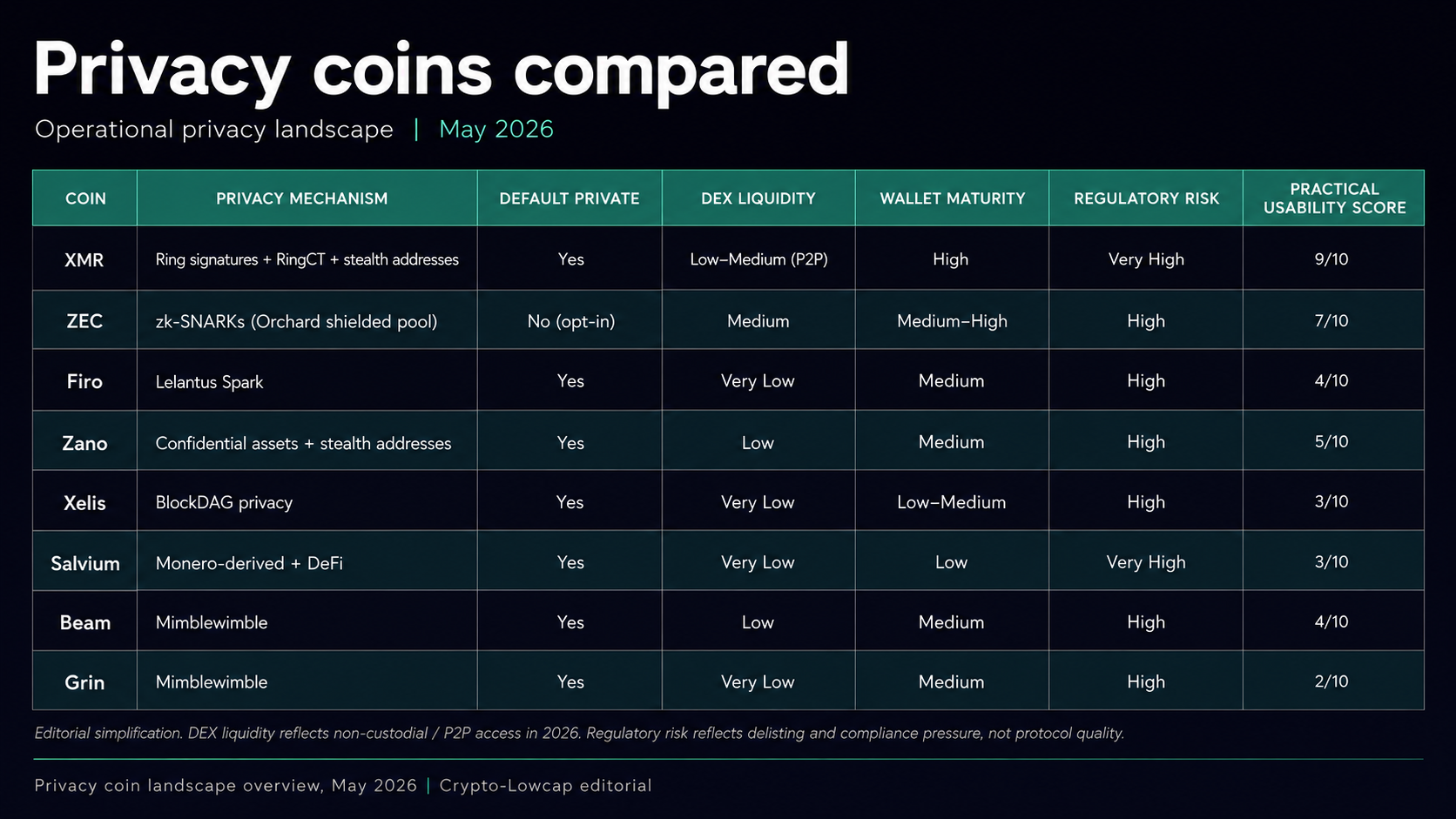
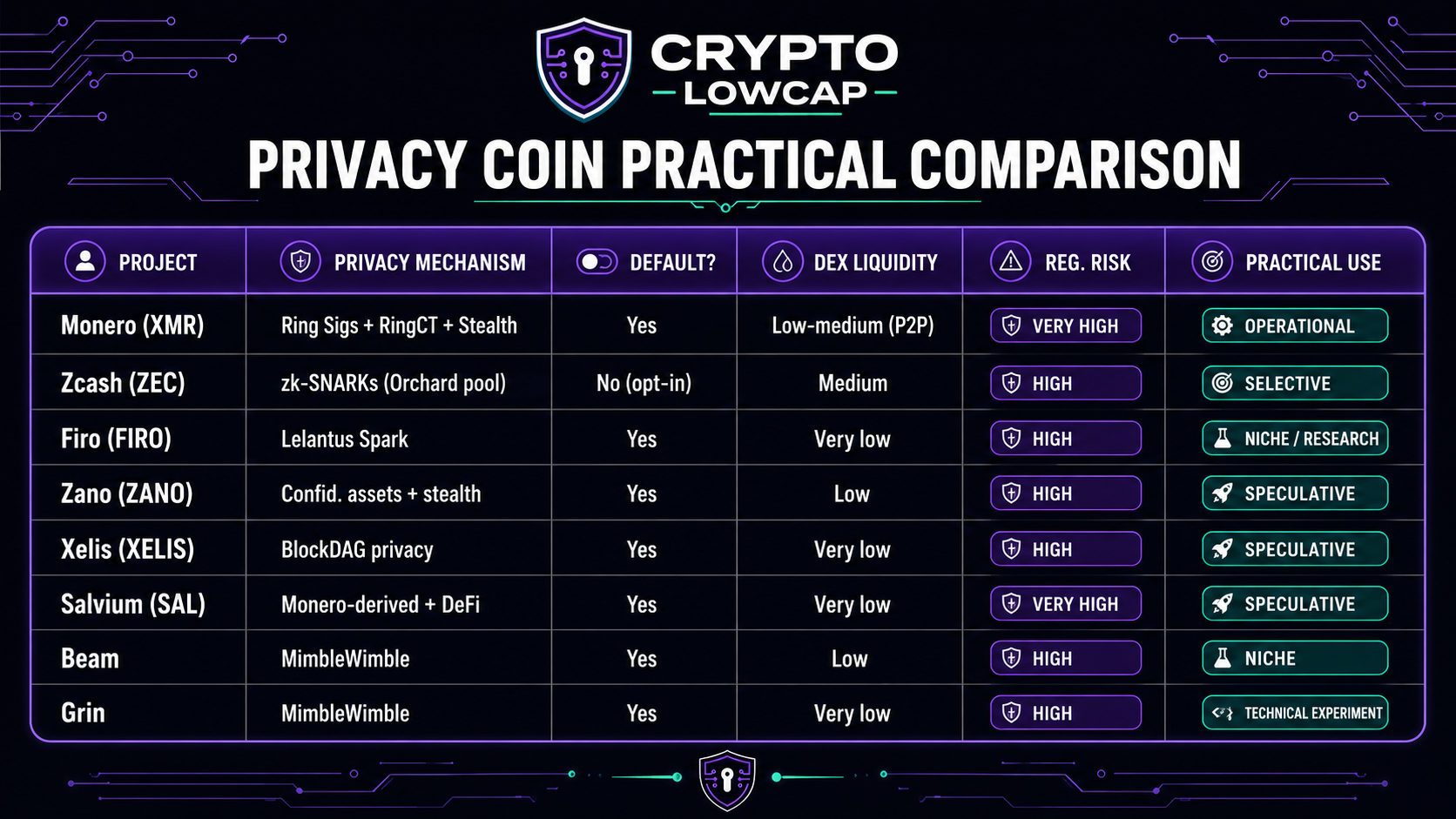
Monero (XMR) remains the operational benchmark for mandatory privacy. Ring signatures obscure sender, RingCT hides amounts, stealth addresses protect recipient — all enforced by protocol with no user action required. No Monero transaction has an externally visible history. This is what fungibility means in practice. Acquisition routes in Europe are now Haveno (with caveats noted above), Bisq (via BTC → XMR atomic swap), BasicSwap, and cash P2P. Wallet ecosystem is mature. This remains my primary privacy coin recommendation for operational use.
Zcash (ZEC) offers strong cryptographic privacy via zk-SNARKs shielded pools. The critical structural weakness is that privacy is opt-in, not mandatory — historically, the majority of ZEC transactions have been transparent. If you use Zcash, you must actively use shielded addresses and the Orchard pool consistently. Zashi (ECC) and YWallet are the correct mobile wallets for shielded-first operation. The selective disclosure feature (viewing keys) makes ZEC genuinely interesting for use cases requiring auditable privacy. ZEC retains marginally more exchange access than XMR in the EU. Solid for selective-transparency use cases; weaker than XMR for default-private everyday operation.
Firo (FIRO) uses Lelantus Spark, a technically sound protocol with strong anonymity guarantees. Practical limitations: thin liquidity, limited exchange access, small community. More relevant as a research subject and niche speculative position than as an operational privacy tool.
Zano (ZANO) is a project I follow closely on this site. Confidential assets, privacy by default, hybrid consensus, active development. Technical architecture is genuinely solid. Liquidity remains limited. Primarily relevant as a conviction-tier privacy coin speculative position, not as cash equivalent infrastructure.
Xelis (XELIS) and Salvium (SAL) are early-stage privacy chains I track in the low-cap space. Both are technically interesting — Xelis for its BlockDAG privacy approach, Salvium for its Monero-derived architecture with DeFi functionality. Neither has the ecosystem maturity for operational financial privacy use in 2026. Speculative positions, not operational tools.
The practical hierarchy. XMR for operational default privacy. ZEC for auditable selective-transparency cases. Everything else is investment thesis or technical experiment in 2026.
6. Spending: Cards, Gift Cards, and the No-KYC Reality
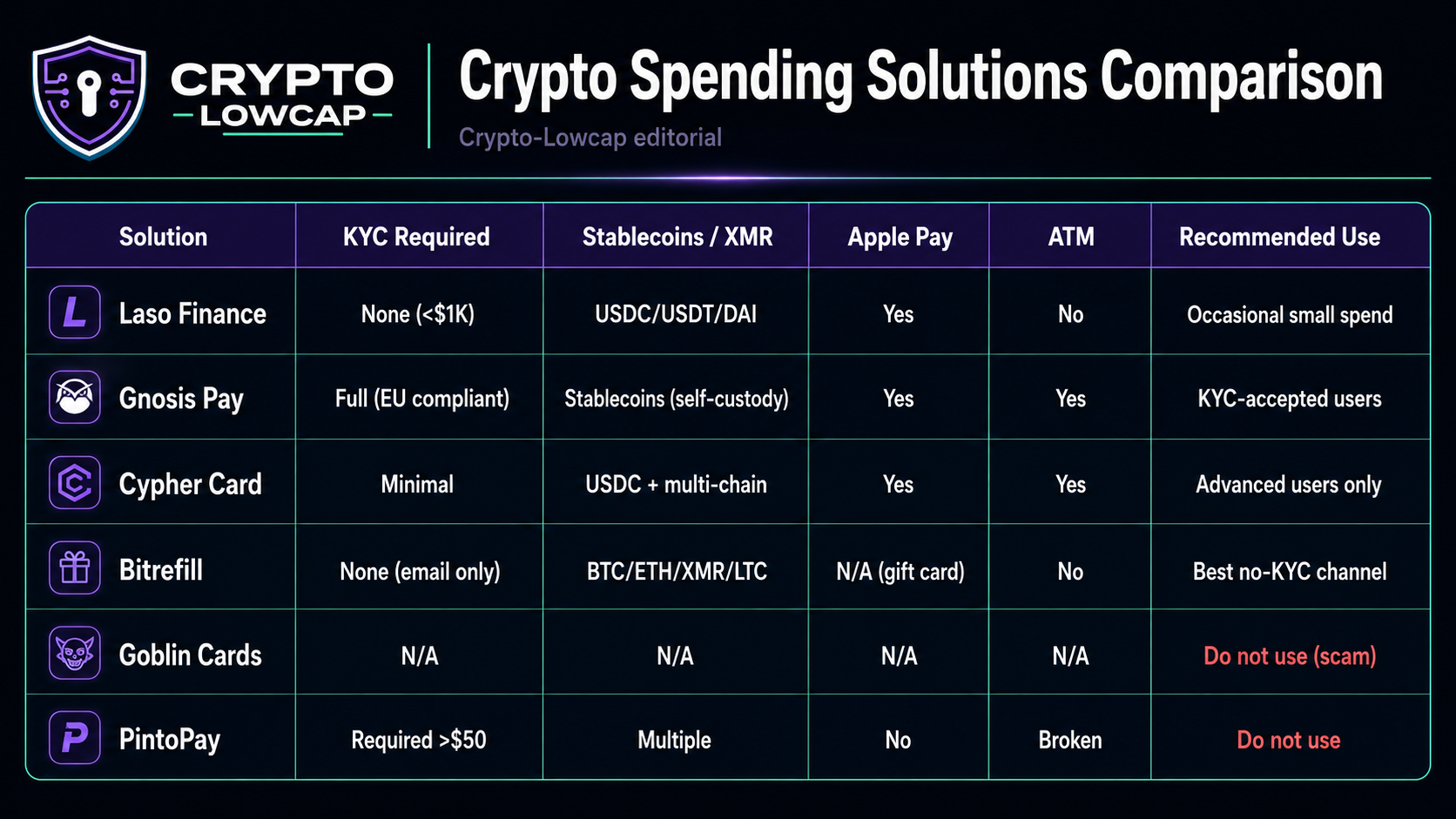
This is where the privacy literature fails users most consistently. The ‘no-KYC crypto card’ narrative — aggressively promoted on X/Twitter and Telegram — ranges from misleading to outright fraudulent. Let me address this directly with cross-verified data.
6.1 The Structural Truth About Crypto Cards
Every Visa and Mastercard transaction flows through a card network operating under US and EU regulatory oversight. The issuing bank (the BIN sponsor) bears legal AML liability for every transaction that crosses its numbers. A card that advertises ‘no KYC’ for recharging is either operating below a simplified due diligence threshold (with full KYC triggered retroactively at that threshold), or exploiting a structural loophole that will close under regulatory pressure, or simply running a scheme designed to collect deposits before disappearing.
The SolCard episode in mid-2025 is the canonical case study. SolCard built a significant user base by offering Visa virtual cards with no KYC — a genuinely functional service for months. Then, under issuing bank pressure, it imposed full KYC retroactively for all Visa card holders in a single announcement. Cards were frozen until identity verification was completed. The SOLC token fell 87% on the news. Users had no recourse. This is the structural risk of any no-KYC card product depending on a regulated BIN sponsor.
6.2 Cards With Actual Utility in 2026
With that established, some card-adjacent products are worth knowing about — with explicit risk framing.
Laso Finance operates an interesting model: USDC/USDT/DAI prepaid cards (single-use, non-rechargeable) compatible with Apple Pay, no KYC below $1,000, explicitly positioned as gift-card-tier prepaid instruments rather than full financial accounts. The no-KYC status is maintained by staying within gift card regulations rather than EMI regulations. Fees are material (5–8% conversion). Not suitable for large amounts or recurring use — the non-rechargeability is a structural constraint. But for isolated anonymous spending in the $100–$500 range, it is currently functional.
Gnosis Pay represents a different model: fully KYC compliant, but the underlying assets remain in a user-controlled smart contract (self-custodial). The KYC is attached to the card issuance, not to the on-chain asset custody. For users who need Visa functionality and are willing to provide identity to an EU-compliant issuer while maintaining on-chain self-custody, this is the most honest hybrid available.
Cypher Card (non-custodial model, minimal KYC) avoids opening a CRS-registered bank account in the user’s name — which limits automatic fiscal information exchange. Premium plan: $199/year, zero conversion fees on USDC, theoretical daily limits up to $1M. The core risk is the same as all cards: issuing bank pressure. Worth monitoring but not yet sufficiently proven under regulatory stress.
6.3 Cards to Avoid — The Exit Scam Category
Three research reports I cross-referenced in preparation for this article converge on the same warning list. These services display clear red flags.
| DO NOT USE — HIGH EXIT SCAM / FRAUD RISK Goblin Cards: $350 upfront activation fee in crypto, no verifiable BIN sponsor, promises of unlimited anonymous ATM withdrawals (economically impossible). Classic exit scam structure. NexasCard: Does not exist as a crypto card product. ‘Nexas’ is a Japanese sporting goods chain (Xebio Holdings). Likely hallucination/marketing fraud. FotonVCC / Zentro: No verifiable issuing entity. ‘Zentro Global Bank’ flagged by multiple financial analysis registries for confiscating customer deposits. PintoPay: Extensive user complaints of frozen accounts, zero functioning support, KYC required above $50/transaction despite ‘crypto bank’ marketing. Rule: If you cannot identify the BIN sponsor via binlist.net and verify the issuing EMI’s regulatory registration, the risk is unacceptable. Never deposit significant capital. |
6.4 Bitrefill — The Most Credible No-KYC Spending Channel
Bitrefill has operated since 2015, accepts BTC, ETH, USDT, XMR, LTC, and others without KYC for standard accounts (email only), and sells gift cards for Amazon, Steam, Uber, Netflix, Airbnb, and hundreds of other merchants. This is the gold standard for no-KYC crypto utility. Daily limits for basic accounts: $5,000. Monthly: $10,000. Fees: 1–3% depending on product. For online spending, Bitrefill is genuinely the most reliable and legally defensible option. Its limitations are structural: online-only merchants (unless stores accept gift cards), no cash equivalent.
6.5 Prepaid Cash Vouchers — The Most Accessible No-KYC Spending Layer
There is a category the mainstream privacy literature consistently overlooks: the prepaid PIN voucher bought with physical cash at a corner shop. No app, no account, no bank link — just a barcode on a receipt and a code number that represents value. In 2026, these instruments have been substantially squeezed by AMLD5/6 regulation, but they are not dead. They remain the most accessible anonymous spending tool available at the point of purchase, and they matter for specific use cases.
Paysafecard
[LEGAL EVERYWHERE if bought with cash]
Paysafecard operates via 16-digit PIN codes sold at tabacs, supermarkets, gas stations, and kiosks across France, Belgium, Germany, Spain, Italy, Switzerland, and ~50 other countries. When purchased with cash and without a my Paysafecard account, no personal data is linked to the PIN at the point of sale. The voucher is anonymous in the sense that matters most: there is no trail between your identity and the voucher value.
Limits under AMLD5 (enforced since January 2020, unchanged in 2026): Individual anonymous payments are capped at €50 per transaction without a my Paysafecard account. You can combine up to 10 PINs per payment, giving a theoretical combined ceiling of €500 in a single transaction — but the €50 per-PIN ceiling applies to each voucher individually, and many merchants enforce a lower combined limit. Opening a basic my Paysafecard account (requires name, address, date of birth — no ID document scan) raises the monthly limit to €250 and simplifies multi-PIN management. Full ‘Unlimited’ status requires passport and selfie biometric and is, at that point, effectively KYC.
Crypto utility in 2026: Direct Paysafecard crypto purchase on regulated exchanges is blocked — MiCA-compliant CASPs require KYC and do not accept Paysafecard without a verified account. The viable use case is P2P: some sellers on Bisq and on legacy P2P forums accept Paysafecard as a payment method. Expect a significant seller premium — 15–25% above market — because Paysafecard chargebacks (reversals by the issuer) are a documented fraud vector. This premium is the cost of the anonymity. CashtoCode (a barcode-based system accepted at a small number of P2P-adjacent platforms and some exchanges) functions similarly and is worth checking if your preferred platform lists it as a payment option.
Key risk: If you buy Paysafecard by card or online, the trail starts at your bank transaction, not at the PIN code. Cash purchase at physical retail is the only acquisition method that preserves the anonymity advantage. Keep receipts in a separate physical location if amounts are meaningful.
Neosurf
[LEGAL EVERYWHERE if bought with cash]
Neosurf uses a 10-digit PIN voucher, available in denominations of €10, €15, €20, €30, €50, and €100. Retail presence in France (BHN network distributors), Belgium (Comme Chez Nous, Cora), Germany (Penny, Carrefour), Spain, Portugal, and Italy. Also present in Australia, Canada, and New Zealand. Available at approximately 135,000 retail outlets globally according to Neosurf’s own data. Like Paysafecard, cash purchase creates no digital identity trail.
Critical structural limitation: Neosurf is deposit-only. There is no withdrawal functionality. You can spend it, not retrieve it. If you use a myNeosurf digital account for larger amounts, that account requires name and email at minimum, and will request ID for higher tiers. The single-use nature (one payment per voucher) limits flexibility.
Crypto utility in 2026: Neosurf’s direct crypto utility is narrower than Paysafecard’s. The historical Bitit partnership (Paris fintech that allowed BTC purchase via Neosurf) is no longer the dominant route. Some P2P sellers list Neosurf as a payment method; liquidity is thin and premiums apply. The more reliable use case is indirect: use Neosurf to pay for services (VPN, hosting, streaming) that you would otherwise pay for with tracked payment methods, freeing up your crypto for other privacy purposes.
Other EU Cash Voucher Options in 2026
CashtoCode is worth specific mention. Unlike Paysafecard and Neosurf (PIN-based), CashtoCode uses a barcode generated at checkout that the user redeems in cash at a participating retailer. The code is generated at the merchant’s site and cash is handed over at the counter — the sequence is reversed. A handful of P2P-adjacent platforms and some exchanges accept CashtoCode for small deposits. Availability varies significantly by country.
Transcash (France-specific): Available at French tabacs and press kiosks in denominations of €10–€200. Similar anonymous cash-purchase model. Limited to specific merchants; crypto use is restricted. Worth knowing exists.
| VERDICT — SECTION 6.5 Prepaid cash vouchers provide genuine anonymity at the point of purchase — something no digital card or P2P app can match. Their value is architectural: they convert physical cash into a spendable digital instrument without creating a bank record. What they do NOT do: allow meaningful direct crypto purchases at reasonable prices in 2026. The P2P premium (15–25%) and thin liquidity make them poor on-ramps. They are best deployed as anonymous spending instruments for non-crypto services (VPN, hosting, subscriptions), reducing your reliance on trackable payment rails for everyday digital expenditure. Use Bitrefill when you have crypto and want to spend it. Use Paysafecard cash vouchers when you have cash and want to spend it anonymously online. These are complementary, not competing, tools. |
7. The SEPA Problem: The Last Mile to Fiat
Converting crypto to fiat via SEPA is the highest-risk phase of the privacy stack. This is where regulatory pressure is most concentrated, where automatic surveillance is most advanced, and where privacy is most likely to break permanently.
7.1 P2P SEPA — The Cleanest Off-Ramp
First, a necessary correction: Wise, Revolut, and the ‘pseudo-anonymous neobank’ myth
Let me address an idea that circulates persistently in privacy forums and that I have seen referenced as a serious option: the concept of a ‘pseudo-anonymous neobank account’ for crypto flows in Europe. It does not exist in 2026.
Wise requires, from the first euro of account activity: a valid government-issued photo ID (passport, national ID, or driving licence), a proof of address (utility bill, bank statement, or rental agreement dated within 3 months), and a live selfie or video verification for biometric liveness checking. This is full KYC/AML — not simplified due diligence, not email-only. Under MiCA Article 70, every CASP and every regulated payment institution serving EU clients must verify client identity before establishing any business relationship. Wise is a licensed payment institution subject to this requirement.
Revolut applies the same standard. N26, Bunq, Monzo, and every other EU-operating neobank are in identical compliance territory. The idea that these accounts provide meaningful anonymity relative to traditional banks is a category error: they have different UX, different fees, and sometimes more crypto-tolerant account policies — but they are equally or more connected to fiscal reporting infrastructure (CRS, DAC8, TFR) than legacy retail banks.
The compartmentalization value of a Revolut account for a crypto user is operational — using it instead of your primary bank account for exchange interactions prevents algorithmic freezing of your main account — not privacy relative to the state. If you need actual compartmentalization at the jurisdictional level, see Section 7.4 below for the legally compliant options and their real limitations.
The cleanest fiat off-ramp from a privacy perspective is direct P2P: selling Bitcoin to a counterparty who sends you EUR via SEPA without a centralized exchange in the chain.
Bisq handles this natively. Post an offer, buyer matches, they send SEPA transfer, you release Bitcoin from multisig escrow. Your bank sees a receipt from an individual — not from an exchange. This matters: exchange SEPA flows are systematically flagged by bank AML algorithms; peer payments from individuals are less automatically suspicious. Bisq liquidity for large amounts is limited, and spread reflects the privacy premium.
Hodl Hodl (centralized server, but no KYC) supports SEPA with multisig escrow and better liquidity than Bisq for some pairs. The platform itself is a potential legal liability point, but the P2P structure means your bank interaction is individual-to-individual.
Peach Bitcoin (Swiss-registered, PolyReg supervised) permits transactions up to CHF 1,000/day and CHF 100,000/year without identity verification, using Swiss FINMA exemptions. Data is stored locally on-device, communications end-to-end encrypted. Highly relevant for European users willing to use a Swiss-jurisdictioned service.
7.2 The Tracfin and DAC8 Reality for French Users
The French regulatory framework deserves explicit treatment because it is where most of my readers are most exposed.
| FRENCH FISCAL & COMPLIANCE THRESHOLDS (2026) PFU (Prélèvement Forfaitaire Unique): 31.4% on crypto capital gains (revised up from 30% per PLFSS 2026). Exemption: annual disposals under €305. DAC8: All CASPs automatically transmit transaction data and balances to DGFiP from January 2026. First cross-border exchange with partner authorities: autumn 2027. Tracfin COSI 1: Automatic declaration if cash deposits/withdrawals for fund transfers exceed €1,000 per operation or €2,000 cumulated/month for the same client. Tracfin COSI 2: Automatic declaration if cumulative monthly cash deposits or withdrawals exceed €10,000. DGFiP-Tracfin sharing: Automatic sharing of data for any flow above €8,000 judged atypical or suspicious. Cerfa 3916-bis: Mandatory annual declaration of any foreign crypto account (held, opened, used, or closed). Fine: €750/account; €1,500 if account value >€50,000. SEPA P2P risk: Banks may file SAR (suspicious activity report) for recurring transfers from unknown individuals, even under Tracfin thresholds. |
7.3 The Last Mile Truth
I will be direct: there is no clean, anonymous, legal path from meaningful crypto holdings to a European bank account in 2026. The Travel Rule, MiCA reporting obligations, and bank AML policies make this structurally impossible. The best you can do is choose your off-ramp provider carefully, document your acquisition trail honestly, and ensure your tax declarations are accurate.
If anonymous cash-out at meaningful scale is your goal, you are either outside the EU or you are considering legally problematic approaches. This guide covers legal privacy practice, not financial crime.
7.4 Legal Intermediate Structures: Offshore Accounts and EMI Solutions
Some users attempt to build privacy through account compartmentalization — separating crypto-related flows from their primary banking relationship by routing conversions through a foreign bank account or an EMI (Electronic Money Institution) outside the EU. This approach has real operational utility and real legal obligations that are non-negotiable for French residents. Let me separate the two clearly.
Offshore Bank Accounts in the Caucasus
Georgia. TBC Bank and Bank of Georgia are the most frequently mentioned institutions for non-resident account opening in 2026. The landscape has changed: since 2024, Georgian banks have significantly tightened onboarding. Virtual account opening (online, without physical presence) is possible but requires: a valid passport, proof of address, 6 months of bank statements, a documented source of funds, and a convincing explanation of why you are opening a Georgian account. A Power of Attorney (notarized and apostilled in France) allows a local representative to complete the process if you cannot travel to Tbilisi. Banks are now applying FATCA reporting for US-connected individuals and CRS reporting for all CRS-partner country residents. The account opening is legitimate. The anonymity relative to your home country’s tax authority is a myth.
Armenia. Similar trajectory. Armenian banks (Ameriabank, ACBA) permit non-resident account opening with comparable documentation requirements. Online application available for a limited range of nationalities. Physical presence or POA for most European applicants. Multi-currency accounts with SWIFT access. Subject to the same CRS reporting obligations.
North Macedonia, Montenegro, Serbia. EU candidate or EEA-adjacent jurisdictions with progressively tightening FATF compliance. Account opening still accessible for EU residents, but the window of regulatory flexibility is narrowing.
| LEGAL OBLIGATION — FRENCH RESIDENTS (NON-NEGOTIABLE) Every foreign bank account AND every foreign digital asset account opened, held, used, or closed during the tax year must be declared via Cerfa form 3916-3916bis, filed alongside your annual income tax return (impots.gouv.fr). This applies to Georgia, Armenia, and every other jurisdiction, regardless of the account’s purpose or activity level. An open account with zero balance still requires declaration if it was active during the year. Penalty for non-declaration: €750 per account per year. €1,500 per account per year if the account value exceeded €50,000 at any point. Willful non-declaration constitutes tax fraud with criminal liability exposure. CRS (Common Reporting Standard) means your Georgian or Armenian bank will report your account to their national tax authority, which forwards it to the DGFiP. DAC8 extends this reporting to digital asset accounts at foreign CASPs from autumn 2027. Declaring the account is not the same as owing tax on it. Having a Georgian account is fully legal. The obligation is disclosure, not prohibition. |
EMI (Electronic Money Institutions) Outside the EEA
Electronic Money Institutions outside the European Economic Area represent a different compartmentalization strategy. EMIs in Seychelles, British Virgin Islands, or similar offshore jurisdictions issue IBANs or payment accounts not directly governed by EU AML directives. The appeal is reduced automatic reporting obligations relative to EU-based EMIs.
What EMIs provide in practice. A payment account (not a full bank account) with a non-EU IBAN, multi-currency support, and often crypto-friendly onboarding policies. Some accept crypto deposits and allow fiat conversion within their platform. Examples of active non-EEA EMIs in 2026 include providers in the Seychelles, Vanuatu, and Comoros corridors — though specific names are not included here because this sector’s operational stability and regulatory compliance changes rapidly. Research independently and verify current status.
Honest limitations. Non-EEA EMIs are not necessarily outside CRS scope: the CRS network now covers 114+ jurisdictions, and the list expands annually. An EMI registered in a CRS-partner jurisdiction reports account information just like a Georgian bank does. More importantly, AMLR’s extraterritorial reach is expanding — EU residents using non-EU financial services for crypto are increasingly in scope even if the EMI is not physically in the EU. And EMIs outside EEA regulatory oversight offer minimal consumer protection if the institution fails or freezes funds.
| VERDICT — SECTION 7.4 Offshore bank accounts and non-EEA EMIs are legitimate compartmentalization tools with real operational utility: they separate crypto-related banking flows from your primary banking relationship, reducing the algorithmic profiling risk from overzealous domestic banks that freeze accounts on crypto patterns. What they do NOT provide: anonymity relative to fiscal authorities, protection from DAC8/CRS reporting, or a legal exemption from French declaration obligations. Use them for flow separation and to reduce friction from crypto-unfriendly domestic banks. Declare them correctly. Do not rely on them as opacity mechanisms against your own tax administration — they are not that. |
8. Network and Metadata: The Layer Most People Ignore
On-chain privacy tools protect transaction visibility on the blockchain. They do absolutely nothing about the metadata your device generates when connecting to the network. This disconnect is the most common and most damaging failure mode I observe.
Tor remains the most effective tool for masking your IP when broadcasting transactions and querying wallet state. Feather Wallet (Monero) routes all traffic through Tor by default. Sparrow Wallet (Bitcoin) supports configurable Tor routing. Broadcasting a transaction from your home IP while using a ‘privacy wallet’ is the most common operational failure. Your ISP, your wallet server, and any network observer link your IP to your on-chain activity unless Tor is active.
VPN. Mullvad VPN is the community standard for this use case. No email required at registration — account identified by a randomly generated 16-digit number only. Accepts cash payments by mail and Monero (with a 10% discount). The key distinction from Tor: a VPN provider knows your real IP and destination simultaneously. For most non-adversarial threat models, a reputable no-log VPN is sufficient. For high-value transactions or high-stakes adversarial scenarios, Tor is the stronger tool.
Running your own node. When you query a third-party Electrum server for your Bitcoin balance, or a remote Monero node for your transaction history, you are telling that server which addresses you control. Running Bitcoin Core (~600GB) or a Monero full node (~200GB) eliminates this metadata exposure entirely. The operational overhead is manageable for committed users. The privacy gain is structural.
9. The Regulatory Horizon: Planning for 2027
The most consequential near-term development has a specific date: July 10, 2027. That is when AMLR (Regulation EU 2024/1624) becomes fully applicable across all EU member states.
Article 58 of the AMLR creates three explicit prohibitions for CASPs: maintaining anonymous crypto accounts; offering wallets that enhance anonymity features; and interacting with cryptocurrencies specifically designed to prevent AML compliance tracing. Monero is the most visible target. The prohibition on listing mandatory-privacy coins at regulated CASPs is explicit.
AMLA (EU Anti-Money Laundering Authority) began operations in Frankfurt in mid-2025 and is assuming supervisory jurisdiction over the largest cross-border CASPs. Regulatory arbitrage across EU member states will be structurally much harder after 2027 with a single supranational enforcement authority.
What this means in practice. Self-custody wallets (Feather, Cake, Monerujo, Sparrow) are not CASPs and are not affected by AMLR directly. The impact falls on acquisition and conversion routes. P2P channels (Bisq, Haveno when recovered) and atomic swap platforms (BasicSwap) are not CASPs and are not covered by AMLR. The practical effect: on-ramps and off-ramps to regulated fiat will become even more restricted for XMR holders, while the asset remains legal to hold and transact in self-custody.
Build your stack now, while the acquisition routes still exist. The window is narrowing.
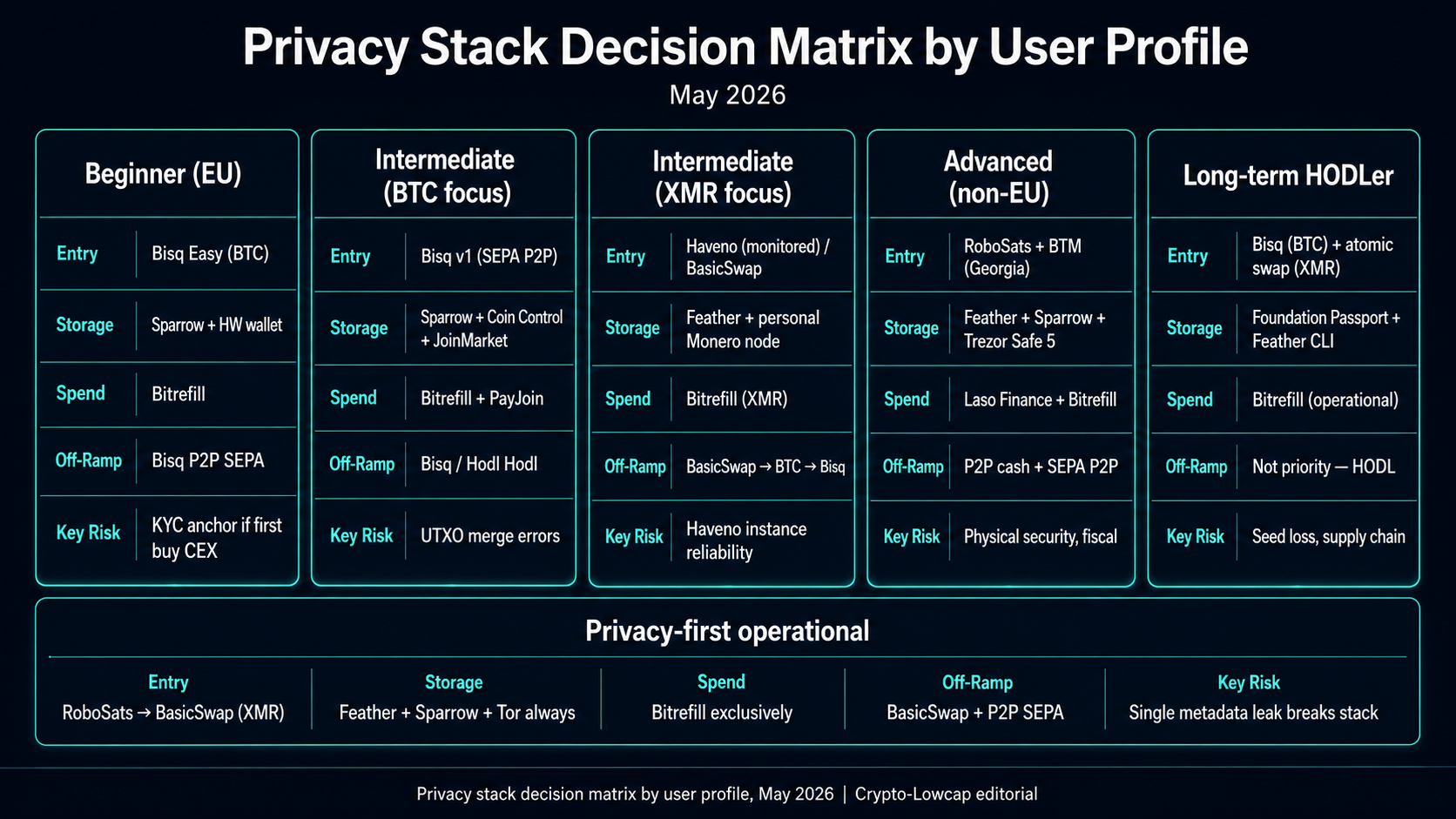
10. Decision Matrix: The Right Stack for Your Profile
10.1 Week-One Action Plans by Profile
The decision matrix above tells you what stack matches your profile. The checklists below tell you exactly what to install, in what order, and in how much time. Start with the profile that matches your current situation, not your aspirational one.
Profile A — The Cautious Investor
Who you are. You are invested in crypto through regulated channels. You want to reduce commercial profiling, protect your holdings from public exposure, and maintain fiscal compliance. You are not trying to hide anything from authorities — you are trying to avoid being a data product. Setup goal: 2 hours on a single Saturday morning.
- Create a dedicated email address for all crypto activity (ProtonMail or Tutanota — free, no phone number required with Proton). Use this email nowhere else. This separates your crypto footprint from your commercial identity.
- Download and install Sparrow Wallet (sparrowwallet.com). Verify the PGP signature. Create a new native SegWit (P2WPKH) or Taproot wallet. Write your seed phrase on paper immediately. Store offline.
- Install Tor Browser (torproject.org). Configure Sparrow to use Tor proxy (127.0.0.1:9150) per the setup instructions in Section 3.1. This is your first hour of work.
- Make your first no-KYC Bitcoin acquisition via Bisq Easy (Android or desktop): download the app, browse offers, complete a small SEPA test trade (€50–100). Verify the sats arrive in Sparrow.
- Download Feather Wallet (featherwallet.org). Verify signature. Configure with a remote node (let Feather manage the list). Create a Monero wallet. Write 25-word seed offline.
- Set up Bitrefill with your dedicated email. Make one small gift card purchase (€10–20) to validate the workflow. This is your no-KYC spending channel.
- File your Cerfa 3916-bis if you hold any foreign crypto accounts. Document your acquisition history for fiscal compliance (any spreadsheet is sufficient).
What NOT to do. Do not merge your Bisq-acquired Bitcoin with any Bitcoin from a KYC exchange in the same Sparrow wallet or transaction. Keep the accounts labeled separately and never spend from both in the same transaction. That is the most common and most irreversible privacy mistake.
Estimated setup time: 2 hours for steps 1–6, plus ongoing fiscal record-keeping.
Profile B — The Privacy-Aware Operator
Who you are. You want genuine compartmentalization between your KYC identity and your crypto activity. You understand that perfect anonymity is not achievable, but you want to make analysis costly and non-trivial. You are prepared to invest a weekend. Setup goal: 1 weekend, operational by Monday.
- Install SimpleLogin (simplelogin.io) or AnonAddy for alias email management. Create unique aliases for each service you register with. No service gets your real email address. Paid plan ($30/year) removes limits.
- Install Tor Browser and make it your default browser for all crypto-related activity. Consider a dedicated device or at minimum a separate browser profile with no Google/Meta extensions.
- Follow the Feather Wallet setup instructions (Section 3.2) completely, including PGP signature verification. Configure Feather to connect to your own Monero node if you have one, or the managed remote node list if not.
- Configure Sparrow Wallet with Tor (Section 3.1). Enable Coin Control and label all UTXOs by source from day one. Create separate wallets for KYC-sourced and non-KYC-sourced funds. They must never interact.
- Set up JoinMarket (github.com/JoinMarket-Org/joinmarket-clientserver) for on-chain Bitcoin privacy. Start as a Taker on a small UTXO (0.001–0.01 BTC) to understand the interface before committing larger amounts. This is the weekend’s most complex step — allocate 3–4 hours including documentation reading.
- Set up the BasicSwap DEX (basicswap.io) for BTC → XMR atomic swaps. Install, configure, and execute a test swap with a small amount to validate the workflow. Document your source-of-funds trail for each swap.
- Subscribe to Mullvad VPN (mullvad.net). Pay with Monero (10% discount). Use for all non-Tor daily browsing. Do not use Mullvad and Tor simultaneously on the same connection — choose one per context.
What NOT to do. Do not use Wasabi Wallet’s community coordinators as your primary CoinJoin tool without verifying the current coordinator status. JoinMarket is the more technically sound option and has no centralized dependency. Do not deposit JoinJoined outputs into a KYC exchange in the same wallet — the 6-hop minimum for CoinJoin anonymity sets assumes you manage the output correctly.
Estimated setup time: 8–12 hours across a weekend. Ongoing maintenance: minimal once configured.
Profile C — The Pragmatic Cypherpunk
Who you are. You want infrastructure-level independence: no CEX in any flow, minimal reliance on third-party services, maximum operational security. You are technically comfortable and willing to invest 2 weeks of setup time. Setup goal: 2 weeks, fully operational.
- Tails OS (tails.boum.org) on a USB drive (8GB minimum). Verify the cryptographic signature. Boot from USB for all sensitive crypto operations. Tails is amnesic by default — nothing persists unless you configure the encrypted persistent storage. Use persistent storage for your wallet seeds and configurations, but treat the OS session as a clean room.
- Set up a dedicated Monero full node on a separate device (old laptop, Raspberry Pi 4 with 512GB SSD). Download the Monero blockchain (~215GB). Connect Feather Wallet to your own node’s IP or .onion address. This is your week-one priority — the sync takes 24–48 hours and needs to be running continuously.
- Acquire Bitcoin via RoboSats over Tor (follow the step-by-step in Section 2.2). Use Phoenix Wallet for the Lightning side. Keep amounts under 0.05 BTC per trade. Do not use your home network for RoboSats access — use mobile data or a public network routed through Tor if maximum operational security is required.
- Execute a BTC → XMR atomic swap via BasicSwap for all acquired BTC you want to hold privately. Document each swap with date, amount, and exchange rate for tax records. The XMR you receive has no on-chain history connecting it to the BTC you sent.
- For fiat off-ramp, set up Bisq v1 and execute a small test SEPA trade (0.001–0.005 BTC) to validate the workflow. For ongoing off-ramp at meaningful amounts, maintain relationships with 2–3 trusted P2P counterparties met at Bitcoin/Monero meetups.
- Pay Mullvad VPN in XMR (mullvad.net accepts Monero). Use Mullvad for daily browsing. Use Tor Browser for all crypto-related activity, wallet access, and RoboSats. Never route Tor over VPN in the same session.
What NOT to do. Do not install crypto wallets on your daily-use device if it has any Google, Apple, or Microsoft account logged in. The attack surface is too large. Tails on a dedicated USB, or a clean-install Linux device with no cloud services, is the correct infrastructure.
Estimated setup time: 2 weeks for full node sync + all wallet configuration. This is not a weekend project. The investment reflects the threat model.
Profile D — The Business / Compliance-First User
Who you are. You operate in a professional or semi-professional capacity. Legal compliance is non-negotiable. You want maximum privacy within those boundaries — using the tools the law permits, not fighting the law. Setup goal: 3–4 hours, sustainable long-term.
- Set up Zcash with shielded-first configuration. Download YWallet (ywallet.app) or Zashi (z.cash/wallets). Critically: ensure all receives and sends use shielded addresses (Unified Addresses, Orchard pool). Transparent Zcash transactions provide no privacy benefit. Verify in the wallet settings that shielded is the default for every transaction.
- Install Sparrow Wallet and configure PayJoin (BIP-78) for recurring payments where counterparties support it (BTCPay Server merchants, specific services). PayJoin provides transaction privacy that is legally unambiguous and generates no regulatory flags. Enable Coin Control for manual UTXO management.
- Set up Bitrefill as your primary spending channel. Create an account with your dedicated crypto email. Use for all digital subscriptions, gift cards, and everyday purchases where crypto can substitute for trackable payment methods.
- For fiat on-ramp: use a MiCA-compliant CEX (Kraken, Bitstamp) with full KYC. Do not attempt to circumvent verification. Maintain a comprehensive acquisition record: date, exchange, price, EUR equivalent at time of purchase. This is your source-of-funds documentation.
- For fiat off-ramp: same CEX with documented source-of-funds trail. For each off-ramp exceeding €1,000, maintain a written record of the acquisition, any intermediate conversions, and the final disposal. Your accountant will need this.
- File Cerfa 3916-bis for all foreign crypto accounts. Declare capital gains via PFU (31.4%) on your annual return. If annual disposals are under €305, you are in the exemption zone.
What NOT to do. Do not use CoinJoin outputs when planning a documented off-ramp through a regulated exchange. The compliance department will ask questions. The cleanest compliance-first path keeps BTC and ZEC (shielded) in separate wallets with documented acquisition history, and uses only Bitrefill or PayJoin for spending.
Estimated setup time: 3–4 hours. This profile has the least friction and the clearest legal standing. The tradeoff is higher institutional visibility — which is the conscious choice you are making.
11. Risks and Red Flags: What to Watch For
KYC retroactivity. Multiple services launched as no-KYC have imposed full identity verification after user funds were deposited. SolCard is the canonical 2025 example. Laso Finance, BingCard, and similar services all carry this structural risk. Never deposit significant amounts in a service you have not tested with a small amount first, and never rely on stated KYC status without checking current community reports on Reddit and Telegram.
The TradeOgre warning. The September 2025 shutdown of TradeOgre by Canadian law enforcement and Europol — with $40M in user funds seized — is the most important cautionary tale for 2026. The complete absence of any AML procedure made the platform an inevitable enforcement target. Users had zero legal recourse for seized funds. Any CEX marketing itself as ‘no-KYC’ is a structural legal liability and a seizure risk, not a privacy solution.
Taint contamination. UTXOs linked to Tornado Cash, sanctioned services, or algorithmically flagged addresses are blacklisted by compliance teams at all major exchanges. Monero’s structural fungibility makes this category of risk architecturally impossible — no XMR carries visible transaction history. This is one underappreciated reason to hold operational balances in XMR rather than BTC.
The metadata failure mode. Using a privacy wallet from your home IP, on a device logged into Google, while your VPN is off, collapses most of the on-chain privacy you built. Privacy is a stack with layers that reinforce each other. One weak layer — a single unTorred broadcast, a single address-IP correlation — can compromise the entire construction.
Fiscal omissions. DAC8 means exchange transaction histories are being automatically transmitted to fiscal authorities. In France, the DGFiP shares atypical flows above €8,000 with Tracfin. Undeclared capital gains are no longer a practical option for users with exchange history — the data is flowing automatically. Correct fiscal declarations are not just legal hygiene; they are the only sustainable exit strategy for meaningful holdings.
12. Verdict: What a Coherent Privacy Stack Looks Like in 2026
Here is my synthesis after cross-referencing multiple research sources and operational testing. Privacy in crypto in 2026 is not a product. It is a discipline with three interdependent layers. Getting one right without the others achieves little.
The technical layer: non-custodial wallets (Sparrow + Feather + Cake), privacy coins (XMR for default, ZEC for selective disclosure), on-chain privacy techniques (JoinMarket CoinJoin, PayJoin via Sparrow, atomic swaps via BasicSwap), and network hygiene (Tor native in Feather, configurable in Sparrow, Mullvad as fallback, personal node where feasible).
The behavioral layer: UTXO discipline enforced via Coin Control, strict address non-reuse, permanent separation of KYC and non-KYC fund contexts (they must never touch), Tor active on every wallet connection, discretion about holdings.
The legal layer: realistic fiscal compliance (DAC8 and Tracfin make avoidance structurally untenable), clean acquisition documentation for any amount that might reach a regulated off-ramp, and clear understanding that the AMLR deadline shrinks the regulated XMR acquisition window to under 14 months from this publication date.
| WHAT I RECOMMEND Entry: Bisq Easy (beginners) or Bisq v1 / Haveno (with caution post-hack) for XMR acquisition. Storage: Feather Wallet (XMR, desktop) + Cake Wallet (mobile) + Sparrow Wallet (BTC). Hardware: Trezor Safe 5 for cold storage, Foundation Passport for Bitcoin-only air-gapped storage. On-chain privacy: JoinMarket for Bitcoin CoinJoin. BasicSwap for BTC/XMR atomic swaps. PayJoin for compatible merchant transactions. Spending: Bitrefill as primary channel. Laso Finance for isolated card-based spend (small amounts, non-EU users preferably). Off-ramp: P2P SEPA via Bisq or Hodl Hodl. Peach Bitcoin for Swiss-exempted flows. Network: Tor native in Feather and configured in Sparrow. Mullvad for daily operations. Own node for maximum metadata security. |
| WHAT I DO NOT RECOMMEND Mixer services associated with OFAC sanctions (Tornado Cash for EU users). No-KYC cards from unverifiable issuers (Goblin Cards, NexasCard, PintoPay, Zentro). Any CEX marketing itself as ‘no-KYC’ — TradeOgre is the cautionary tale. Samourai Wallet in any form (convicted founders, compromised infrastructure). Haveno / RetoSwap for significant amounts until post-hack audit is complete. The fiction that any of these tools provide absolute anonymity. Cash P2P at scale in the EU as a primary strategy. |
Key Takeaways
- MiCA/AMLR is structural, not temporary. The July 2027 AMLR deadline is the next hard constraint. Plan now.
- The first purchase determines your privacy baseline for everything downstream. A KYC anchor is permanent.
- Samourai is dead. zkSNACKs is dead. TradeOgre is dead. LocalMonero is dead. RetoSwap is suspended post-hack. Your mental model of the toolset needs to reflect 2026, not 2022.
- JoinMarket and community Nostr-discoverable Wasabi coordinators are the functional CoinJoin options. JoinMarket is more technically sound.
- Feather Wallet + personal Monero node is the strongest XMR privacy stack. Sparrow + JoinMarket + hardware wallet is the strongest BTC privacy stack.
- Bitrefill is the most credible no-KYC spending channel. Use it before any card product.
- No-KYC crypto cards are a gray zone at best and an exit scam at worst. SolCard and TradeOgre are the 2025 case studies. Test with small amounts before committing.
- DAC8 reporting means exchange histories reach fiscal authorities automatically. Correct declarations are not optional.
- Privacy is a stack. Every layer — technical, behavioral, legal — matters. One weak link compromises the whole construction.
- The AMLR window for regulated XMR acquisition closes July 2027. The P2P routes (Bisq, Haveno when recovered, BasicSwap) are not CASPs and are not covered. Build your stack while the routes exist.
Last updated: May 2026. This is a living document. If you identify factual errors, service closures, or material updates, reach out via @CryptoRowenta01 on X. Next revision planned: Q3 2026 following AMLA supervisory launch and Haveno post-hack audit results.