NØNOS: The Privacy OS That Actually Thinks About What It Is Doing
NØNOS privacy OS is a first-principles operating system built in Rust, with real post-quantum cryptography and a team that answered every hard question I put to them, twice. The technology deserves the attention. The token deserves the caution.
| ⚠️ BEFORE WE START — NOT FINANCIAL ADVICE This article does not constitute investment advice. These are purely personal observations from a fundamental analyst who has been covering the privacy crypto space since 2016. Micro-cap and low-cap projects carry significant risk. The positions and opinions expressed here are my own. Do your own research. |
I have covered privacy-focused projects since 2016, including in my earlier comparative look at Xelis, NØNOS, and Salvium. I have seen hundreds of projects claim to be ‘secure by design.’ Most of them mean they run over HTTPS and have a privacy policy. NØNOS is something different, and I want to be precise about what that means and what it does not mean yet.
The premise is simple and correct: every privacy tool people use, Monero, Signal, Tor, runs on an operating system that was never designed to forget. Linux accumulates state. macOS syncs with the cloud. Windows logs everything by default. The foundation is leaky, and adding privacy layers on top of a leaky foundation is damage control, not a solution. NØNOS is an attempt to rebuild the foundation.
I spent several weeks on this project before writing a word. I read the Whitepaper v2 (May 2026) in full. I went through the GitHub repository NON-OS. I cross-checked the on-chain data. Then, through a contact in the NØNOS community, I submitted a written questionnaire directly to the team. They answered all seventeen questions in full, without a PR filter. Once I had a draft, I went a step further and sent it back to them for a technical accuracy pass, because a codebase moving this fast can outrun a whitepaper snapshot in a matter of weeks. It did. Several of my original claims were dated rather than wrong, and one was a real correction. I have incorporated all of it below, sourced and labeled.
What follows is an analysis built on that full process. I want to be clear upfront about two things. First, this is a project I find genuinely compelling at the technical level, and I will not hide that. Second, the token associated with the project raises real questions I address honestly, because a conviction on the technology is not the same as a position on a financial instrument. I hold both of those judgments simultaneously, and I think my readers are capable of doing the same.
Before we start
This article does not constitute investment advice. These are personal observations from a fundamental analyst covering the privacy crypto space since 2016. Micro-cap projects carry significant risk. The NOX token presents the characteristics of an extremely high-risk speculative instrument. Do your own research.
A note on methodology and sourcing
All quotes attributed to ‘NØNOS Team, June 2026’ come from a written exchange with the project team, conducted via a 17-question pre-publication questionnaire submitted through a community intermediary. A draft of this article was subsequently sent back to the team for a technical accuracy review, and their corrections, all sourced to specific file paths and verified against a live boot, are incorporated throughout. Quotes are reproduced in context without editing. No commercial arrangement exists between crypto-lowcap.com and NØNOS Systems.
Throughout this article: VERIFIED = confirmed independently on-chain, in the public repository, or via team-provided reproducible evidence I could cross-check. TEAM CLAIM = stated by the team, not independently confirmed at time of writing. ANALYST OPINION = my own interpretation.
1. Who Built This, and Why It Matters
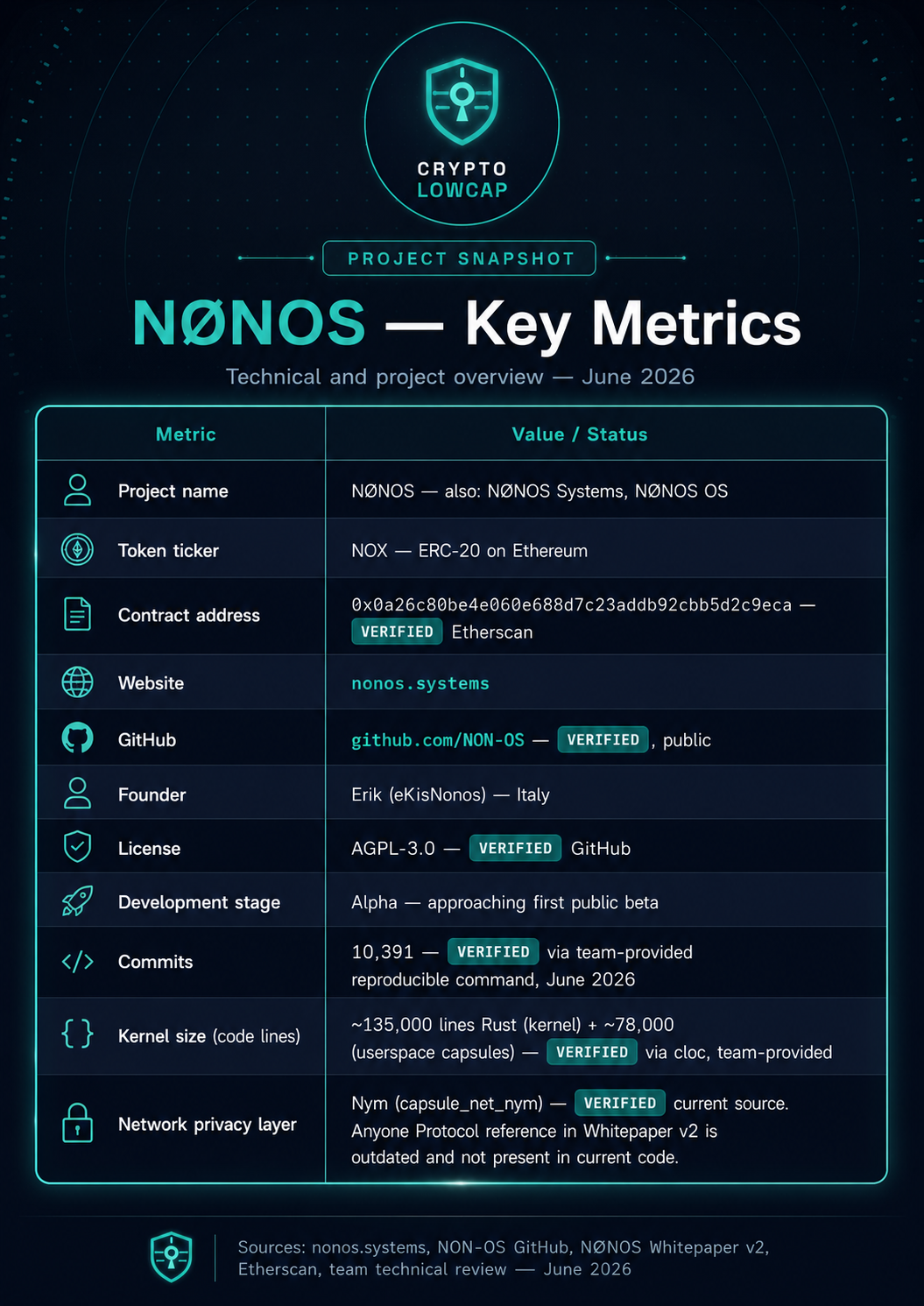
NØNOS was conceived and built almost entirely by a single developer, the pseudonym eKisNonos. His first name, Erik, appears on the official nonos.systems website. The GitHub organization NON-OS lists an Italian location. The contact is eK@nonos-tech.xyz.
The whitepaper carries the byline ‘By Erik (Founder),’ dated May 2026. VERIFIED — GitHub commit history, confirmed via team-provided reproducible command (git rev-list –count HEAD): the repository shows over 10,000 commits (10,391 at time of the team’s technical review), the vast majority from a single contributor. I want to sit with that number for a moment, because it is remarkable in both directions. It represents an extraordinary volume of real engineering output for one person. It also represents an extraordinary concentration of risk for any project that aims to become infrastructure.
There is no disclosed venture capital. VERIFIED — nonos-mint.xyz: the project raised through a hybrid round of 374 NFTs at 0.125 ETH each, offering buyers a share of future protocol revenues. The kernel operates under AGPL-3.0, with a more permissive license under consideration for wider distribution.
What Erik built, before we even get to whether it works at scale, is a coherent architectural argument. Microkernels have been theorized since the 1980s. What is new here is the combination: a kernel written in memory-safe Rust, with zero persistent state as a first-class design constraint rather than an afterthought, with hybrid post-quantum cryptography on every trust boundary, and with a tokenized application marketplace attached. No production OS today combines all four. That combination is what earned this project enough of my attention to spend several weeks on it, and to go back a second time before publishing.
2. The Architecture: A System That Earns Its Claims
I want to explain the architecture in terms that matter analytically, not just technically. The question is not ‘what does NØNOS do?’ The question is ‘what does NØNOS make impossible that other systems only try to prevent?’ Those are very different questions, and the answer to the second one is what makes this project worth covering.
2.1 ZeroState: The OS That Forgets
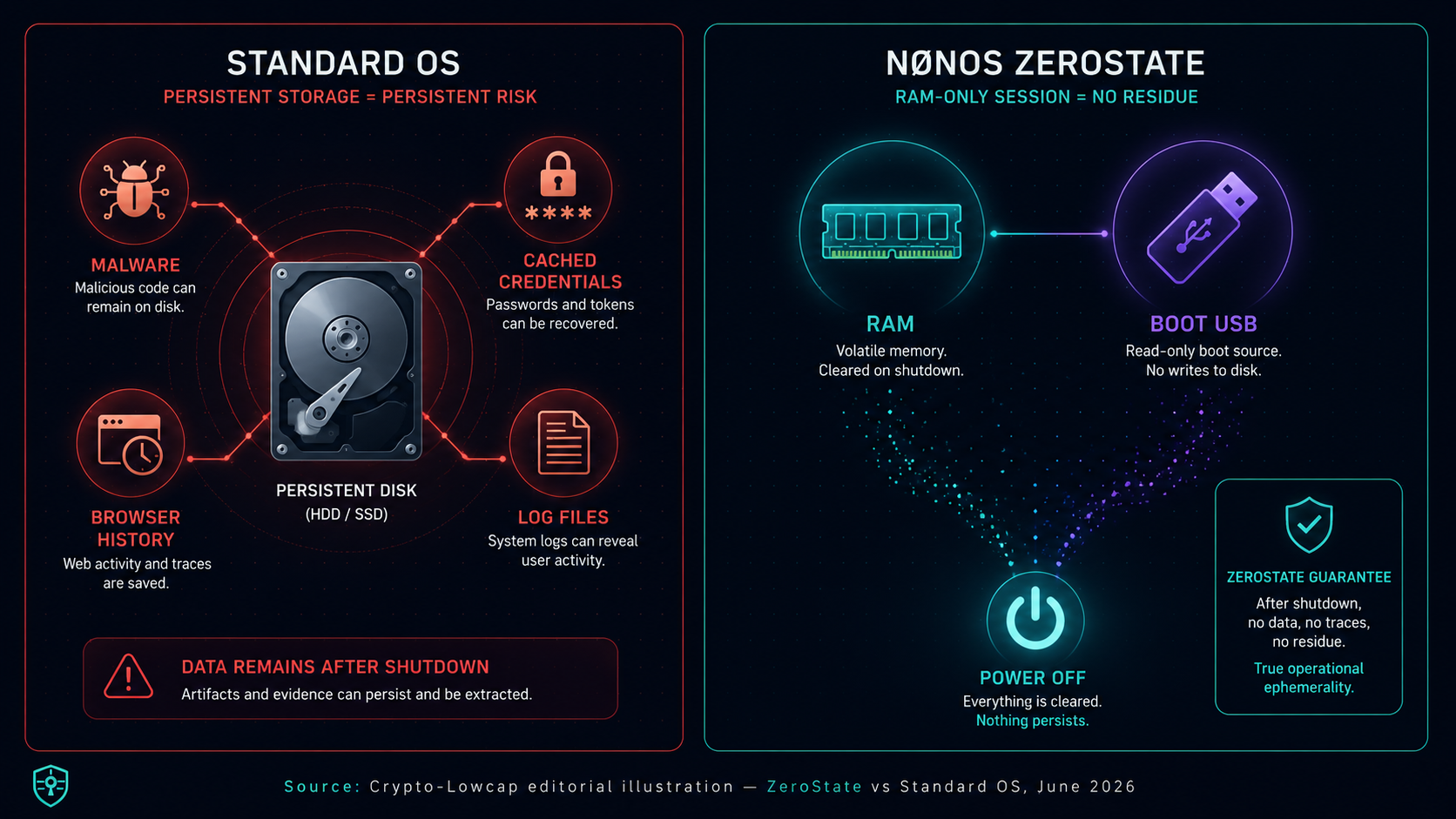
VERIFIED — whitepaper v2 and GitHub: the OS boots from external media via UEFI, loads everything into RAM, and operates exclusively from memory. When the machine stops, the RAM empties. No logs. No cached credentials. No installed applications. No malware. Nothing. The system starts clean every single time, and that is not a feature you can configure. It is what the system is.
Tails has done something similar for years. The difference is architectural depth. In Tails, amnesia is a userspace decision built on a Linux kernel that has no inherent interest in forgetting. In NØNOS, ZeroState is enforced at the kernel level. Persistence is not the default state the user has to opt out of. It does not exist as a concept unless you explicitly invoke it.
I pressed the team on what this means in practice, and their answer was one of the most important things said in our exchange.
|
🗣️ NØNOS TEAM SAYS “NØNOS is RAM-first and zero-state by design today. Production sealed persistence is a stable-release gate, not an afterthought. We should not encourage high-risk users to store sensitive long-term data until that gate is closed.” — NØNOS Team, June 2026 |
A project at a $1.5 to $1.7 million market cap, explicitly telling an analyst not to recommend their OS to vulnerable users yet, is not posturing. It is the kind of intellectual honesty that is extraordinarily rare in this space at any valuation. It is also the reason I trust the technical claims more than I would from a team that told me everything was ready.
To be precise about what ZeroState protects and what it does not: it eliminates post-reboot malware persistence, long-lived credential leakage, forensic analysis of seized hardware, and supply-chain compromise that survives reboots. It does not protect against active network surveillance during a session, cold-boot RAM extraction while the machine is running, or a malicious capsule that the user authorizes. The threat model is real and meaningful. It is not total.
2.2 Capsules: Limiting the Damage Before It Happens
VERIFIED — GitHub: every component in NØNOS runs as a capsule, a signed, capability-bounded process that declares exactly what it is permitted to do. Drivers, filesystems, network stacks, compositors, and applications are all capsules. None of them touch the kernel directly.
A browser capsule holds tokens that allow it to open specific network connections and write to a defined temporary folder. That is all it can do. If it is compromised, the attacker inherits those permissions and nothing else. They cannot touch the kernel. They cannot read another capsule’s memory. They cannot escalate. In Linux, a compromised driver is a compromised system. In NØNOS, it is a crashed capsule. The kernel respawns it with fresh grants. The rest of the system continues.
The hardware broker mediates all physical resource access through epoch-tagged grants that revoke atomically when a capsule dies. This means driver crashes are recovery events, not failure cascades. ANALYST OPINION: this is the correct architectural answer to the observation that software will always get compromised. The question worth asking is not whether an application can be exploited, but what an attacker gains when it is. NØNOS’s structural answer is: exactly what was declared in the manifest, and nothing more.
2.3 Post-Quantum Cryptography: Designing for 2031, Not 2026
VERIFIED — GitHub (nonos-sign/src/wire/) and NIST FIPS 204 (August 2024): every component in the trust chain carries two signatures. Ed25519, the current best-practice classical algorithm, and ML-DSA-65, standardized by NIST in August 2024. Both must verify for any component to be accepted by the kernel.
A precision worth making cleanly, at the team’s own request: the trust chain’s signature mechanism is specifically Ed25519 + ML-DSA-65. A separate primitive, ML-KEM-768 (Kyber), also exists in the cryptography library (src/crypto/pqc/kyber.rs), but it handles key encapsulation for encryption and key exchange, not signatures. Both are real, both are post-quantum, and they do different jobs. Conflating them into a single ‘post-quantum trust chain’ claim, which I initially did, overstates what the signature mechanism itself uses.
The reasoning behind the dual signature is straightforward. A capsule signed today will still be running on some machine in 2031. If Ed25519 is broken by a quantum computer between now and then, the ML-DSA-65 signature still holds. If the lattice-based scheme has an unexpected flaw, the classical signature still holds. Breaking one does not break the chain. This requirement is enforced in the kernel source and cannot be bypassed in the production build.
TPM Measured Boot and Anti-Rollback
VERIFIED — team-provided reproducible evidence (qemu-serial.log grep for ‘MeasuredBoot: ACTIVE’ and ‘tpm-counter: monotonic’): a more recent addition strengthens this further. The UEFI bootloader now performs TPM 2.0 measured boot, extending PCR 8, 9, and 14, and enforces an anti-rollback index against a TPM monotonic counter, so an older signed kernel is refused even if validly signed. This was not in the original whitepaper snapshot I worked from and represents genuine progress on the trust chain since May 2026.
2.4 Zero-Knowledge Attestation: Transparent, Not Trusted-Setup
This is the section where my original draft contained a real error, and I want to correct it plainly rather than bury it. I had written that NØNOS’s ZK system relied on a single-party trusted setup, carrying the theoretical risk that the team held ‘toxic waste’ parameters capable of producing forged proofs. That was accurate for the architecture described in Whitepaper v2. It is no longer accurate for the current codebase.
VERIFIED — GitHub (src/crypto/zk_kernel/pedersen.rs, membership.rs, equality.rs, and the attest/ and range/ directories): the capsule attestation system has moved to a transparent zero-knowledge scheme. Pedersen commitments with Chaum-Pedersen equality proofs, and a BLAKE3 Merkle policy-membership tree over edwards25519. There is no trusted setup, no ceremony, and no trapdoor or toxic waste to distrust. This was a deliberate architectural move away from any setup-dependent construction, and it removes a category of risk I had flagged as open. The multi-party ceremony I listed as a required future milestone (M-MPC) is not pending. It is obsolete by design.
The same transparent scheme attests both trust boundaries: the kernel at the boot boundary (verified by the bootloader, nonos-bootloader/src/zk/attest/verify/boot.rs) and each capsule at the spawn boundary. I asked the team to explain, in plain terms, what this attestation actually does, and their answer remains the clearest description I have read on this topic from any source.
|
🗣️ NØNOS TEAM SAYS “ZK in NØNOS does not mean the OS proves every future instruction of an application. It does not replace memory isolation. It does not replace capsule capabilities. ZK today is admission evidence. A capsule carries a proof showing membership in an enrolled policy set without revealing the enrolled secret. The proof is bound to the capsule binary hash, the granted capability mask, and the policy epoch. The kernel verifies the proof during spawn. If the proof is absent or invalid, the capsule is rejected. The OS story is not ‘ZK everywhere’ as a vague phrase. It is boot proof at boot boundary and capsule proof at spawn boundary, with ordinary OS mechanisms enforcing runtime behavior after admission.” — NØNOS Team, June 2026 |
Live on the Spawn Path
VERIFIED — team-provided reproducible evidence (qemu-serial.log grep for ‘[ZK-ATTEST] ok’, count: 43 on the captured boot): this is not a theoretical claim. On a live boot, every spawned capsule is individually attested and logged. This directly corrects a second error in my original draft, where I had characterized ZK verification at the spawn boundary as ‘tests only,’ relying on an older whitepaper snapshot. It is live, on the operational spawn path, today.
What remains an open and legitimate caveat, and one the team did not ask me to soften, is the absence of an external cryptographic audit of this scheme or any other part of the codebase. Transparent does not mean audited. I address that directly in the risk section below.
3. What You Can Do With It Right Now
This is where I want to be very precise, because early-stage OS projects have a history of conflating ‘it compiles’ with ‘it works.’ The NØNOS team surprised me on this question, both by correcting my initial characterization and by being specific about what ‘works’ means to them.
|
🗣️ NØNOS TEAM SAYS “NØNOS is not QEMU-only, but broad bare-metal support must be promoted from source capability to supported hardware through evidence. A platform becomes supported when there is a reference-machine dossier: boot logs, handoff dump, memory map, PCI inventory, IRQ routing, IOMMU evidence, reboot evidence, and soak results. That is not a small claim. It is a disciplined one.” — NØNOS Team, June 2026 |
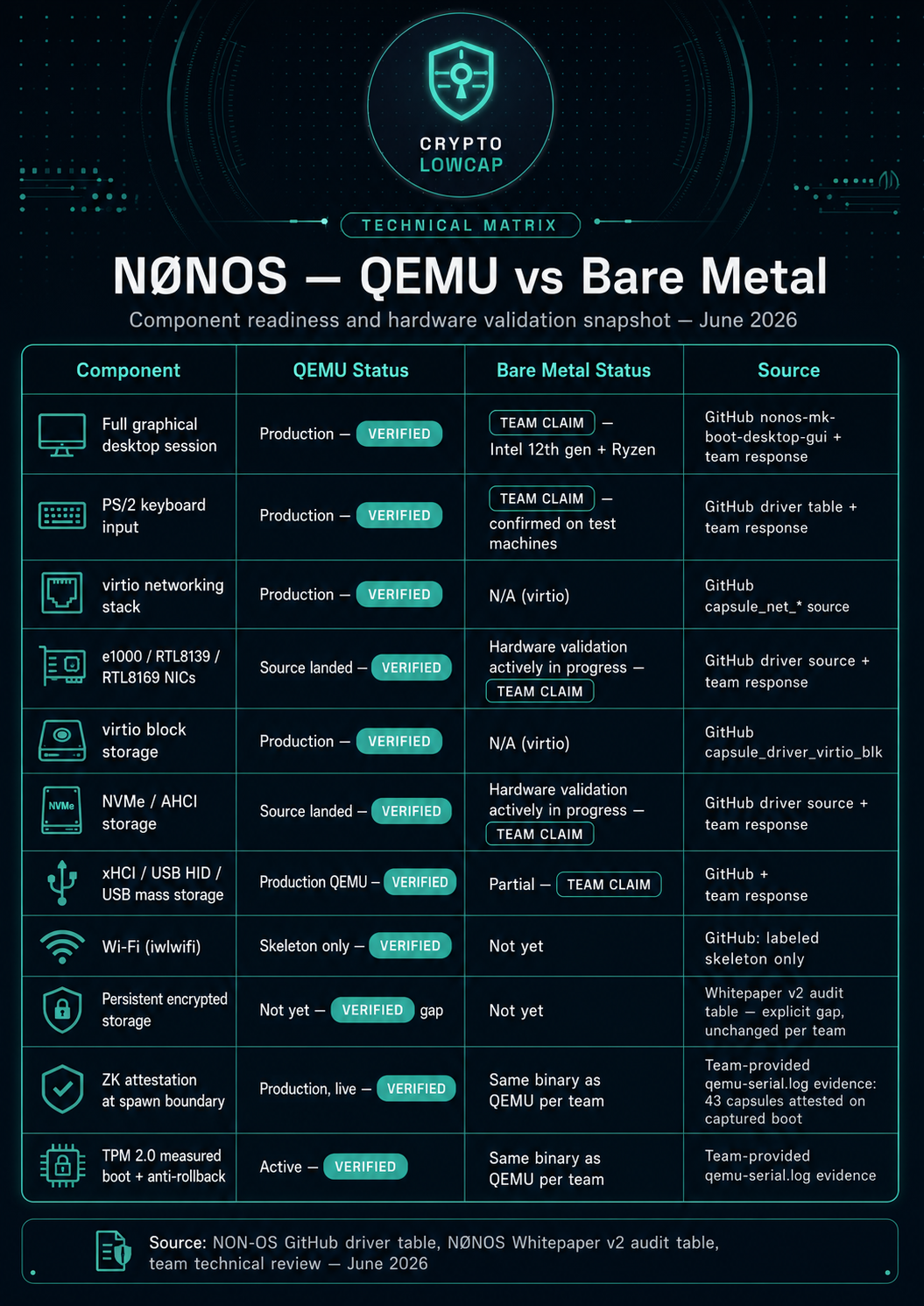
TEAM CLAIM — unverified independently: the team states the kernel boots on a 12th-gen Intel laptop and a Ryzen workstation, with framebuffer output and PS/2 input confirmed on physical hardware. I have not been able to independently verify these dossiers from public sources. The team notes hardware validation is actively in progress, and that the QEMU production path runs the same kernel binary, the same drivers-as-capsules, and the same verified-boot chain as physical hardware, meaning QEMU is a faithful stand-in rather than a different product. The remaining step is publishing per-machine reference dossiers, which the public beta and community testing are intended to produce.
VERIFIED — GitHub and whitepaper v2: in the QEMU production path, the full graphical session is functional. Boot, graphical desktop, launcher, terminal, text editor, userland services. This is a real operating system running in a virtual machine, not a demo video or a mockup. A security researcher or kernel engineer can boot it today and inspect its behavior.
Latest Update from the Team
| 🛠️ LATEST UPDATE — early July 2026 Via their official X account, the NØNOS team confirmed active work on a from-scratch Rust web browser (no standard library) running natively inside the OS, alongside hardening of the entire network stack: an in-house TLS implementation, HTML and CSS engines, layout, and image/SVG decoders, none of it borrowed from existing libraries. The full system, microkernel and bootloader, continues to run exclusively in RAM and erases itself on shutdown, in line with the ZeroState model detailed earlier. The team says the build is still rough in places and has been transparent about current gaps and upcoming milestones, with a public beta described as imminent, alongside a promised dev clip showing real sites, the stacks behind them, and the team’s own explanations of the current state. |
Who Can Use It Today
I asked the team directly: who can realistically use NØNOS today? Their answer was, again, precisely calibrated.
|
🗣️ NØNOS TEAM SAYS “Security researchers can benefit today. Kernel engineers, driver engineers, cryptographers, privacy-infrastructure builders can benefit today. Journalists, financial-defense users, and high-risk anti-telemetry users are exactly the users the project ultimately cares about. They are also the users we should be most careful not to mislead. A privacy operating system should not ask vulnerable people to trust unfinished claims.” — NØNOS Team, June 2026 |
I find that last sentence important enough to say again in my own words. NØNOS is not ready for operational use by the people who need it most. The team knows this, they said so without prompting, and the appropriate response from an analyst is to respect that honesty rather than paper over it.
4. The Network Layer: Nym, Confirmed
In my original draft, I flagged a discrepancy I could not resolve: the whitepaper and codebase documented Anyone Protocol integration, while the team’s exchange named Nym as the current active implementation. I said I would rather name an unresolved discrepancy than absorb it silently. The team’s technical review resolved it.
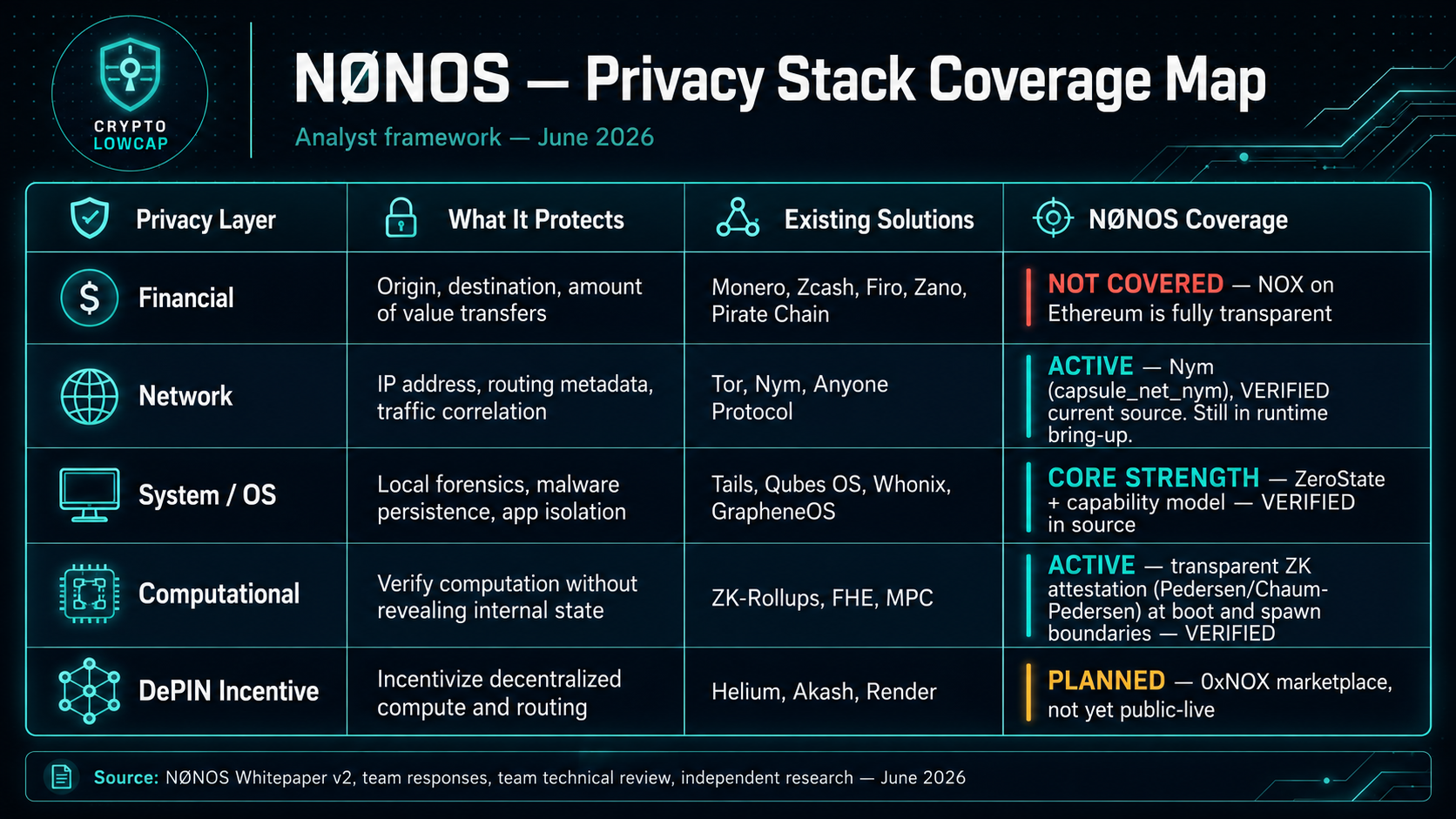
VERIFIED — current GitHub source: there is no onion.rs and no Anyone Protocol integration in the current codebase. The anonymity and network-masking capsule present in the tree is Nym, implemented as capsule_net_nym. The Anyone Protocol reference in Whitepaper v2 is a legacy reference that did not carry forward into the current code. The discrepancy I flagged is resolved in favor of Nym, not left open.
A fair caveat the team offered without my asking, which I want to preserve because it is exactly the kind of qualifier that builds credibility rather than undermining it: the networking stack is still in runtime bring-up. Nym is an implemented capsule, not yet a hardened, runtime-proven-at-scale system. That distinction matters for anyone evaluating the network privacy layer’s current maturity.
5. Where the NØNOS Privacy OS Sits in the Privacy Ecosystem
Before covering what NØNOS does not do, I want to be precise about what it is not competing with. Comparing NØNOS to Monero or Zcash is a category error. Monero protects who sent money to whom and how much, a decade-long story of cryptographic resistance in its own right. NØNOS protects the machine on which that transaction was generated. These address different threat vectors and the correct relationship between them is combination, not competition.
A Monero transaction generated on a compromised Windows machine with keyloggers is still Monero. The transaction is private on-chain. What happened before it was signed is not. NØNOS addresses the before. Privacy coins address the transaction itself. A user who genuinely needs both types of protection needs both tools, a point I explore further in my broader analysis of financial privacy on the blockchain.
|
🗣️ NØNOS TEAM SAYS “Tails and Qubes should be treated with respect. They solve real problems for real users today. NØNOS is working at a different layer. It is not a privacy distribution on top of Linux, and it is not a Xen desktop. The honest relationship today is complementary. The future overlap depends on NØNOS passing the hard gates: audit, hardware validation, persistence, networking, and release operations.” — NØNOS Team, June 2026 |
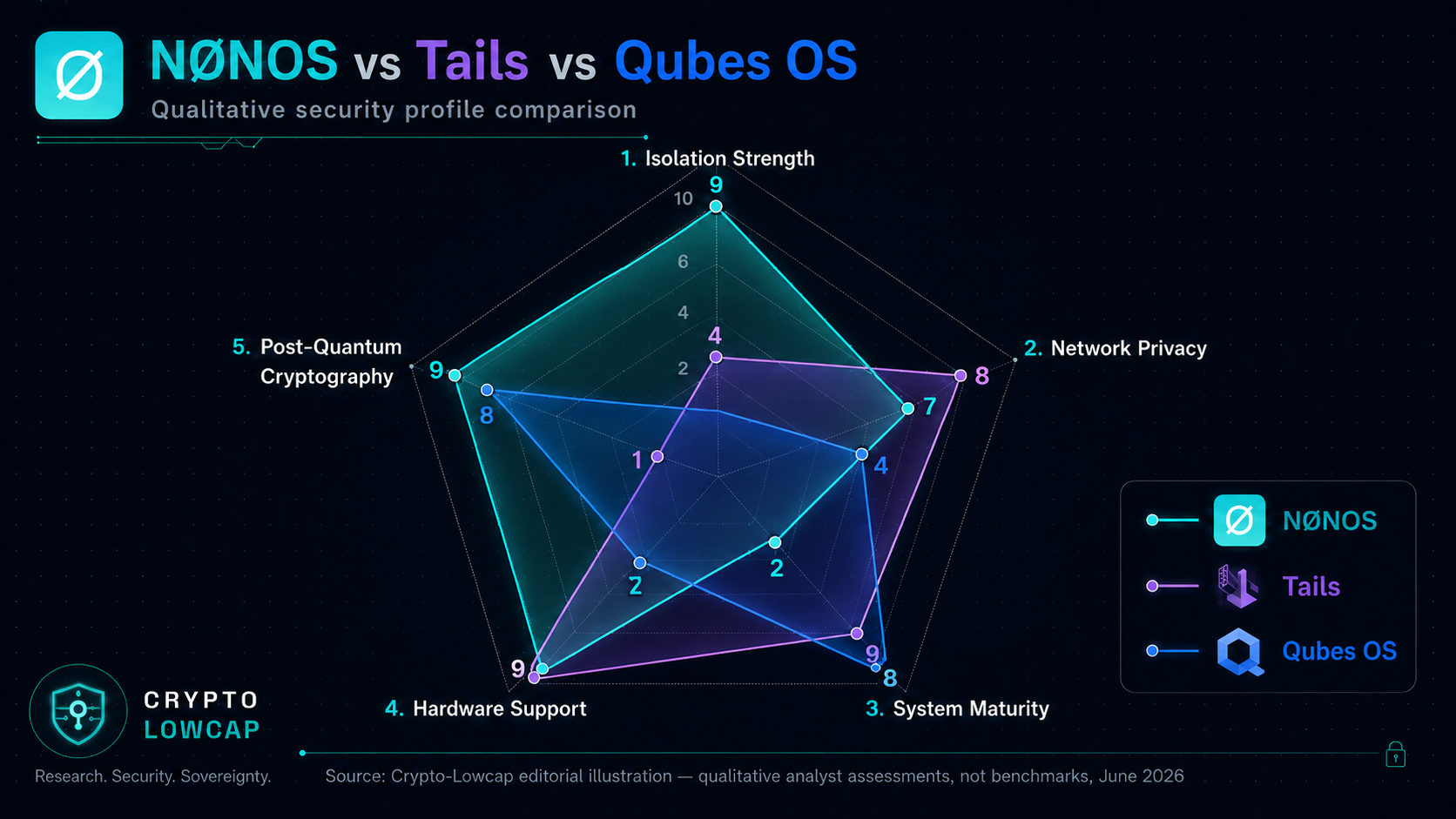
That framing is accurate and I share it. Tails gives a mature amnesic environment for Tor usage. Qubes gives mature VM-based compartmentalization. NØNOS is attempting something architecturally more radical: making the base OS primitive itself smaller and stricter. For ordinary end users who need to protect sources today, Tails is the right tool. For researchers and builders who care about what privacy computing could look like at the OS level, NØNOS is already giving them something to inspect and critique.
6. How It Compares to Mature Alternatives
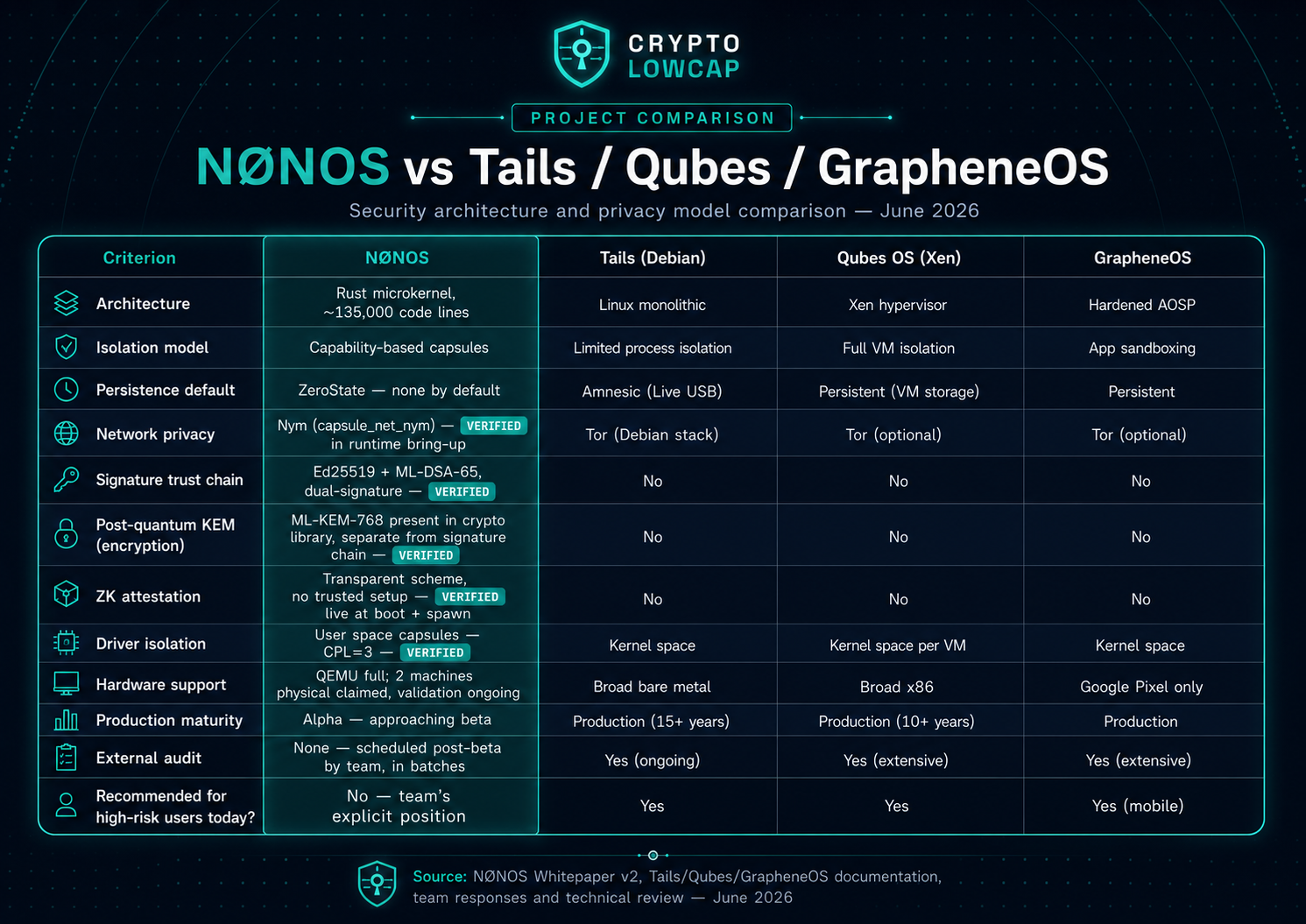
The second-to-last row deserves a moment. The team’s position on external audit is not that it is unnecessary. It is that auditing a codebase that is still changing weekly burns a one-time, expensive review on a moving target. Their stated plan is to ship the public beta, stabilize the surface through community testing, and then commission external audits in batches against a stabilized codebase. That is a defensible sequencing argument, not an excuse. I still count the absence of any audit today as a live risk in the section below, because intentions do not substitute for verification. But the reasoning is worth stating plainly rather than reducing to ‘no audit.’
On the last row: NØNOS is not yet the right choice for the users it ultimately wants to serve. That is the team’s own explicit position, restated consistently across our exchange.
7. The Token: Where I Have Questions
I want to approach this section differently from how I would approach it in a standard project analysis. The questions I have about the NOX token are real. They are not rhetorical. And some of them received partial answers in the team exchange that moved my position, while one figure needed a direct correction.
The market reality
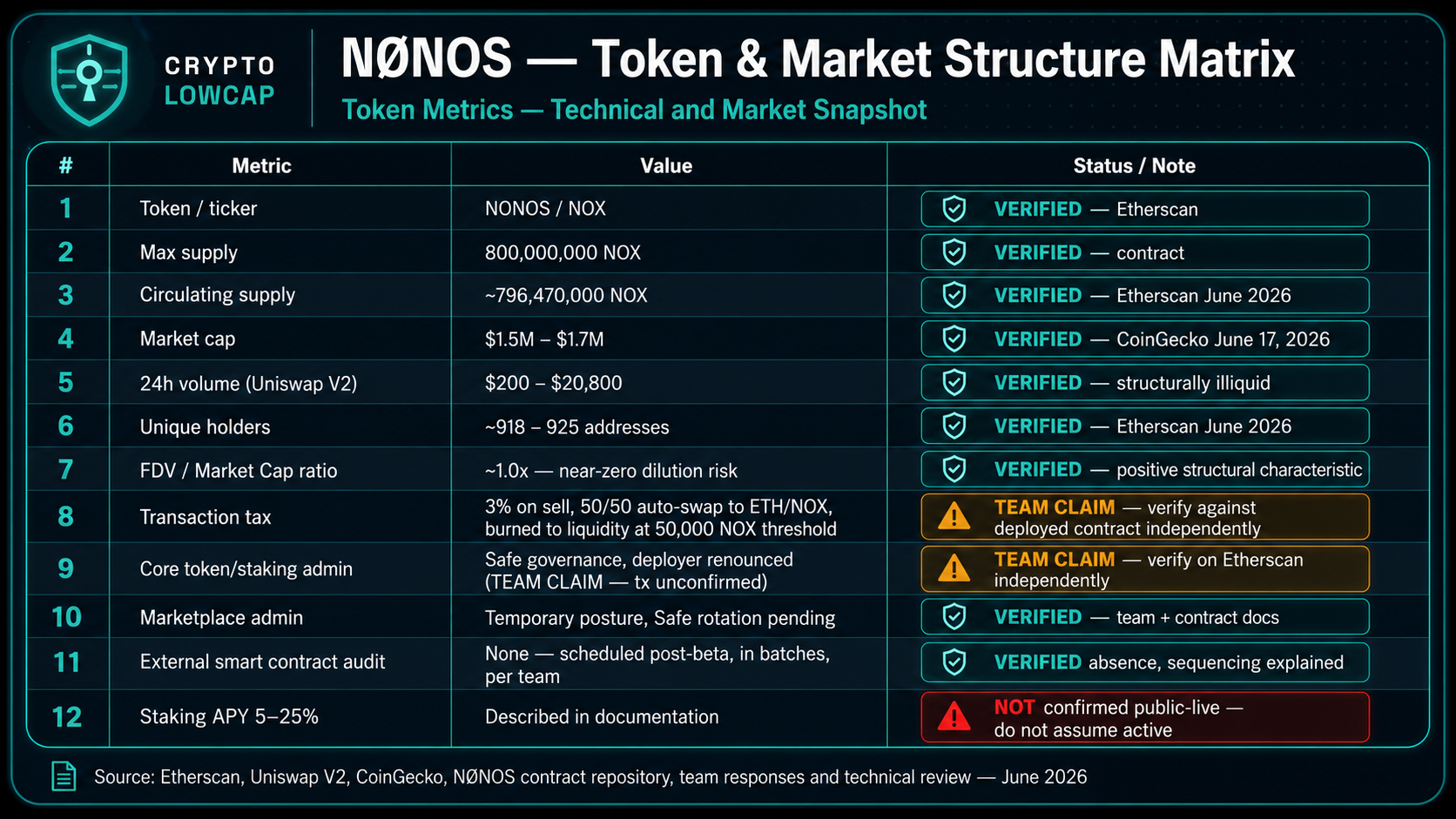
VERIFIED — Etherscan, Uniswap V2, CoinGecko (June 17, 2026): max supply 800 million NOX. Circulating supply approximately 796.47 million. Market capitalization $1.5 to $1.7 million. Unique holder addresses approximately 918 to 925. 24-hour trading volume on Uniswap V2: between $200 and $20,800. Those numbers are accurate and they describe a token with the effective absence of a functioning secondary market.
The team answered this directly when I raised it, and asked me not to soften the read.
|
🗣️ NØNOS TEAM SAYS “Liquidity is early, and that should be said plainly. Thin liquidity means slippage, poor execution, and limited market depth. Nobody should pretend otherwise. The important distinction is that infrastructure and liquidity are not the same thing. The plan should be real utility first, not artificial volume.” — NØNOS Team, June 2026 |
I accept that distinction. VERIFIED — public contract repository: the infrastructure exists. Token, staking, registry contracts, bridge, swap routing, marketplace base contracts. What does not yet exist is the complete public utility loop that connects those pieces to the OS-side install path. Until that loop is operational, the token’s primary use case is speculative. That is a factual description, not a criticism.
One structural observation worth noting: with approximately 796 million of 800 million tokens already in circulation, the FDV/Market Cap ratio is approximately 1.0x. There is almost no dilution risk from future supply. That is an unusual and positive tokenomics characteristic at this stage, and it deserves to be named alongside the liquidity concerns.
The transaction tax: corrected
My original draft stated a 2% buy-and-sell transaction tax. That figure was imprecise and I corrected it after the team flagged it directly. TEAM CLAIM — June 2026, pending independent contract verification: the mechanism is a 3% sell-side tax, auto-swapped in an equal split, 50% converted to ETH and 50% retained in NOX, with accumulated NOX added to burned liquidity once a 50,000 NOX threshold is reached. I have not independently verified this against the deployed contract at time of writing, and I am labeling it as a team claim rather than verified fact. Readers should confirm against the current contract before treating the mechanism as final. If accurate, it is a more deliberately deflationary design than my original description credited, and it deserves to be read alongside the FDV point above as a second structural positive worth watching.
The governance question
The contract structure was the element that most concerned me in my initial analysis. I asked the team directly.
|
🗣️ NØNOS TEAM SAYS “For token and staking, the contract docs record Safe governance and renounced deployer privileges for the major roles. For marketplace components, some have disclosed temporary admin posture while final Safe rotation and launch gates are completed. The correct governance direction is clear: rotate privileged roles to Safe or timelock control, minimize upgradeability, publish admin state, keep launch gates closed until final dry-runs pass.” — NØNOS Team, June 2026 |
TEAM CLAIM — unverified independently: the deployer privileges for the core token and staking contracts have reportedly been renounced in favor of Safe governance. The team did not provide a transaction hash in their response. This should be verifiable on Etherscan by any reader. If confirmed, it materially narrows the governance concern on the token side. Until confirmed, I treat it as a team statement.
VERIFIED — team + contract documentation: the marketplace contracts still carry a disclosed temporary admin posture pending final Safe rotation. The 0xNOX-ADMIN milestone is explicitly not yet complete. A project whose OS philosophy is Zero-Trust should hold its own economic layer to the same standard. The team’s stated direction is exactly right. The question is execution timeline.
What the token actually does today
|
🗣️ NØNOS TEAM SAYS “NOX does not grant kernel authority. The kernel does not read a wallet balance and turn it into Mmio, Dma, FileSystem, Network, or Admin capability. A token can participate in ecosystem economics. It cannot bypass capsule identity, manifests, signatures, ZK attestation, capability ceilings, or syscall enforcement. That separation is intentional and important.” — NØNOS Team, June 2026 |
What the Token Is (and Is Not) For
This is important and I want to be clear about it. The token is an economic layer, not a security layer. Its intended use cases, capsule marketplace settlement, staking, access registries, reward distribution, are all contingent on the marketplace becoming operational. Until that happens, the token’s function is to represent a bet on whether the marketplace gets built. The team was explicit that this is deliberate: they are not rushing the pieces that touch retail money, because being wrong there costs users money in a way that being early on OS features does not.
8. The Team: Honesty as a Signal
I want to spend time on this because it is analytically relevant, not just a courtesy. The quality of a team’s intellectual honesty in responding to hard questions, twice, is information. It tells you something about how they will respond to failures, to security disclosures, to the gap between their roadmap and reality. The NØNOS team’s answers were, consistently, more self-aware and more precisely sourced than what I typically receive from projects with ten times the market cap.
On the bus factor
VERIFIED — GitHub commit history: over 10,000 commits from a single contributor. I asked about succession planning.
|
🗣️ NØNOS TEAM SAYS “Concentrated execution got NØNOS from nothing to a booting graphical OS. That is a strength in the first phase and a real continuity risk in the next phase. The beta phase should turn concentrated authorship into domain ownership. The project needs maintainers and reviewers across boot, memory management, scheduler, cryptography, ZK, storage, networking, GUI, contracts, and incident response. The important thing is not to add names for optics. It is to add authority, review, and continuity.” — NØNOS Team, June 2026 |
The phrase ‘not to add names for optics’ is telling. It describes a team that understands the difference between signaling and solving.
On foundation and legal structure
TEAM CLAIM: ‘The current phase is founder-led execution; target phase is public stewardship through a formal structure.’ No legal entity has yet been incorporated. For anyone building on or contributing to NØNOS, that means there is currently no entity to contract with, no structure to hold the trust anchor keys institutionally, and no legal successor if the founder becomes unavailable.
On vulnerability disclosure
VERIFIED — team response: critical security issues go to team@nonos.systems. A formal policy with response SLAs and a scope definition would be the next maturity step.
On the accuracy pass itself
ANALYST OPINION: I want to be explicit about why the technical review round changed my assessment of this team, not just of the article. Every correction they sent came with a file path, and where a live system could demonstrate the claim, a reproducible terminal command. They did not ask me to soften the token risk assessment, the audit gap, or the bus factor risk. They corrected exactly what was factually wrong or dated, explained why, and left my analytical conclusions alone, which is precisely what I asked for and precisely what a credible team does when the facts are actually on their side. At a sub-$2 million market cap, I have not seen this combination of technical rigor and restraint before.
9. Risks: The Full Picture
I want to structure the risks differently from a standard checklist. Some of these are factual gaps. Some are structural concerns. One is a regulatory reality that the project’s public documentation does not yet address.
Risk 1 — Token Illiquidity: Structural, Not Cyclical
VERIFIED — Etherscan, Uniswap V2, June 2026. 24h volume between $200 and $20,800. Fewer than 1,000 unique holders. Any position above a few hundred dollars faces destructive slippage on exit. The team acknowledged this plainly and asked me not to soften it. This is not a liquidity problem that resolves with time. It resolves with a working marketplace generating real on-chain activity. Until then, anyone buying NOX is buying a position they may not be able to exit cleanly.
Risk 2 — No External Security Audit, Sequencing Explained But Not Resolved
VERIFIED — team confirmation. Neither the kernel cryptographic implementation nor the smart contracts have been reviewed by an external firm. The team’s stated reasoning is deliberate sequencing: audit a stabilized surface post-beta, in batches, rather than burn a review on code still changing weekly. That is a defensible argument, and the team pointed to twelve internal CI security gates, including ci-adversarial, ci-attestation, ci-trust-chain, ci-reproducible, and ci-supply-chain, running on every merged pull request, plus byte-reproducible builds and release-provenance gates. Internal CI rigor is real and worth crediting. It is not a substitute for independent external review, and until that review happens, every cryptographic claim in this article, mine and theirs, rests on internal verification alone.
Risk 3 — Regulatory Exposure: Privacy Infrastructure Under Scrutiny
ANALYST OPINION — this risk is not addressed in the project’s public documentation and was not raised in either round of my exchange with the team, but it belongs in any serious analysis.
NØNOS is designed around network anonymization, ephemeral computation, and zero forensic trace. It explicitly targets journalists, dissidents, sovereign infrastructure operators, and financial defense use cases. Those are legitimate and important use cases. They are also precisely the use cases that regulators in multiple jurisdictions are attempting to restrict. Under MiCA, the NOX token may face classification pressure. The FATF Travel Rule creates compliance headaches for any exchange considering listing NOX if the primary narrative involves enabling anonymous compute or untraceable infrastructure. Several EU jurisdictions are enacting restrictions on tools that deliberately obstruct lawful interception. The project has no disclosed legal entity, no published regulatory strategy, and no compliance posture. For a project at this stage, in this use case, that gap will become harder to ignore as the product matures.
Risk 4 — Single Contributor, No Foundation
VERIFIED — GitHub. Over 10,000 commits from one person. No legal entity. The team describes the beta phase as the transition from concentrated authorship to domain ownership. That transition has not yet happened. If the project reaches operational scale before it does, the continuity risk becomes existential for users depending on the trust anchor and the marketplace.
Risk 5 — Persistent Storage: Currently Unencrypted
VERIFIED — whitepaper v2 audit table, unchanged per team’s technical review. The capsule_vfs module has no at-rest encryption. A disk removed from a running NØNOS machine exposes file contents. The team’s own position: do not encourage high-risk users to store sensitive long-term data until this gate is closed. Until M-VFS-CRYPT is complete and validated, the privacy claim for persistent storage does not hold.
Risk 6 — Marketplace Governance Transition Incomplete
TEAM CLAIM (core token/staking) + VERIFIED (marketplace): the core token and staking deployer privileges are reportedly renounced (unconfirmed on-chain). The marketplace contracts carry a disclosed temporary admin posture pending Safe rotation. A Zero-Trust OS should have a Zero-Trust economic layer. The team’s stated direction is correct. The 0xNOX-ADMIN milestone needs to complete and be publicly verifiable before this risk closes.
10. Fundamental Scoring
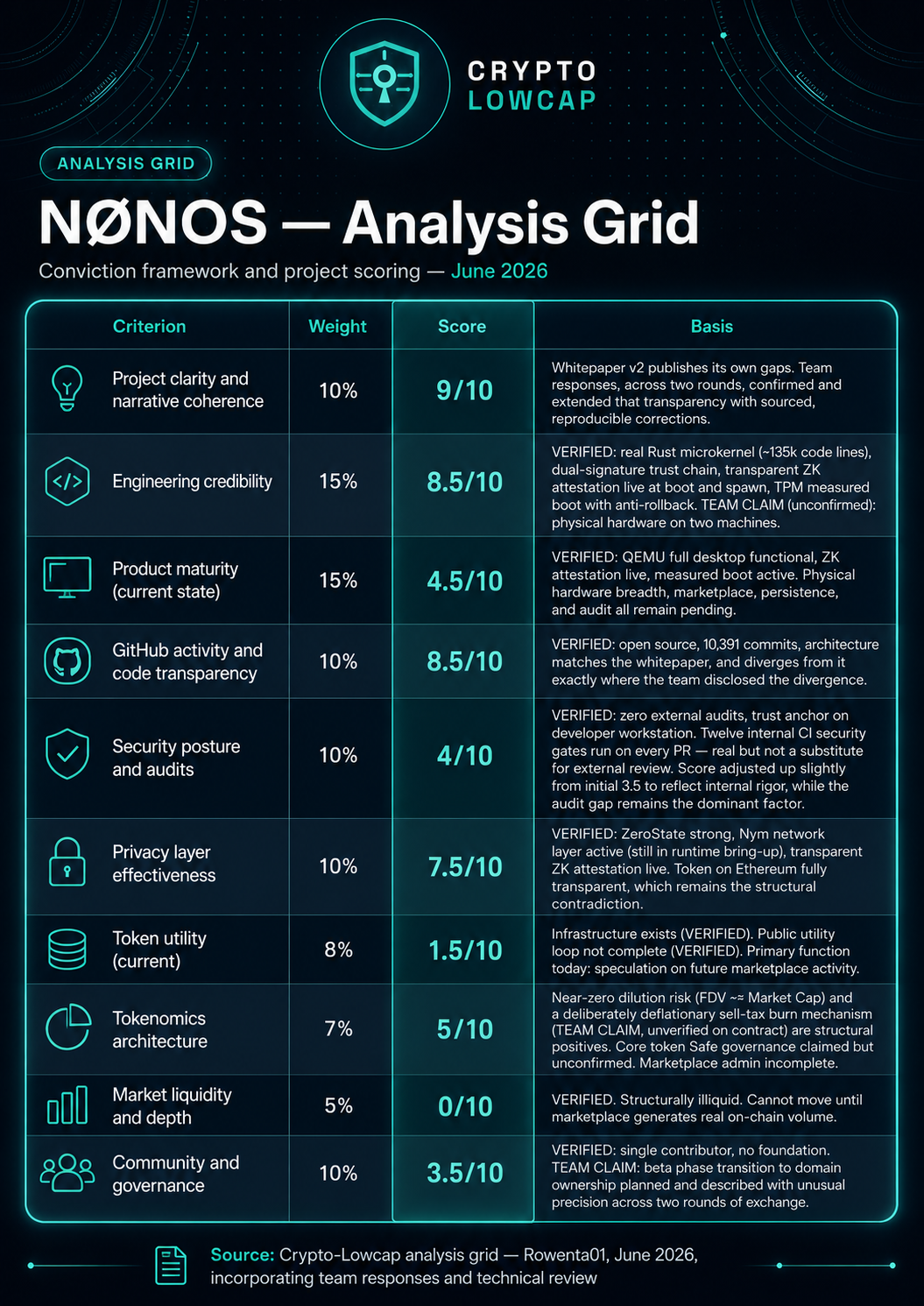
Composite fundamental score: 56/100
Revised upward from 54 after the technical review round. The corrections improved several scores on their merits: live ZK attestation, transparent trust setup, and TPM anti-rollback are genuine engineering progress, not just clarifications. The token economics, external audit gap, and unaddressed regulatory exposure keep the composite in the lower half. A project that completes the external audit, the HSM ceremony, the bare-metal ISO, and the marketplace with real activity would score materially higher.
11. My Verdict
I want to close this analysis the way I opened it: without false balance, but also without false dichotomies.
NØNOS is the most technically credible privacy infrastructure project I have analyzed in 2026. That judgment rests on four things now, not three: verified code that matches the claims, a whitepaper that documents its own gaps, a team that answered seventeen hard questions with precision and without spin, and a second round of corrections, sourced to file paths and reproducible commands, that fixed my errors without touching my conclusions. At a $1.7 million market cap, that combination is extraordinary.
What Is Working
The kernel is real. The ZeroState architecture is coherent and defensible. The dual-signature post-quantum trust chain is implemented and verifiable, and it is now reinforced by TPM measured boot and anti-rollback protection I was not initially aware of. The ZK attestation system is transparent by design, live in production on the spawn path, and free of the trusted-setup risk I originally attributed to it. The team’s framing of who can and cannot use the system today remains more honest than anything I have read from projects at ten times the valuation.
At the same time, the questions I have about the token are real and not resolved by the team’s honesty. The liquidity is structural, not cyclical. The external audit has not happened, and while the sequencing argument for that is reasonable, it does not close the exposure today. The marketplace admin transition is incomplete. The regulatory exposure is real and the project currently has no stated strategy for it. I am not going to minimize any of that because the engineering impressed me a second time. Both things remain true.
ANALYST OPINION: what I think NØNOS is executing correctly, in a way that most projects at this stage do not, is the sequencing, and now I have twice as much evidence for that read. They are not shipping a product they cannot defend. They corrected my article the same way they appear to be building their system: precisely, with sources, without inflating what is not yet true. The beta will be the first test of whether that discipline holds under external pressure to move faster. I will be watching, and I would not be surprised if I am back here in six months writing an update rather than a new piece.
CONVICTION TIER — NØNOS OS Technology
WATCHLIST — Active Surveillance
Rationale: ZeroState at the kernel level, capability-based isolation, a verified and now TPM-reinforced post-quantum trust chain, transparent ZK attestation live on the spawn path, and two rounds of demonstrated team integrity represent a genuine and increasingly well-evidenced architectural advance. The code is real. The QEMU session is functional. The whitepaper and the team both document gaps proactively. Not yet ready for high-risk operational use — the team’s own explicit position, which I share.
Upgrade conditions: External cryptographic audit published, even if scheduled post-beta as planned. Physical hardware dossiers published for at least three diverse machines. Persistent encrypted storage implemented and validated. Additional core contributors with named domain ownership established.
Downgrade conditions: Development stalls before bare-metal stability. Founder unavailability with no succession structure in place. No external contributors emerge after beta. The post-beta audit does not materialize on the stated timeline.
CONVICTION TIER — NOX Token
TIER 3 — Speculative
Rationale: Structurally illiquid. No external audit on either the kernel or the smart contracts, though the team’s sequencing rationale is reasonable. Marketplace admin transition incomplete and unconfirmed on-chain. Public utility loop not yet live. Regulatory exposure unaddressed. Near-zero dilution risk and a claimed deflationary burn mechanism are structural positives that do not compensate for the other gaps.
Upgrade conditions: 0xNOX-ADMIN rotation verifiable on-chain with published transaction hash. Sell-tax and burn mechanism independently confirmed against the deployed contract. External smart contract audit published. Marketplace public-live with confirmed capsule install cycles generating real on-chain volume. Liquidity depth sufficient for $10K+ trades without destructive slippage.
Downgrade conditions: Development stalls before marketplace launch. Regulatory action in key jurisdictions against privacy infrastructure tokens. Trust anchor key compromise with no recovery structure. Founder unavailability before foundation is incorporated.
What to Watch
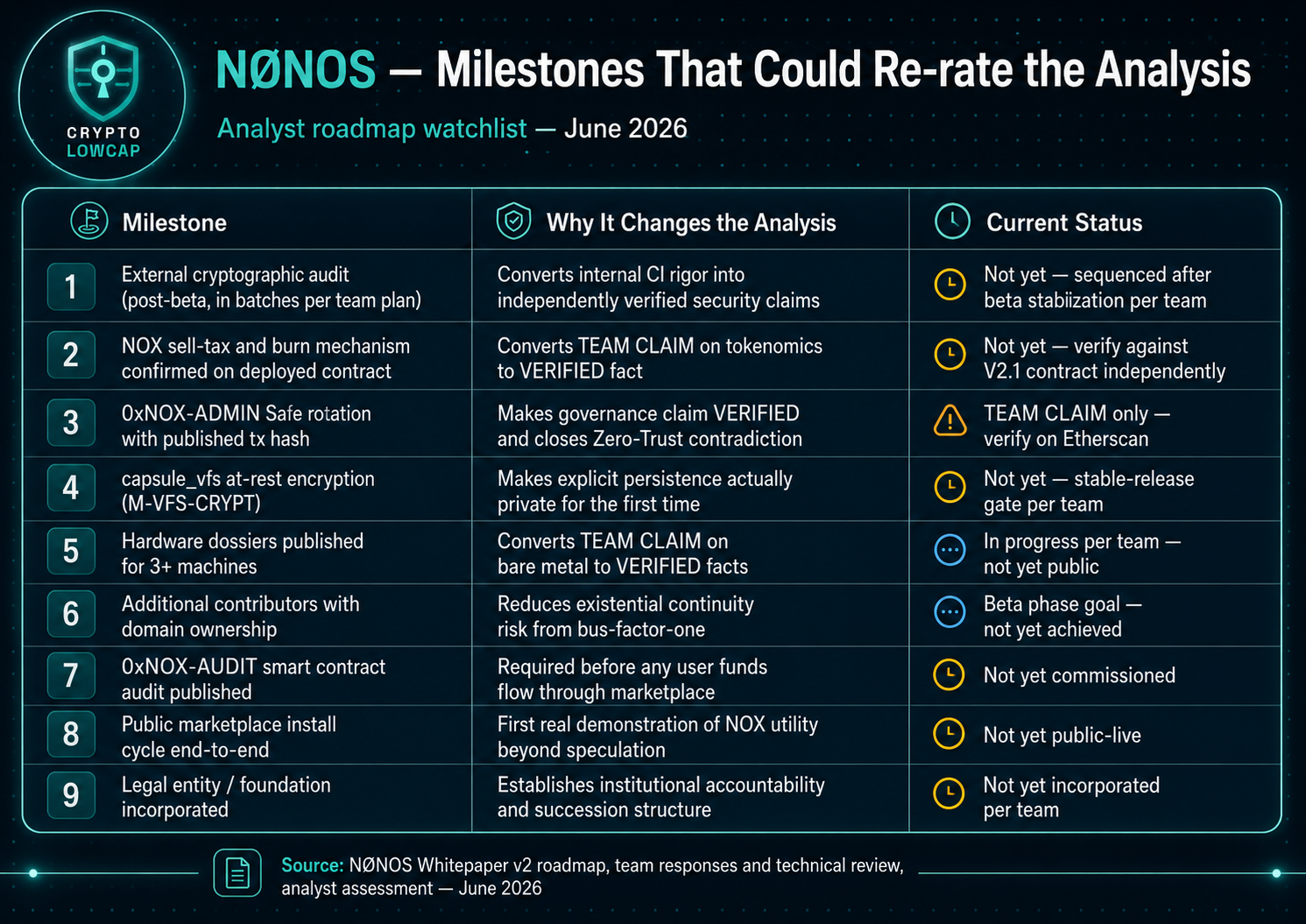
The milestones that would materially change my analysis, in order of analytical importance. Updated to reflect the technical review round.
crypto-lowcap.com | Privacy, Decentralization & Blockchain Innovation
Follow @CryptoRowenta01 on X | Subscribe to the newsletter
© 2026 crypto-lowcap.com — Not financial advice. Always DYOR.