
Before the Crowd: 8 Hidden Lowcaps With Cryptographic Edge
Eight overlooked lowcaps, four narratives, and the discipline behind my speculative map for the next cycle.
Author: Rowenta01 | crypto-lowcap.com | Est. reading time: ~16 minutes
Tags: #Lowcap #Privacy #PoW #PostQuantum #PoUW #AI #Speculation #DragonX #ZKas #Zephyr #NONOS #Midstate #Parano1d #TensorCash #Keryx
| ⚠️ BEFORE WE START, NOT FINANCIAL ADVICE. This article does not constitute investment advice. These are purely personal observations from a fundamental analyst who has been covering the privacy and lowcap crypto space since 2016. It is openly speculative: it projects scenarios and market capitalisations that do not exist yet. Micro-cap and low-cap projects carry significant risk, including total loss, illiquidity, consensus failures and delistings. Every market figure below is frozen at the snapshot date shown next to it and may already be stale. Do your own research. |

1. A confession, and a method
I have been reading whitepapers, mining obscure chains and sitting on thin order books since 2016. Ten years in this corner of the market teach you two uncomfortable things. The first is that the best technology rarely wins the cycle. Second, the crowd always arrives, it just never arrives where the price is still cheap.
This article is my attempt to write down where I am looking before the crowd does. I will not pretend it is anything other than speculative. It plays the game every lowcap invites you to play: projection, scenarios, arrival valuations that may never materialise. What I can promise is that I will show my work. The grid, the arithmetic, the assumptions, and above all the conditions under which each thesis dies.
There is one part of this article that is not speculative, and I want to state it before any number appears. My interest in privacy coins did not start with a chart. Financial privacy is not a feature to be priced like a faster block time. It is the condition for every other freedom that passes through money: to donate, to dissent, to trade, to simply exist without a permanent record of every purchase in a database you do not control. I will keep defending projects that build this, whether they reprice or not. When they do, it is a consequence. If they do not, the case for privacy remains exactly as strong.
Keep both ideas in mind as you read. Conviction on the cause, discipline on the trade. Confusing the two is how people lose money on things they believe in.
2. Where we stand in the cycle
As of my 20 September 2026 snapshot, Bitcoin trades around $81.1k, its dominance sits near 58.7%, and the 90-day Altcoin Season Index reads 41 out of 100. Nothing in that regime justifies microcap euphoria. Capital is still concentrated at the top of the market, and the rotation toward small capitalisations that defines every altcoin phase has not started.
That is precisely why this map is drawn now. Good speculative positions are built in boredom and unwound in noise. When the Altcoin Season Index is flashing green and your timeline is full of charts, the discovery phase of most of these projects will already be behind them. I would rather be early and patient than on time and crowded.
3. The foundations: what actually moves a lowcap
Before choosing projects, I wanted to know what separates the lowcaps that repriced massively in past cycles from the ones that never did, or that failed their second act. So I coded 25 project-cycle episodes, from Verge in 2017 to Kaspa, Neurai, Dynex, Ergo, Radiant, Nexa and others, scoring each on eleven factors from zero to two. Then I measured the gap between the average winner and the average failure on each factor.
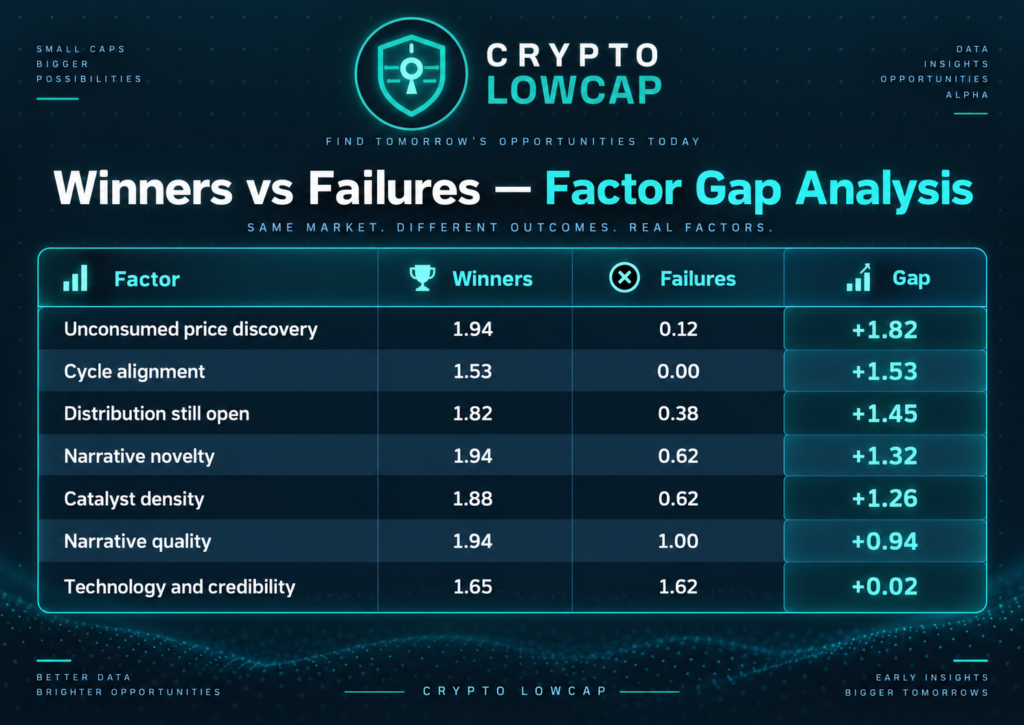
The last line is the one that changed how I work. Technology is almost as present among the failures as among the winners, a gap of 0.02 on a scale of two. Ergo still has excellent eUTXO engineering and lost around 99% from its 2021 peak. Quality makes a story credible. It does not decide whether the story gets repriced. What decides it is how much price discovery the project still has left to travel.
From that result, and from years of watching thin order books, I work with six principles.
Principle one: a narrative that fits in ten seconds
Verge in 2017 did not win on cryptography. It won because the pitch was simple enough to travel without its author, into a retail bull market, from a tiny denominator. Neurai in 2023 did not win on architecture either. It won because it said AI at the exact moment the market wanted to hear it. For every project below, I write the ten-second pitch first. If I cannot, the project does not make the list, however elegant the code.
Principle two: two gaps decide, three amplify
Asymmetric returns sit at the intersection of several gaps between what a project is and what the market does with it. Two are discriminating. The perception gap asks whether the project is worth more than the market believes. Meanwhile, the distribution gap asks whether access friction remains to be lifted. Three others only amplify: a reachable valuation, an attention gap (alive but unwatched), and missing data that creates an unjustified discount.
The winners of past cycles had both discriminating gaps open at the same time. An undervalued project already listed on a major exchange does not reprice like a microcap, because its access friction is gone. Likewise, an invisible project with a story nobody understands does not reprice either. This is why I track distribution as a ladder. L0 is the first tiny venues where a project appears, L1 the first credible non-KYC exchange, L2 the mid-tier centralised exchanges, L3 and above the majors. Every rung that is still closed is a future catalyst.
Principle three: think in market cap, never in price
A x100 on the price of a coin whose supply triples is a x300 on the network. Most young proof-of-work chains emit aggressively in their first months, so raw price multiples are close to meaningless. For each project I compute the hurdle: the market capitalisation the network would need, after modelled dilution, to deliver a given price multiple at twelve and twenty-four months.
Inflation is treated as a cost of time, not as a veto. A chain emitting heavily from a $10k denominator can still be one of the most asymmetric setups on the map. It simply means the clock matters, and that a lower nominal price is not an automatic discount.
Principle four: catalysts have an order
A catalyst is not good news. It is an event that lifts a documented constraint on credibility, supply, access or attention. The order in which those constraints lift matters more than the events themselves. In the cases I studied, the sequence that held was almost always credibility, then supply, then access, then attention.
Radiant is the teaching case of the right event at the wrong time: its major listing arrived about a year after the attention peak, onto a much larger supply. Zclassic is the case of a single-use catalyst, a fork date that concentrated all demand before the event and left nothing after it. My test for any announced catalyst is always the same: what should remain thirty to ninety days after it?
Principle five: potential is not capturability
Almost every project below has order books that would move on a few thousand dollars. I do not score that as a weakness of the thesis. Displayed volume is a consequence of attention, not a constraint on it, and published research on wash trading shows that part of reported volume on some venues corresponds to no economic activity at all. But thin books do constrain how much of a thesis you can actually hold. Potential and position size are two separate questions, and I keep them separate.
Principle six: know the anatomy of a hype
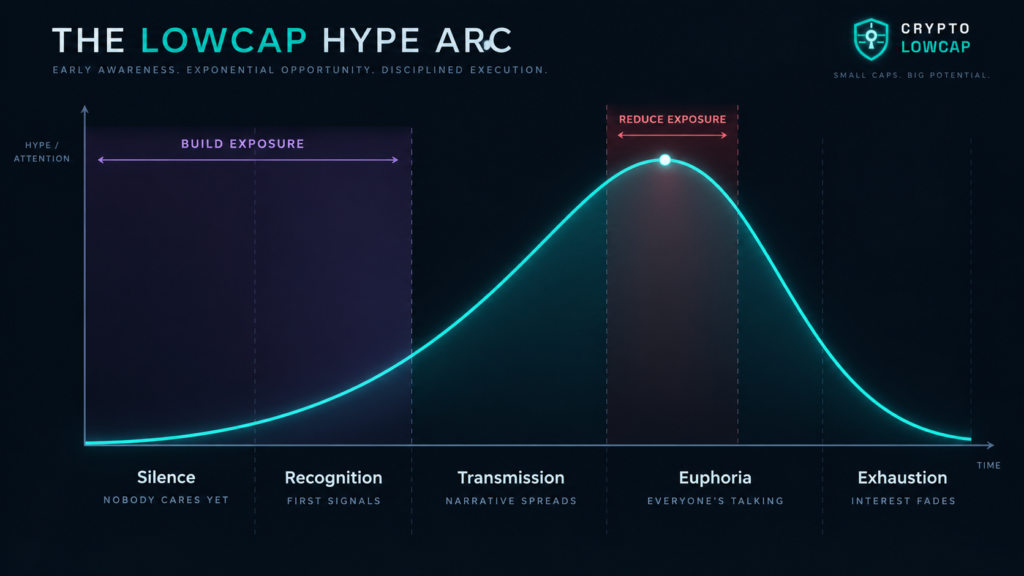
I do not despise FOMO. Instead, I study it, because it is the engine that turns a correct thesis into a price. In my experience a lowcap arc moves through five phases. Silence, where only builders and a few miners are present. Recognition, when a first real access rung opens and outside voices appear. Transmission, when the pitch starts travelling without its author. Euphoria, when the price itself becomes the narrative, the pitch disappears from the conversation and volume explodes. Exhaustion, when the same leverage that carried the rise amplifies the fall.
Attention is the only reflexive catalyst: it feeds on itself for as long as the market regime allows, and no team fully controls it. The tell is simple. When people stop sharing the pitch and start sharing the chart, the arc is being consumed. I build exposure in the first two phases and reduce it in the fourth. Admittedly, I have not always managed it. The method exists precisely because instinct fails in euphoria.
4. How to read the map of overlooked lowcaps
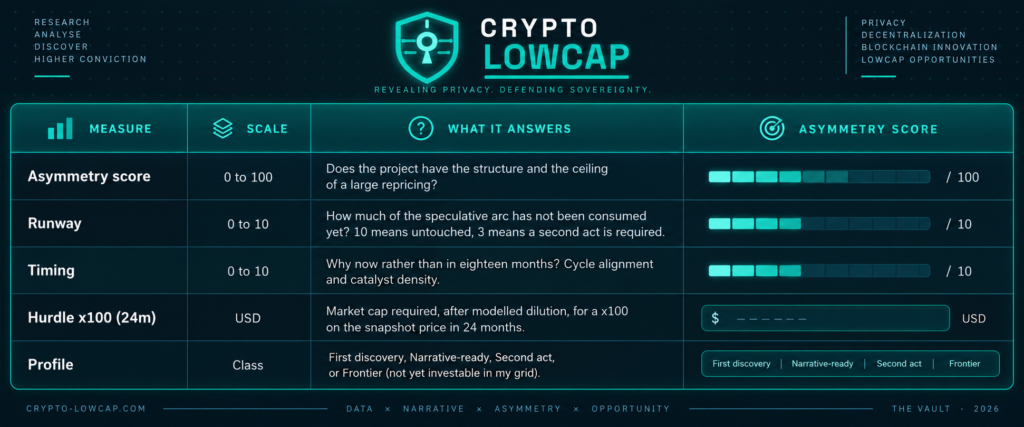
Each project is profiled with my internal grid, which I call CAA-X. To keep this readable, here is what each measure means in plain words. None of them is a probability of success.
Here is the whole map before we go project by project.
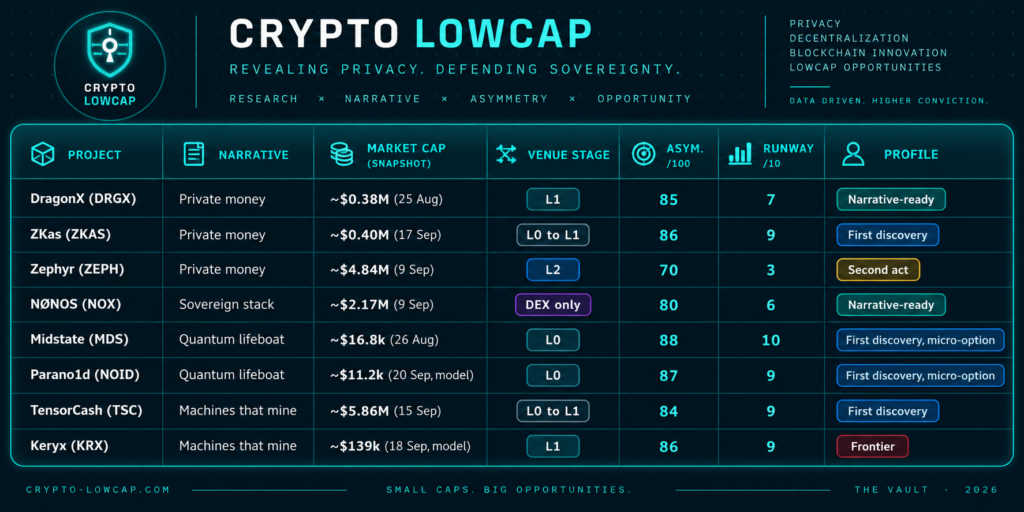
Market caps are reconstructed from price x circulating supply at the date shown. “Model” means supply was modelled from the emission schedule rather than read live. Sources: project explorers, exchange order books, CoinGecko where available.
5. Narrative I: Private money, by default
Privacy coins have spent the last years in a regulatory winter: delistings from major exchanges, compliance pressure, and in Europe an anti-money-laundering package that, from July 2027, bars regulated providers from handling anonymity-enhancing coins. Most of the market reads that as a death sentence. I read it as the most structural perception gap in crypto. A narrative that has been punished for years is not priced for a comeback, and every delisting pushed the discovery of new privacy chains toward small, non-KYC venues where denominators stay tiny.
The contrarian bet here is not that regulators will change their minds. It is that demand for financial privacy grows precisely as surveillance does, and that the market periodically remembers it.
DragonX (DRGX), narrative-ready
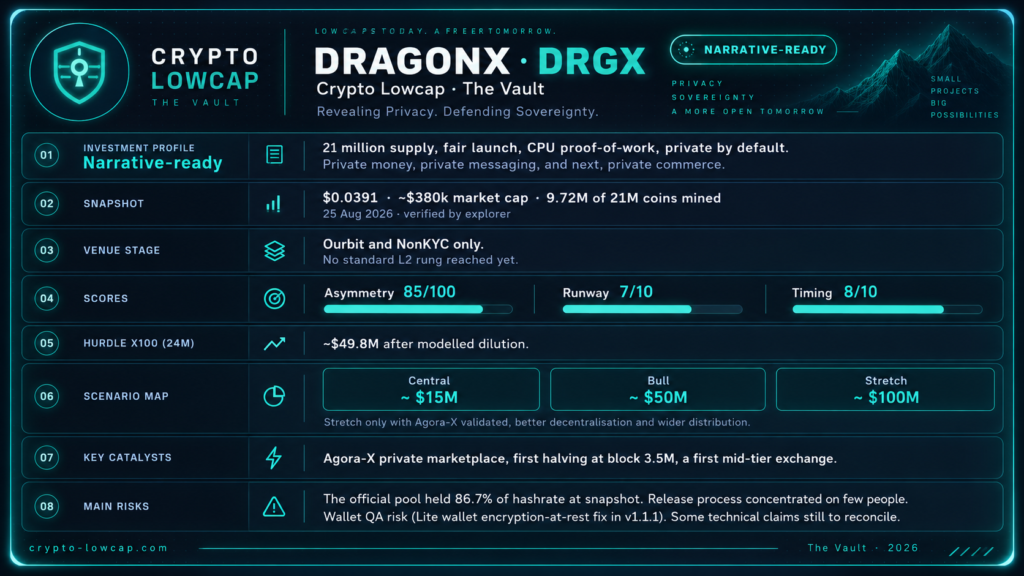
DragonX is not on this list because it is the best privacy coin. It is here because the market pays very little for a story that can be told in one breath, and that story just got more concrete: encrypted chat is no longer a promise, it ships inside the ObsidianDragon wallet. The hashrate concentration is the honest counterweight. I will not size this the way I would size a chain with a diversified mining base. For the builders’ side of the story, read our exclusive DragonX interview and my earlier DragonX protocol analysis.
ZKas (ZKAS), first discovery
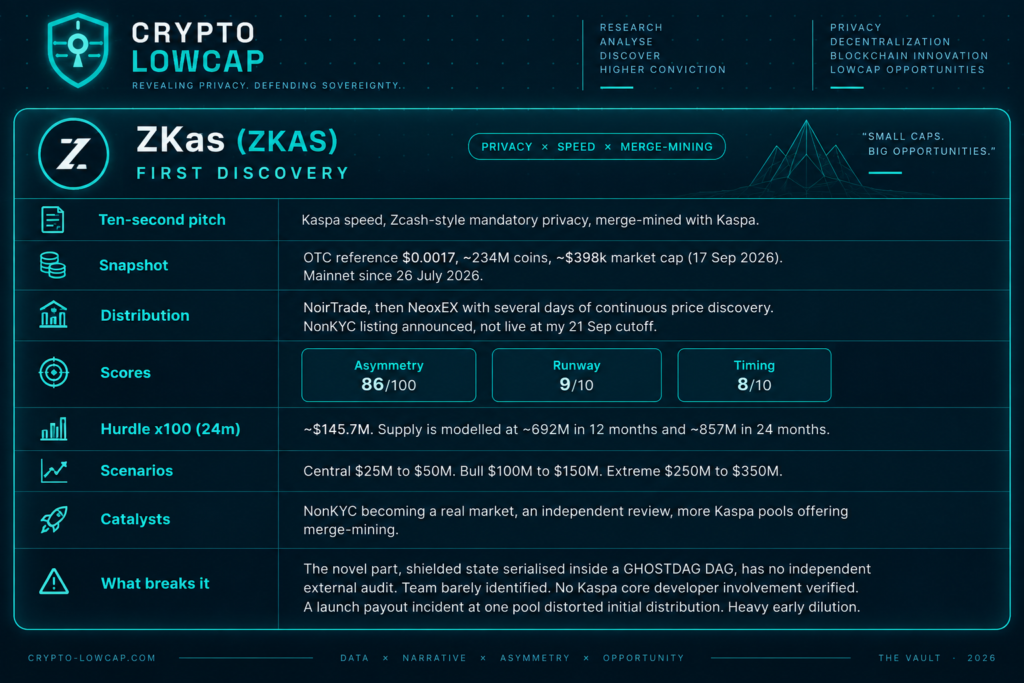
ZKas has the most compressible pitch on this entire map. There is no transparent transfer at all, which gives the privacy-by-default story a coherence most chains lack, and it borrows its security budget from Kaspa miners. The edge comes precisely from the distance between an architecture that is already credible and a validation that is still incomplete. If the audit arrives before the market cap has changed category, that distance is the trade. Should it arrive with a critical finding, the trade is over. An exclusive Crypto-Lowcap interview with the ZKas team is in preparation, and the audit question will open it.
Zephyr (ZEPH), second act
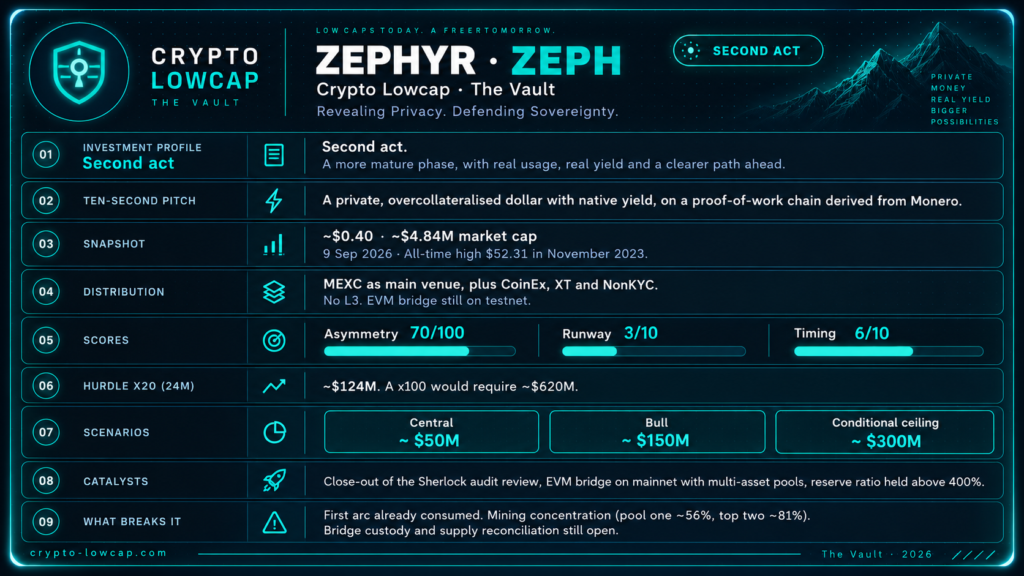
Zephyr is the exception on this map, and I include it deliberately. Its first arc is behind it, which my backtest says is the hardest position to reprice from. But “private dollar plus private yield” remains one of the strongest pitches in privacy, and the bridge toward EVM liquidity is the kind of event that can renew a narrative rather than recycle it. It is a conditional radar, not a first-discovery bet: I want to see the reset proven before the price anticipates it.
6. Narrative II: The sovereign stack
The next frontier of privacy is not the transaction. It is the machine that signs it. A private coin running on a compromised operating system is a lock on a cardboard door. The sovereign computing narrative, verifiable systems, zero-trust design, a chain of trust you can inspect yourself, is still almost absent from crypto markets. I expect it to become far easier to tell as AI agents start holding keys and moving funds.
NØNOS (NOX), narrative-ready
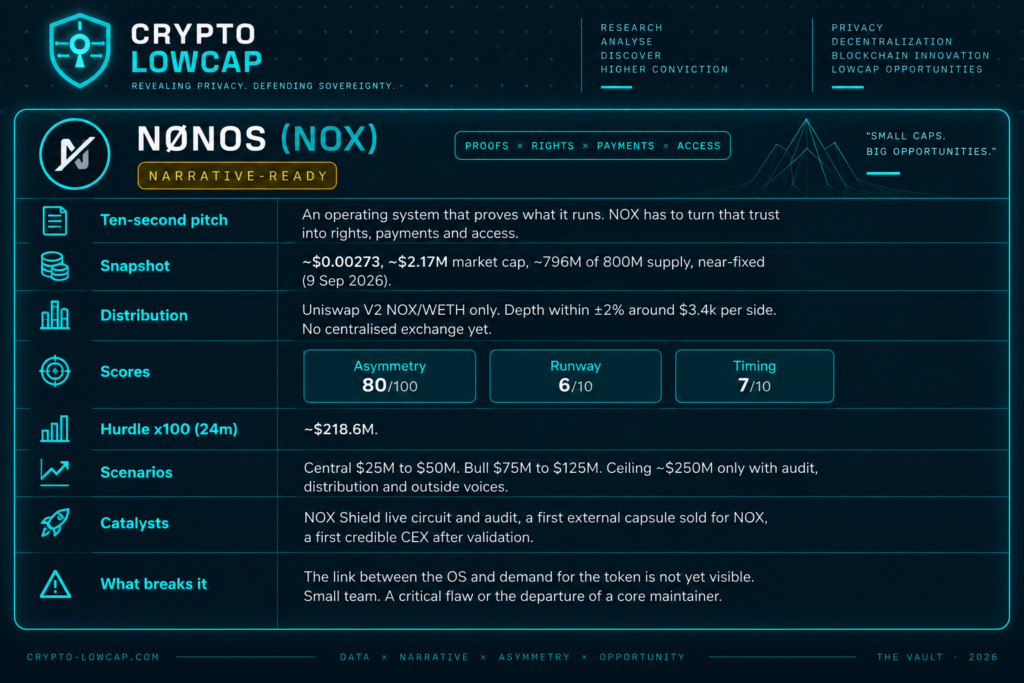
NØNOS has done something rare for a project this size: it built its public narrative around verification, with a gated roadmap and a public surface where claims can be checked. The market noticed. The price repriced recently, which is why the runway score fell from 7 to 6. Meanwhile, the technology is progressing faster than the financial asymmetry. Still, the question I keep asking is the one that matters for any infrastructure token: a very good OS can still be a very bad token. Only the gates of the marketplace will tell. My full NØNOS privacy OS analysis explains why I keep the operating system and the token in two separate columns.
7. Narrative III: The quantum lifeboat
Most proof-of-work chains, Bitcoin included, rely on signature schemes that a sufficiently large quantum computer could break. Nobody knows when that day comes, and I will not pretend to. What I do know is that the market has not priced post-quantum proof-of-work at all, and that a single credible headline on quantum progress can move an entire narrative overnight. The two projects below are not positions. They are options, priced at the cost of a used car, with a bus factor close to one.
Midstate (MDS), first discovery, micro-option
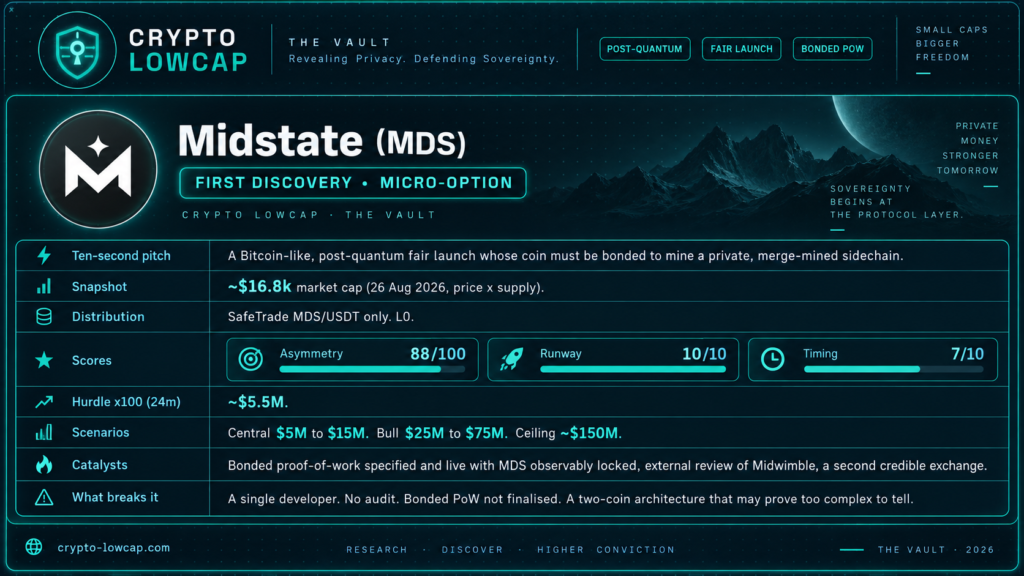
Midstate is the purest first-discovery setup I track: hash-only cryptography, a verifiable fair launch, one venue, and a runway nothing has touched. What changed on 21 September is the economic link. Its solo developer described on Discord a “bonded proof of work” in which MDS must be locked to produce blocks on Midwimble, the separate private chain merge-mined with the same algorithm. The more Midwimble is mined, the more MDS is potentially immobilised. It is a mechanism simple enough to travel. Yet it is also a set of parameters that do not exist yet. The developer, ciphernom, walks through the design logic in our exclusive Midstate interview.
Parano1d (NOID), first discovery, micro-option
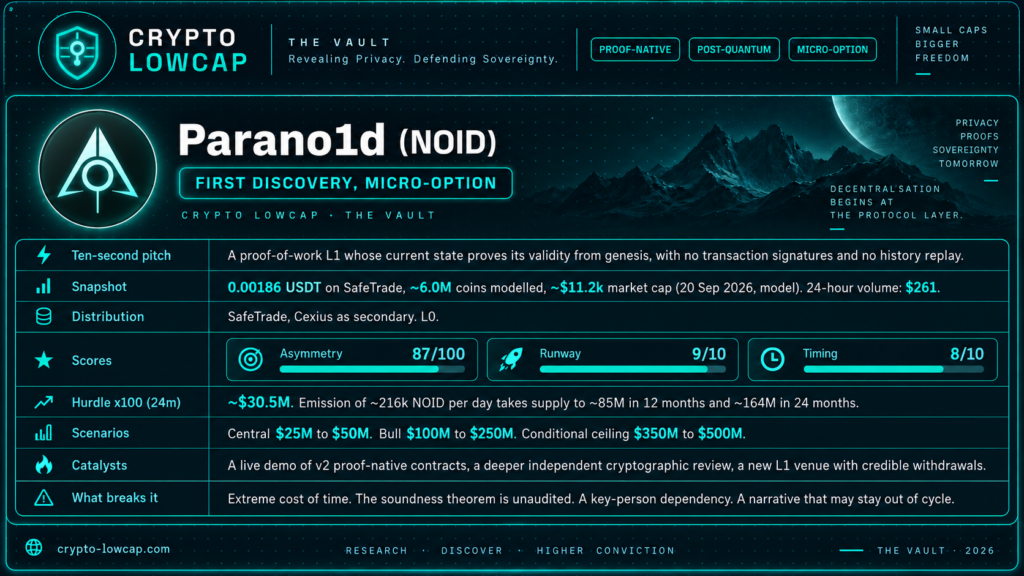
Parano1d is the most technically unusual project on this map, and the one where the arithmetic matters most. Supply multiplies by more than twenty in two years, so the recent price correction brought the valuation back near the entry zone I had modelled, without making it a bargain by itself. This is the textbook case for principle three. I reason in market cap and in time, and I only reinforce if the network and the v2 prototype stay clean while the market starts absorbing the emission.
8. Narrative IV: Machines that mine by thinking
Artificial intelligence is the meta narrative of this decade, and proof of useful work is where it meets mining: instead of burning energy on arbitrary hashes, miners run AI inference, and the work itself secures the chain. My backtest has a warning attached. Neurai and Dynex both produced enormous multiples on the AI theme in 2023, and Dynex proved that timing alone can carry a project whose fundamentals were far from unanimous. That is exactly why I score narrative, timing and technology separately.
TensorCash (TSC), first discovery
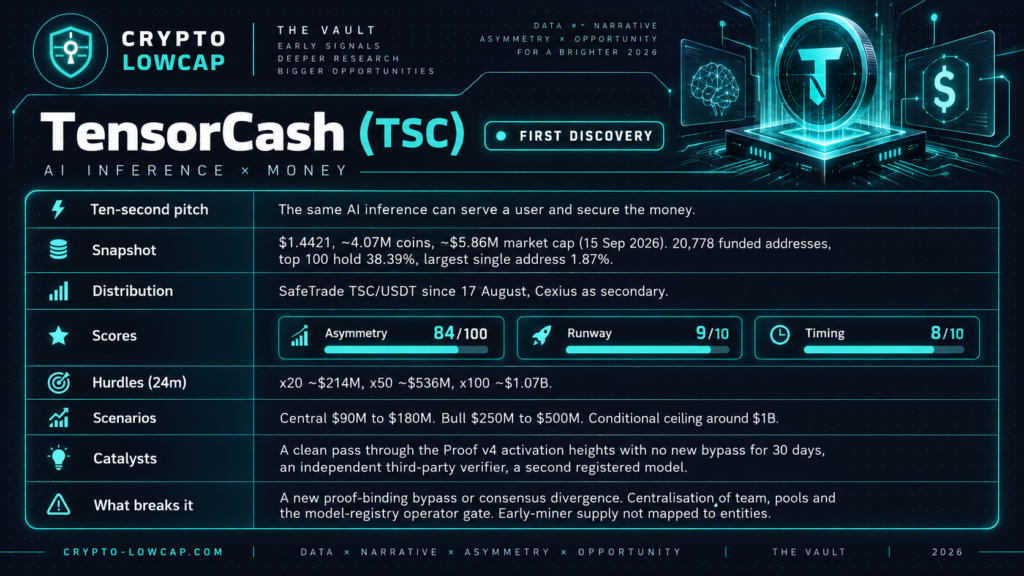
TensorCash is no longer a lottery-ticket microcap, and I want to be precise about what that means. At close to $6M, the first-wave convexity has partly been consumed: the arithmetic now points to a x20 or x50 profile rather than a x100, which would require the protocol to become the recognised leader of its category. What keeps it on the map is the quality of the engineering and the discipline of the team, which I was able to test directly in my interview with its lead developer, Imosuke Takakuni. Of all eight projects, this is the one where intrinsic quality and speculative runway overlap most.
Keryx (KRX), frontier
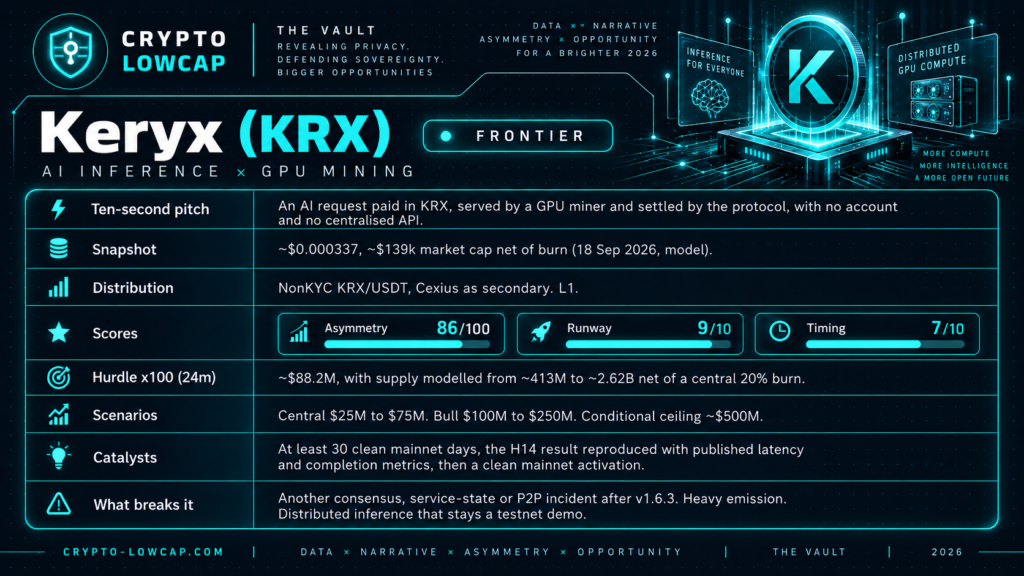
Keryx is on this map with an asterisk. Its latest H14 testnet milestone, reported on 21 September, delivered something I had been waiting to see: a 79 GiB model answered its first prompt from weights split across six consumer GPUs in four countries, none of which could hold the model alone, each link signing the response, with settlement on-chain. “The network is the model” stopped being a slogan that day. But Keryx also carries a history of consensus incidents, and my grid does not let a spectacular testnet override an unstable mainnet. Very high on optionality, low on immediate investability. It stays on the frontier until the chain proves it can run clean for a month. Separately, a Crypto-Lowcap interview with the Keryx builders is on its way, and mainnet stability will be my first question.
9. Risks: the part nobody retweets
A speculative map without its failure modes is marketing. Here is what cuts across all eight projects.
Project-level risks
- Total loss is a realistic outcome. Past cycles are full of technically sound projects that lost more than 95% and never came back. Ergo, Nexa and Radiant are in my own backtest for that reason.
- Thin books everywhere. Every project on this map would score poorly on how much capital can enter and leave without moving the price. That limits position size, not the thesis.
- Key-person risk. Midstate and Parano1d depend on very few developers, NØNOS on a small team, DragonX on a concentrated release process. A departure is a thesis-level event.
- Unaudited cryptography. The most original parts of ZKas, Midwimble and Parano1d have no completed independent audit. Originality and unaudited risk are the same thing seen from two sides.
- Mining concentration. One pool held 86.7% of DragonX hashrate at snapshot, and two pools held about 81% of Zephyr. Concentration is a security risk before it is a narrative one.
Market and timing risks
- Dilution and time. Parano1d, Keryx and ZKas emit heavily in their early life. If the altcoin phase comes late, the hurdle rises while you wait.
- Regulation. Privacy coins face a shrinking perimeter of regulated venues, especially in Europe from July 2027. Delisting risk is part of the discount, but it is also real.
- Regime risk. The whole map assumes an altcoin phase that rotates toward small capitalisations. If it never comes, or comes after the catalysts, DERO in 2022 is the reminder: the market can price the promise, then ignore the delivery.
- Stale data. Every figure is frozen at its snapshot date. In microcaps, a week can change a market cap by an order of magnitude. Recompute before acting on anything.
10. Verdict: a map, not a shopping list
I did not rank these projects from best to worst, because they do not answer the same question. Midstate, Parano1d and ZKas offer the most untouched runway and the lowest denominators, with the highest execution and audit risk. DragonX, TensorCash and NØNOS offer the best balance between a narrative that already travels and a story the market has not finished pricing. Zephyr is a second act that has to earn its reset. Keryx is the most exciting frontier on the map and, in my grid, not yet a position.
If I had to compress ten years of lowcap speculation into one line, it would be this: build exposure while it is quiet, respect the arithmetic of dilution, and leave when the price becomes the narrative. Most of these theses will fail. The method is designed so that the ones that work can pay for the ones that do not, and so that I never confuse a thesis I believe in with a trade I have to defend.
As for privacy, my position does not depend on any of the numbers above. I will keep covering the teams that build tools to protect financial privacy, in bull markets and in winters. The market will reprice them when it remembers why they matter. My job is to be there before it does.
Key takeaways
| KEY TAKEAWAYS 1. In my backtest, unconsumed price discovery separates winners from failures (+1.82). Technology barely does (+0.02). 2. Always reason in market cap after dilution. A x100 in price can mean a x300 for the network. 3. Catalysts work in order: credibility, supply, access, then attention. A listing before credibility gives a spike that does not hold. 4. Four narratives for the next arc: private money, the sovereign stack, the quantum lifeboat, and machines that mine by thinking. 5. Every thesis above has an explicit kill switch. Read it before the pitch. |
| EDITORIAL NOTE Figures come from the Crypto-Lowcap research dossiers on each project, dated between 25 August and 21 September 2026. Scores are analyst opinion produced with a proprietary grid, not probabilities. No project team reviewed or paid for this article. The author may hold positions in some of the assets discussed. |
Related reading: our exclusive interviews with TensorCash’s Imosuke Takakuni, Midstate’s ciphernom and the DragonX team, plus my analysis of why proof-of-useful-work could finally matter.
crypto-lowcap.com | Privacy, Decentralization & Blockchain Innovation
Follow @CryptoRowenta01 on X | Subscribe to the newsletter
© 2026 crypto-lowcap.com, not financial advice. Always DYOR.