
Parano1d Interview: How to Make Sovereign Verification Last Forever
“The developers can disappear. The software can change. The cryptography can evolve. The ability to verify must remain.” Ignotus Nemo, founder of Parano1d
Project: Parano1d (NOID) | Interviewed by: Rowenta01 | crypto-lowcap.com
Tags: #Parano1d #NOID #PostQuantum #ProofNative #PoW #Lowcap #Interview
| BEFORE WE START This interview does not constitute investment advice. The questions and answers reflect the views of the project team and of an independent analyst who has been covering the privacy and low-cap crypto space since 2016. Micro-cap and low-cap projects carry significant risk. Do your own research. |

Why Parano1d deserves a closer look
Parano1d is a proof-of-work blockchain built around one rule: the present state must be verifiable on its own, without replaying the chain from genesis. Every block carries a recursive proof that the current state is valid, so a node checks the present instead of re-executing the past. Spending relies on a zero-knowledge proof of a secret rather than a public signature, and the security model is designed with post-quantum attackers in mind. The mainnet has been running since a clean genesis on 21 August 2026, and the v2 upgrade adds proof-native contracts at block 210,537.
I have followed the project since that genesis, through an aborted first launch, a fast sequence of fixes and a mandatory upgrade shipped in a matter of weeks. What caught my attention was less the speed than the posture: the assumptions are published, the analysis is open to challenge, and the release notes credit the miners who found problems. Behind all of it stands one pseudonymous developer, Ignotus Nemo, founder and core developer of Parano1d.
In this Parano1d interview, he explains where the idea came from, why he archived his first prototype, what the hardest engineering trade-off was, which assumptions the post-quantum claims rest on, what the protocol does not guarantee, and why he replaced the monetary design. He also shares how he reads the sector and where he wants Parano1d to stand in a hundred years. Ignotus chose which questions to answer; his answers appear in full, in his own words, grouped by theme. As usual, the TensorCash and DragonX interviews follow the same approach.
Parano1d at a glance
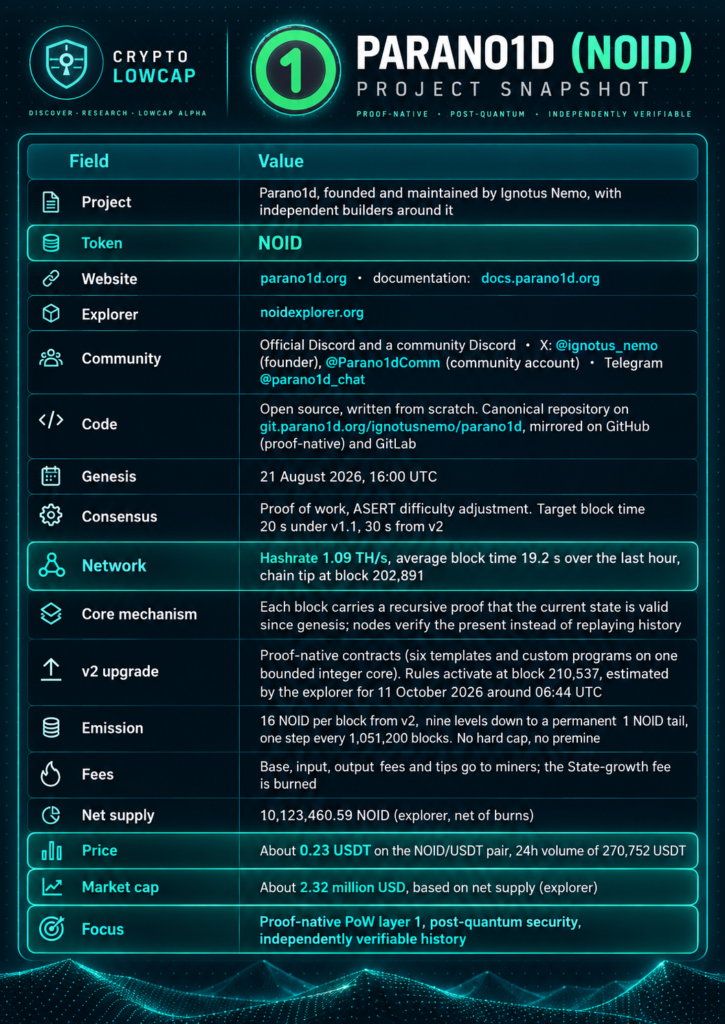
Sources: docs.parano1d.org/protocol/parameters and /economics, v2.0.1 release notes, consulted 9 October 2026. Network, supply and market figures: noidexplorer.org and the NOID/USDT order book, snapshot 9 October 2026 around 14:20 CEST. Market figures move fast on thin markets; treat them as a point-in-time read, not a valuation.
1. Origins: from Specter to Parano1d
Before Parano1d, what were you working on, and what convinced you that the idea of the present proving the past needed a new chain, rather than a research paper or a contribution to an existing project? And where does the name ParanO(1)d come from?
Ignotus Nemo: I’ve worked in cryptography and information security for years, and I first got into Bitcoin around 2011–2012.
What kept bothering me was pretty simple: as blockchains grow, verification gets heavier until people stop verifying for themselves and start relying on APIs and infrastructure. To me, that is rented verification. The post-quantum transition can make that debt even worse.
The first attempt was Specter. I published the idea on Bitcointalk in March 2026 and built a prototype around signatureless authorization and recursive validity. The prototype did its job: it exposed structural problems in the state and proof architecture. I archived it instead of pretending those choices were final. The original thread is still here: https://bitcointalk.org/index.php?topic=5578256
Parano1d was the rewrite from scratch. The rule was simple: the present state must be independently verifiable without replaying the chain from genesis. That was architectural enough that I did not want to bolt it onto a system built around different assumptions. I wanted to build the whole thing around that idea and see if it actually worked as a live network.
As for the name, I’ve always thought a developer should be a little paranoid if the system is supposed to be secure. I wanted users to be a little paranoid too: don’t trust an API, an explorer, a foundation or even me if you can verify it yourself. That is a big part of decentralization, and I think Web3 somehow forgot it.
I noticed the O(1) inside “paranoid” and used ParanO(1)d at first. In practice it was annoying to index, use in binaries and put everywhere, so eventually it just became Parano1d.
A decentralized network shouldn’t have a CEO
From the outside, a reader sees you as the maintainer, with miners, pool operators and community members building explorers and tools around the chain. Who actually owns what today, and how did those people find the project? If you went offline for a month, could someone else build, sign and ship a critical fix on their own? And which profile is missing most today?
Ignotus Nemo: I’m the core developer, but I’m not the only builder in Parano1d. We’re already seeing independent developers building pools, miners, explorers, tools, lightweight verifiers, mobile wallets and other infrastructure. Most of them found the project on their own, and I think that’s exactly how it should happen.
Right now, a lot of the core development still depends on me. I’m not going to pretend otherwise. But as the project grows, my role should become less important, not more. The code is open, and I’ve deliberately set up multiple Git mirrors and kept them synchronized so access to the latest source doesn’t depend on a single hosting platform.
I also designed the P2P layer with this in mind. Every Parano1d GUI wallet runs its own node and actively participates in the network mesh. Built-in DNS seeds provide initial entry points. Once connected, a wallet discovers other peers, verifies data locally, and exchanges transactions and blocks. Stable peer connections can replace the initial seed connections. With reachable peers available, the network can continue operating even if the original seeds go offline.
The network itself is already decentralized. Major protocol upgrades depend on coordination and broad agreement among independent participants. I can propose changes, but adoption is their decision. As more independent participants join, coordinating upgrades will naturally take longer. That’s a tradeoff I accept. It’s how the project becomes less dependent on any one person, including me.
My job is to build a protocol that minimizes the need for emergency updates. Over time, the community should be able to propose, review, and coordinate planned upgrades with broad support, without depending on me to lead every change.
That’s also one of the reasons I chose to remain pseudonymous. A decentralized network shouldn’t have a CEO.
2. Under the hood: proving the present instead of replaying the past
In plain terms, each Parano1d block carries a proof that the current state is correct, so a node checks the present instead of replaying the whole history. Making that work on a proof-of-work chain producing a block every 20 seconds, now 30, cannot have been simple. What was the hardest trade-off you had to make, and what fought back the most?
Ignotus Nemo: The hardest trade-off was deciding where the computational work should happen. Generating proofs takes CPU time and memory. I accepted a more demanding block-production process so that other nodes could verify the result quickly, without having to replay years of transactions.
What fought back most was making all of this work reliably while the network kept moving. Imagine downloading the current state while new blocks are arriving, a peer disconnects, or two miners produce competing blocks. The proof, the downloaded data, and the chain your node follows must all agree. Getting that right was harder than making the proof verifier fast.
A lot of the engineering went into memory management, synchronization, and keeping wallets responsive while heavy computation was running. A proof that verifies in milliseconds is nice, but it doesn’t mean much if the software struggles on ordinary hardware.
So yes, producing blocks is more demanding. But that’s a cost paid now instead of a growing verification burden imposed on everyone who joins the network in the future. I think that’s a reasonable trade.
Two things readers tend to assume are solved. First, the post-quantum protection holds “under the published assumptions”: in everyday language, what are those assumptions, and what would have to go wrong for them to fail? Second, what does Parano1d explicitly not guarantee, the thing people assume it does but it does not?
Ignotus Nemo: In simple terms, the assumptions come down to three things: the strength of our hash function, the security of recursive proof composition, and how much computational work a quantum attack would actually require.
Poseidon2b, our hash function, must resist shortcuts that would make recovering a spending secret or forging a proof significantly easier than our analysis allows. The recursive proofs, their public verification parameters, and the implementation all have to behave as the security model assumes. And our estimates have to account for attackers combining and parallelizing their work.
If someone finds a weakness in the hash function, a flaw in how proofs are composed, or a substantially cheaper quantum attack, the corresponding security claims may no longer hold. That’s why I publish the assumptions and keep investigating them. I would rather explain exactly what the security depends on than simply call something quantum-proof and move on.
As for what Parano1d doesn’t guarantee, the biggest misconception is privacy. Parano1d hides your spending secret, but it doesn’t make your transactions anonymous. Anyone can record the transactions and contract data they see. Pruning historical data from nodes doesn’t magically erase copies someone else has already stored.
Privacy is an important problem, but full transaction privacy was never the goal at this stage.
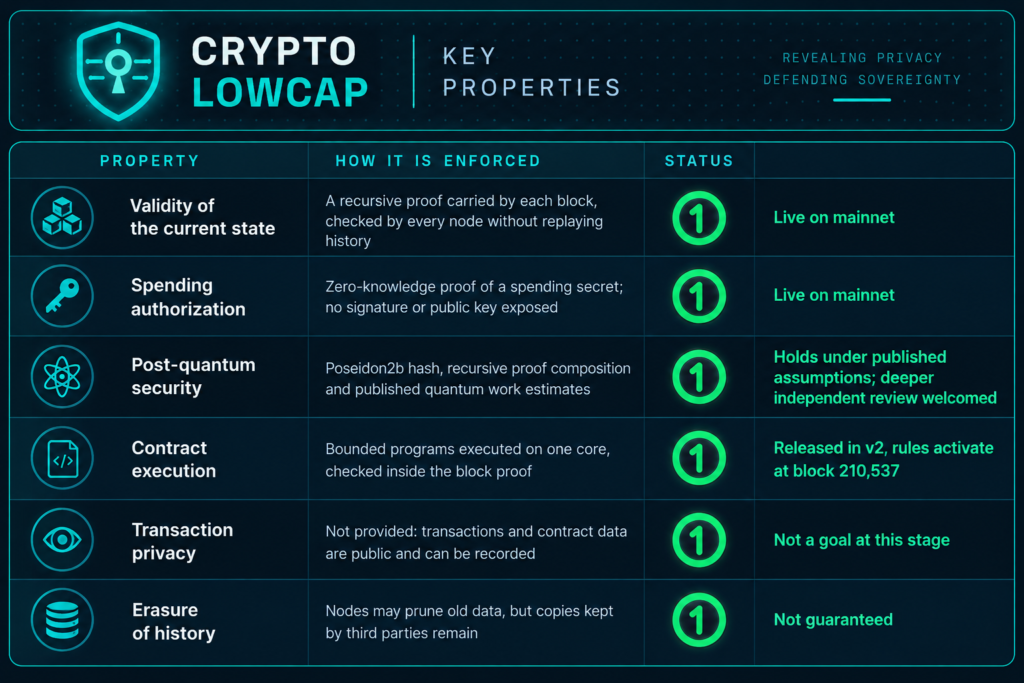
Source: Ignotus Nemo’s answers in this interview, cross-checked with docs.parano1d.org.

3. Proof-native contracts: smaller on purpose
The v2 contracts run on one bounded integer core, with strict limits on loops, storage and calls between contracts. What did you deliberately give up compared with the smart contracts people know from Ethereum, and what kind of application is this model better suited to than anything else out there?
Ignotus Nemo: I deliberately gave up the general-purpose programming model people associate with Ethereum. Parano1d contracts are short programs with a small amount of persistent state, no loops, and no calls into other contracts.
That means the work required for each execution is bounded. Every contract runs on the same core inside the block’s proof. Developers can define their own rules without having to build a separate proof system for every application.
I think the most natural use case is financial agreements between people: who can claim funds, when, how much, and who can recover what’s left. Refundable payments, delegated spending budgets, recurring claims, or funds released in stages all fit this model.
For example, suppose I sponsor someone’s work. I can give them spending authority within an agreed budget while keeping the right to recover whatever remains. The network enforces those conditions, and every successful execution produces a new, verifiable balance and set of rights.
The parties can keep their terms and receipts. Future nodes don’t need to replay the entire history of that agreement. They verify the current state through its proof.
I wasn’t trying to build another Ethereum with a different execution engine. I wanted a smaller, predictable model for enforceable financial rights, where every transition becomes part of the proof the chain carries forward.
4. Bugs, bounties and open review
The first launch attempt in August was stopped and restarted from a clean genesis on August 21, and v2.0.1 fixed a same-height difficulty race that miners had documented with their own data. Nobody doubts the speed of correction. What has changed in the process itself so the next class of bug is caught before it reaches mainnet? And since the proof system behind Parano1d is recent cryptography, has anyone outside the project reviewed its soundness, is an external review planned, and what stands in the way?
Ignotus Nemo: I launched a bug bounty early, and it brought in many reports. Independent contributors helped identify real problems, and those findings strengthened both the code and the testing process. Testing now puts more emphasis on how nodes behave together under load, during interruptions and around protocol changes. (Bug Hunt report example from Aug 26 GitHub discussion #26)
For cryptography, the analysis and calculations are public, with independent reproduction and discussion on Ethereum Research https://ethresear.ch/t/ethereum-lessons-from-a-live-end-to-end-pq-proof-native-protocol/25730/7. I also built https://noid.network/, where anyone can use AI to examine the construction and challenge its assumptions. That process has already produced findings and corrections.
I welcome deeper independent cryptographic review. The main challenge is finding researchers with the specialist expertise and time to examine the full construction.
5. Monetary design: a schedule by height and a permanent tail
V2 replaces the old reward reductions, which depended on how full the state was, with a fixed schedule by block height, from 16 NOID down to a permanent 1 NOID. Why did you change the monetary design, and why a permanent tail rather than a hard cap? And since miners have real costs to cover, what in the design gives someone a reason to keep NOID rather than move it on as soon as it lands?
Ignotus Nemo: I changed it because State occupancy turned out to be the wrong monetary clock. Parano1d can process many payments while reusing the same storage space. Activity can grow while State stays small, which made the timing of reward reductions unpredictable. Block height gives everyone a clear schedule, independent of how efficiently the network uses storage.
I kept the permanent tail because block producers should have an ongoing subsidy alongside transaction fees. A hard cap eventually leaves them dependent entirely on fees. The tail provides a fixed 1 NOID per block, rather than issuing a percentage of the supply. It’s a deliberate trade-off: continuing, predictable issuance to help fund the network’s ongoing security. economics documentation on GitHub
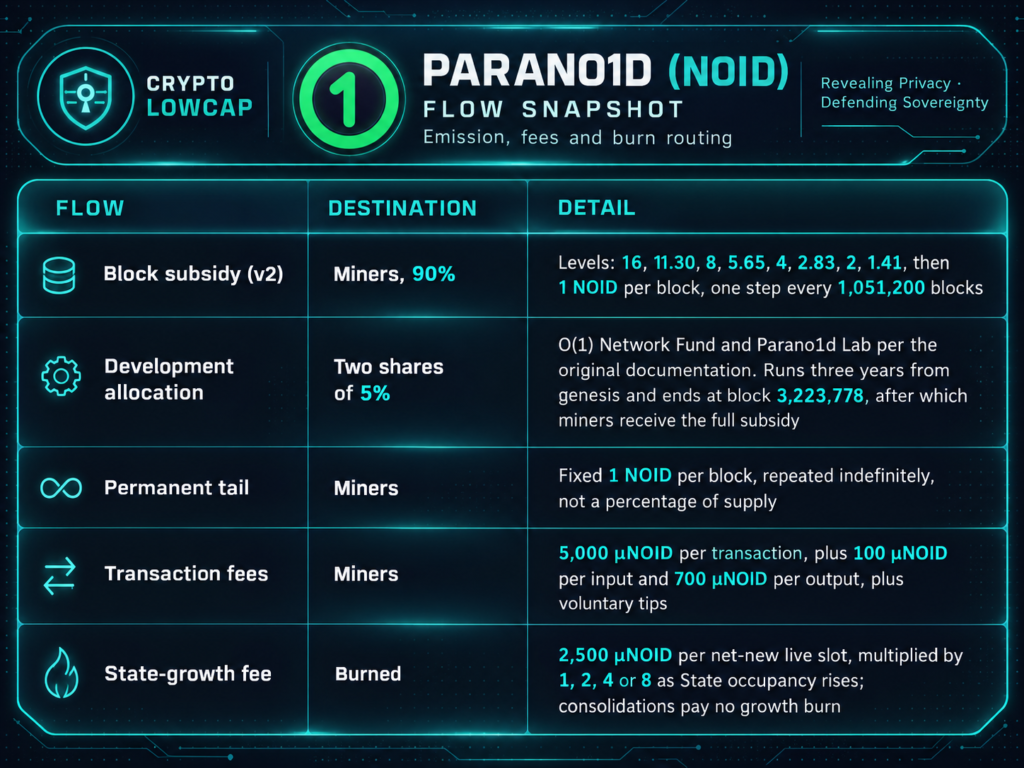
Sources: docs.parano1d.org/protocol/economics and /parameters, consulted 9 October 2026.
| ROWENTA’S NOTE Each issuance level lasts 1,051,200 blocks, which at the 30-second target is exactly 365 days. The first v2 year therefore issues at most 16,819,200 NOID before burns, then 11,878,560 the following year. Against the 10.1 million NOID net supply shown by the explorer on 9 October, that is a heavy dilution at first, but a scheduled one that shrinks every year, which is precisely the predictability Ignotus describes. What remains a data gap: how the two 5% development allocations are spent, and by whom, is not documented publicly at the time of writing. |
6. The pitch, in his own format
If you had to explain Parano1d to someone with no interest in cryptography, what do you actually say? And who are you building for first: miners, developers writing contracts, or people who simply want to hold value on a chain designed to outlast quantum computers?
Ignotus Nemo: answered in video, below.
7. Reading the space
Outside of Parano1d, which projects do you follow or respect right now, and what do they have in common? And what makes you dismiss a project within five minutes of looking at it?
Ignotus Nemo: I follow Bitcoin, Zcash, and proof-system projects such as Plonky3. Bitcoin interests me for its independent verification model, Zcash for its cryptographic engineering, and Plonky3 for turning proof-system research into practical, open tools.
What earns my respect is work that other people can inspect, run and challenge. I look for clear design decisions, published assumptions and evidence behind the claims.
What makes me lose interest quickly is a gap between the marketing and what can actually be verified. Hidden code, unexplained points of central control, or “quantum-proof” claims without a security argument are immediate red flags. If the branding and token promotion are far ahead of the technical substance, I usually move on.
8. A hundred years of verification
Realistically, not best case, where is Parano1d a year from now, and where would you want it to be in three years? And open floor: anything I did not ask that you think matters, or something you would want readers to understand that never comes across in a release note?
Ignotus Nemo: The whole crypto industry is becoming paranoid. Ethereum wants execution proofs. Zcash is exploring proof-carrying data. Bitcoin researchers want nodes to verify history without replaying it. Different approaches, but the direction is obvious. The industry is slowly realizing that verification shouldn’t become harder just because a blockchain gets older. Parano1d was built around that idea from day one. Not as a roadmap. Not as a promise. It’s running today.
So where will we be in three years? That’s an interesting question when some of the biggest projects are spending years moving toward principles we’ve already implemented. Imagine what we can build in that same time. And we’re already going further. Parano1d is being designed to retire obsolete proof machinery without losing the ability to verify its own history. Even the cryptography shouldn’t become permanent baggage.
In a year, I expect a stronger network. In three, I want more independent developers and less dependence on me. But my real ambition is much longer than three years.
A hundred years from now nobody should need to trust Ignotus Nemo, an archive provider or a foundation to know whether their money is real. They should be able to verify it themselves, all the way back to genesis in minutes. Not spend months replaying a century of everyone else’s transactions.
The developers can disappear. The software can change. The cryptography can evolve.
The ability to verify must remain. The present should prove the past.
I am parano1d.
Ignotus Nemo, founder and core developer, Parano1d
| Follow Parano1d Website parano1d.org Documentation docs.parano1d.org Code git.parano1d.org/ignotusnemo/parano1d GitHub mirror github.com/proof-native/parano1d Open review noid.network Explorer noidexplorer.org Discord discord.gg/MxtdCBm2S9 X @ignotus_nemo (founder) · @Parano1dComm (community) |
Further reading on crypto-lowcap.com
Thanks to Ignotus Nemo for the time and the candour. If you want the analyst’s view on Parano1d rather than the founder’s, my coverage of the project sits in Before the Crowd: 8 Hidden Lowcaps With Cryptographic Edge, and the wider framework behind it in The Hidden Anatomy of Asymmetric Lowcap Returns.
Related reading: our exclusive interview with Keryx founder Slash on Proof-of-Model, our conversation with Midstate’s ciphernom on a post-quantum, CPU-mined chain, and the TensorCash interview with Imosuke Takakuni.