Exclusive Interview: Pirate Chain with Captain Draeth
INTERVIEW · 6 May 2020
Exclusive Interview: Pirate Chain with Captain Draeth
Editorial note — April 2026
This interview was originally published in May 2020 — nearly six years ago at the time of this republication. It is preserved here for archival and historical reference. Many specifics discussed (the 2020/2021 roadmap, the BPSAA alliance, GalleonOS, mobile wallet beta status, the team structure, market context) are no longer current. The strategic and philosophical positioning of Pirate Chain — mandatory shielded transactions, dPoW, no premine, no dev fee — remains a useful historical reference for understanding the privacy-coin landscape of that era. Always verify current project status, team and technology directly with Pirate Chain before acting.
Connect with Pirate Chain
- Website: pirate.black
- Bitcointalk: Original ANN thread
The interview
Could you tell us a little about your background and the reasons why you came to work on Pirate Chain?
Draeth (Pirate Chain): My name is Draeth, I’m a captain at Pirate Chain. My background includes over a decade of engineering in various fields, as well as owning several successful small businesses. I got into crypto about 5 years ago mining Litecoin, and I found Pirate Chain a couple months after its genesis block. I mined it at first and then, realizing the technology, team and potential behind it, I felt this was something I wanted to be a part of. I started doing anything I could to help support the project and over time was promoted through the ranks all the way to Captain.
Can you explain the long story of Pirate Chain, and the relationships with Komodo?
Draeth (Pirate Chain): Developers over at Komodo were the ones who created Pirate Chain, and implemented the best tech available to them: fully shielded P2P transactions using zk-SNARKs, delayed Proof-of-Work and more. A lot of Pirate Chain’s developments have come from Komodo over time, and developers from Komodo continue to this day to develop for Pirate Chain.
Can you explain the choice of dPoW with Komodo? Does it have a cost for Pirate Chain?
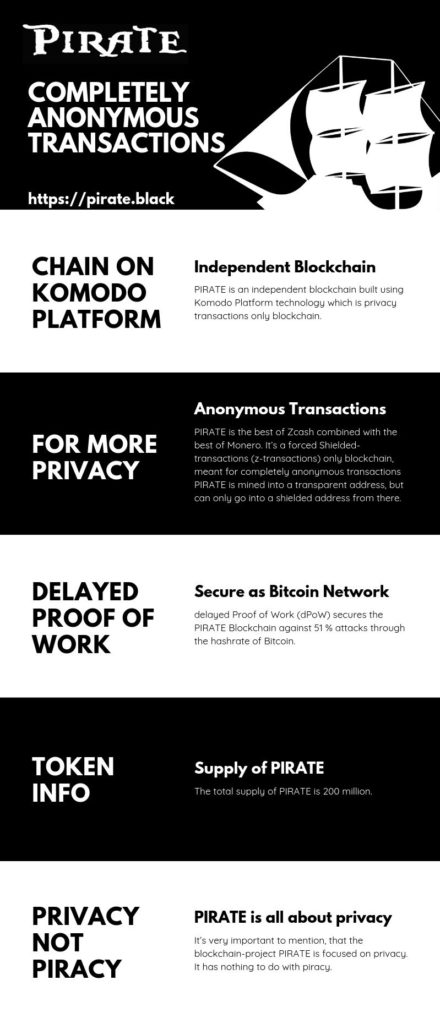
Draeth (Pirate Chain): dPoW allows Pirate Chain to be virtually immune to 51% attacks by notarizing Pirate Chain’s blockchain onto Komodo’s, and Komodo’s is then notarized onto Bitcoin’s. To 51% attack Pirate Chain you would need to control 51% of Pirate Chain, Komodo’s, and Bitcoin’s hashrate simultaneously. It does not cost Pirate Chain anything to use this.
Why have you chosen Equihash (ASIC-friendly) as the mining algorithm, unlike many altcoins?
Draeth (Pirate Chain): To us, ASICs are an inevitability. They are more efficient in terms of power-to-hashrate and create stability due to the ease of purchasing them these days. Trying to stay ASIC-resistant is a battle that will always be lost, because miners will always be developed to get an advantage in hashrate. A prime example is Monero, which has to change its algorithm every so often because ASICs end up being discovered on their network.
What are Pirate Chain’s key features?
Draeth (Pirate Chain): 51% attack resistance; private send-only transactions using zk-SNARKs; no metadata leakage; anonymous messaging; no ICO/IEO, no premine, no dev fee; the largest anonymity set in the industry.
Can you explain Sapling and its importance for Pirate Chain?
Draeth (Pirate Chain): Sapling reduces the transaction size of shielded transactions and is faster than Sprout, reducing transaction times from minutes to seconds. It allowed for more transactions per block and got rid of the bugs that occurred in Zcash’s implementation of Sprout.
You have relationships with Verus and Turtle Network. Can you explain why these projects deserve attention?
Draeth (Pirate Chain): With Verus, we have assisted each other in development and marketing. Verus’s lead developer, Mike T., was the one who implemented Sapling into Komodo, Pirate Chain and Verus. With Turtle Network, we are both members of the BPSAA and have assisted each other with development; we are also listed on Turtle Network’s DEX. BPSAA membership endows all members with a shared mindshare and a common dev pool.
What are your sources of funding today, and what is the economic model going forward?
Draeth (Pirate Chain): Current sources include donations from notary nodes operated by Pirate Chain members and community donations. Unlike other coins that levy taxes on mining rewards for dev fees, we elected not to tax our mining community. Instead, we are creating useful and marketable products to generate sustainable revenue streams — for example, a privacy-focused point-of-sale system and a messaging service.
Have you planned another governance model in the future, like Dash or Decred?
Draeth (Pirate Chain): The role of the community is extremely important. Our community helps us make decisions, is actively involved in marketing, and is the key to successfully moving forward. Several community members have stepped up and even helped with development. Contributors are always recognized and promoted accordingly, and they will continue to have this role in the future.
How is the team organized today?
Draeth (Pirate Chain): The team is organized into Captains, First Mates and Deckhands. Captains give approval to decisions and steer the project. First Mates continually contribute to marketing, development, writing, etc, and are some of the most trusted individuals on the team. Deckhands are big supporters who contribute occasionally and have been recognized by the team.
Many people are repelled by the ‘Pirate Chain’ name. Don’t you think the brand needs to evolve to reach a wider audience?
Draeth (Pirate Chain): We have had many discussions about this, and it always ends the same way: the majority of people who hear the name and look into the project actually like it. Often the loudest voices are the negative ones, even if they are few. Pirates are all about personal freedom and privacy, and all of us at Pirate Chain are proud of the name. People used to say Google was a dumb name — we all know what happened with them.
What are the plans and objectives of Pirate Chain for 2020/2021?
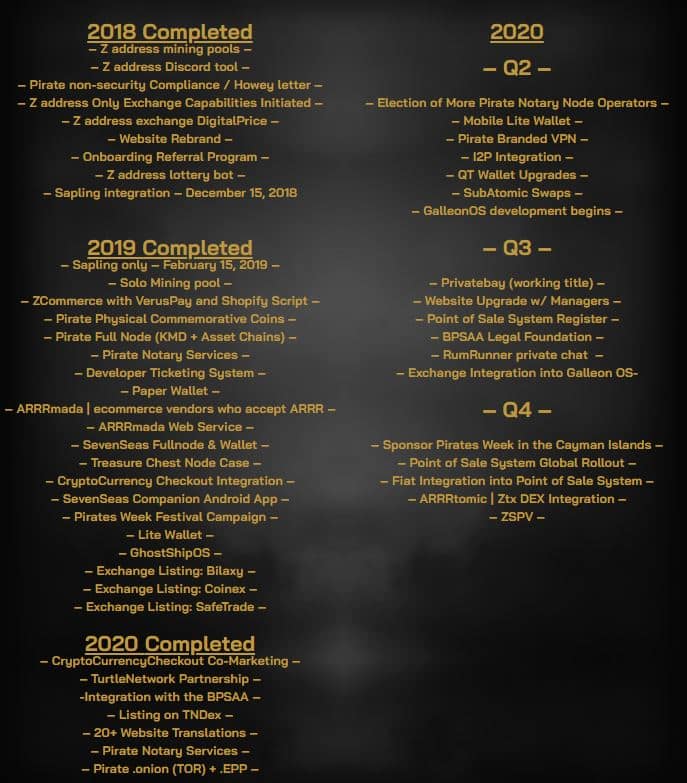
Draeth (Pirate Chain): Creating a point-of-sale system, building revenue streams to fund development and marketing, anonymous messaging services, our flagship operating system (GalleonOS), deeper integration of our products into the BPSAA, and much more.
What is the next big thing for Pirate Chain?
Draeth (Pirate Chain): Our mobile wallet (entering open beta within a week) and SubAtomic swaps.
What is the goal of Pirate Chain?
Draeth (Pirate Chain): To give people their financial freedom back. Money nowadays is traceable (including Bitcoin and chains with optional privacy), and when you know you are being watched you can never be free. It has been proven that people act differently and are not their true selves under observation. Being able to purchase things with something untraceable like Pirate Chain — without being force-fed ads on ‘things you might also like’, or having others see everything you purchase — is what we’re building. Our strategic directions are marketing to online businesses, building a point-of-sale system for physical stores, and reaching those who take their privacy seriously.
Which altcoin is closest to Pirate Chain’s intentions?
Draeth (Pirate Chain): Monero. We both take privacy very seriously and have private-transactions-only chains. The main difference is that zk-SNARKs, the privacy protocol Pirate Chain uses, offers stronger privacy than Monero’s protocol. Even fluffypony of Monero has publicly acknowledged that zk-SNARKs provide much stronger untraceability characteristics than Monero.
Why is Pirate Chain superior to / different from its competitors?
Draeth (Pirate Chain): Virtually 51%-attack immune with dPoW, offering fully shielded P2P-only transactions, and building a variety of products and services to complement itself. Another big difference is that we actually have plans to generate income, whereas others will always rely on their dev fee, which is unsustainable.
Thanks to the Pirate Chain team for taking the time to participate in this interview.
— Rowenta01
Stay in the loop
Crypto Lowcap is an independent media outlet covering privacy, decentralization and low-cap innovation since 2016. We never accept paid coverage — our analyses are our own.
Follow Rowenta on X · Follow The Dowser on X
Liked this piece? Share it, challenge it, or send us the next project we should investigate.