
ZKas Interview: How a Hidden Privacy Coin Makes Zero-Knowledge Mandatory
“Zero-tax untraceable cash is the only way to go.” Ronnie, developer of the ZKas privacy coin
Project: ZKas (ZKAS) | Interviewed by: Rowenta01 | crypto-lowcap.com
Tags: #ZKas #ZKAS #Orchard #BlockDAG #PrivacyCoin #Lowcap #Interview
| BEFORE WE START This interview does not constitute investment advice. The questions and answers reflect the views of the project team and of an independent analyst who has been covering the privacy and low-cap crypto space since 2016. Micro-cap and low-cap projects carry significant risk. Do your own research. |

Why the ZKas privacy coin deserves a closer look
ZKas is a proof of work chain on which privacy is not an option. Its consensus carries no transparent transfer type; as a result, every amount and every address lives inside an Orchard shielded pool, on top of a GHOSTDAG BlockDAG that targets roughly one block per second. Mainnet went live on 26 July 2026 with its genesis anchored to a Bitcoin block. Moreover, Kaspa miners can merge-mine the chain through the same kHeavyHash, so they earn ZKAS from work they already do. Today, the ZKas privacy coin ships wallets for desktop and Android, a paper wallet, an explorer, a payment gateway, an SDK and several pools.
I wanted this interview now because the past three months have been unusually dense. First, the team cut its own testnet from 14 blocks per second down to one. Three weeks after launch, it hard forked the difficulty adjustment, and then in October it closed a merge-mining flaw that let a single proof of work earn credit for two blocks. The report came from outside the team, and it briefly spilled into a public argument on X. In addition, the same upgrade, named ZKrise, removed the project’s own 5% development fee.
The chain that emerges from those three months has an odd shape, and it deserves a look before reading him. Its security budget has grown faster than its visibility: the hashrate behind ZKas has risen by roughly two thirds in a month. By contrast, the token still sits beyond rank 4,900 on the aggregators with a single market listed. The count of nodes visible from the explorer has fallen over the same period, which Ronnie puts down to the October fork. In short, engineering is not the constraint here. Reach is.
What this interview covers
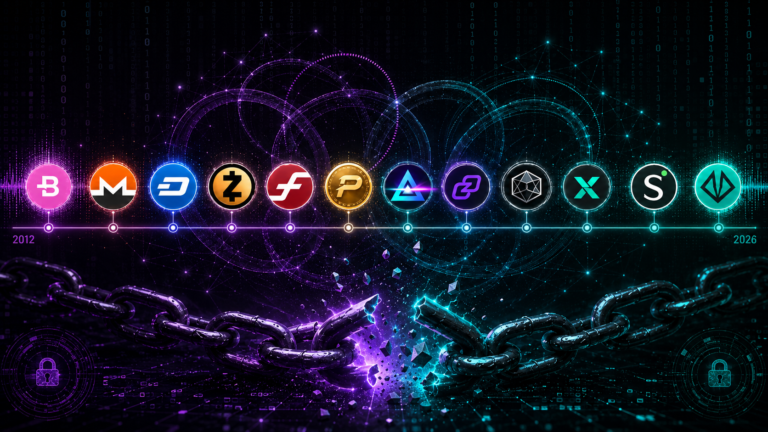
Ronnie, who signs most of the project’s announcements, agreed to answer in writing. What follows covers where the ZKas privacy coin came from and why mandatory privacy rather than optional, who writes the code, and how the team keeps a shielded pool identical on every node of a graph where blocks arrive in parallel. It also covers what the October fork actually fixed, how emission and funding work now that the development fee is gone, the relationship with Kaspa and its pools, and where Ronnie expects the project to be in one year and in three. He skipped several questions and told me so upfront. The answers below are his own: I have grouped them by theme and corrected nothing beyond an obvious typo. For the wider context on cryptographic privacy, see our history of privacy coins from 2012 to 2026.
The ZKas privacy coin at a glance
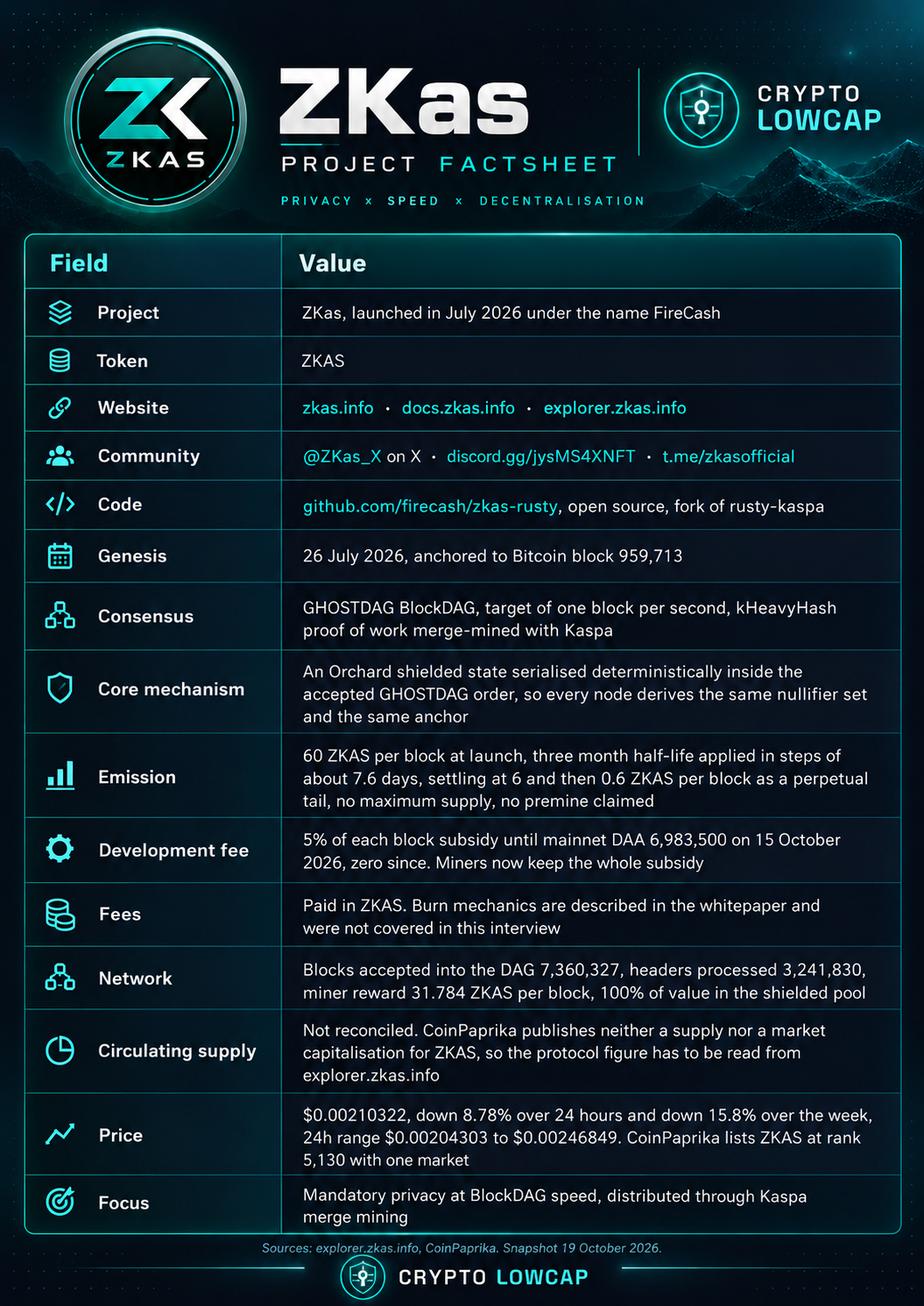
Sources: explorer.zkas.info and CoinPaprika, read on 19 October 2026. On 17 October the explorer showed 75.8 PH/s and 37 visible nodes, against 44.89 PH/s and 54 nodes a month earlier. The team attributes that dip to the October fork, and the explorer was back to 44 reachable nodes on 19 October. Market figures move fast on thin markets; treat them as a point-in-time read, not a valuation.
1. Origins and the people behind ZKas
ZKas started in early July as FireCash, introduced as “Kaspa with mandatory privacy.” What convinced you that a new chain was the right answer, rather than pushing for a privacy layer on Kaspa itself or contributing to an existing privacy project?
Ronnie: If we were to build ZKas, ex FireCash, as a solution on top of Kaspa, it would be called “Kaspa with optional privacy”, because mandatory privacy can’t be built on any public ledger.
Reasonable question: which type of privacy is better? Zcash is the biggest example of an optional privacy system and it doesn’t work, it doesn’t preserve privacy. Now imagine what’s happening inside even smaller anonymity set optional privacy systems.
More in our blog: why ZKas provides the best privacy experience.
What got you into privacy in the first place, and why did you decide to put this much of yourself into ZKas specifically? You sign most announcements: was being the visible face of the project something you wanted, or a role you ended up holding because someone had to?
Ronnie: I have been to many crypto projects throughout these years, to some I contributed with writing code. I value privacy and open source, so I work on building in this space. ZKas is the only one I started on my own and I doubt there will be some other crypto project.
The dev-updates and small-news channels allow posts by any people with a core dev or dev role, which makes the news stay close to the origins.
A reader can see you, Leo as the contact for integrations, and a handful of names across the firecash repositories. The last two weeks alone brought a security fork, a tokenomics change and a coordinated upgrade. Who actually owns what today? And if you went offline for a month, could someone else build, sign and ship a critical fix on their own?
Ronnie: If I was to disappear, it would depend on other community members and developers to continue the project. All ZKas related code is open source, anyone can run it and improve it.
If it seems like I’m the only one writing code, it’s a wrong impression. There are around 5 other developers who help with big upgrades or just small parts of code, some of them commit to ZKas repos, some connect directly with me to help with the code. Many more are testing the security of ZKas with AI tools and constantly report their findings.
2. Under the hood of the ZKas privacy coin: a shielded pool inside a BlockDAG
Zcash designed Orchard for a chain where blocks arrive one after another. ZKas produces blocks in parallel and only puts them in order afterwards. In plain terms, what was the hardest part of making every node end up with exactly the same shielded state?
Ronnie: ZKas is a codebase fork of Kaspa, not Zcash. The hardest part was to securely implement the shielded state on a DAG. For example, in testnet we caught a refundable transaction fee flaw.
Readers tend to assume the protocol already solves two things. First, on a chain with no visible balances, how would anyone notice if someone managed to create coins out of thin air? Second, what does ZKas explicitly not guarantee, the thing people assume it does but it does not?
Ronnie: ZKas has a mechanism to audit how much was issued, every coinbase mint, fee and burn. The fake coins, if they existed, would sit as extra hidden notes inside the pool, so they wouldn’t have been auditable.
If someone was to create new coins, the only way to detect it would be watching the price falling, then trying to analyze what could lead to it.
ZKas doesn’t eliminate network level privacy issues. Running a ZKas node exposes your IP address, and there is metadata collection by centralized exchanges, withdrawal addresses, amounts.
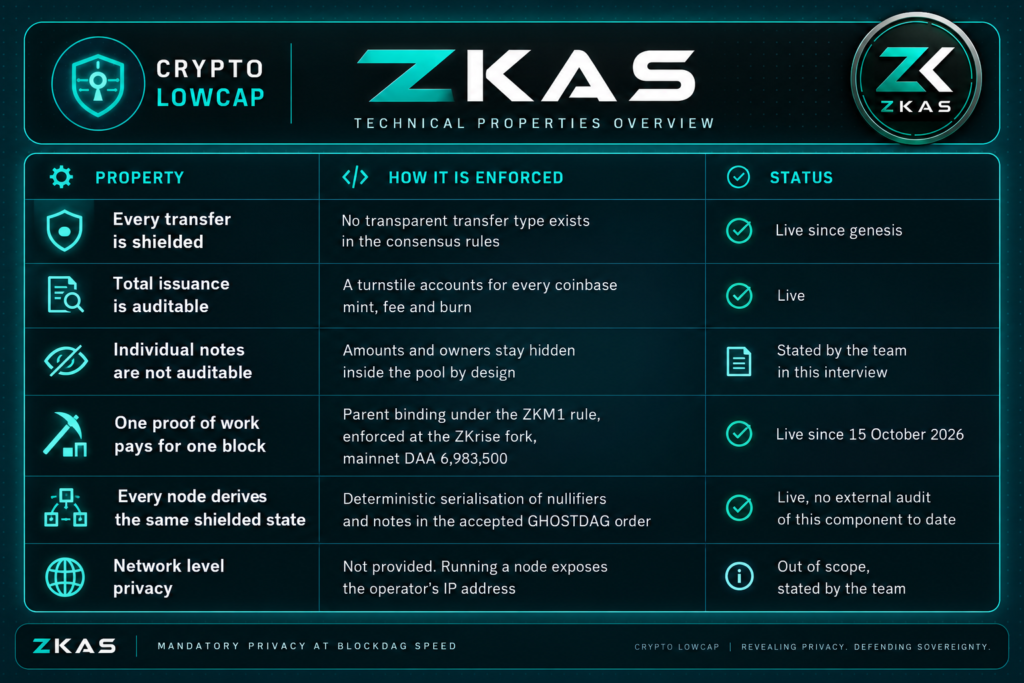
Source: Ronnie’s answers in this interview, cross-checked with the consensus parameters published in github.com/firecash/zkas-rusty and with docs.zkas.info.
3. Incidents and prevention
ZKrise closes a hole where a single proof of work could earn two ZKas blocks. Walk a reader through how that was possible, and how it surfaced. Your own position is that nobody exploited it because doing so would have cost more in Kaspa rewards than it gained, which is an argument about incentives rather than about the protocol. Is there anything in the chain history itself that backs it up?
Ronnie: To make it clear, if someone was to produce 2 blocks at once, the difficulty would be adjusted in a few minutes, which means ZKas tokenomics and supply wouldn’t be inflated but would be issued according to the schedule. The bug would only influence the earnings of other miners.
The bug has never been exploited because the attacker would lose its KAS rewards and the whole operation would become unprofitable. Check docs.zkas.info/zk-01, you can verify the bug has never been abused. The ZKrise network upgrade has closed this possible gap.
Checking the ZKas privacy coin against its own chain history
| ROWENTA’S NOTE The page Ronnie points to publishes the method rather than the conclusion alone. The team reports reading 6,984,673 headers from genesis to the fork, of which 6,978,482 carried a merge-mining witness and miners produced 6,191 natively. The count of distinct merge-mining parents equals the witness count, so no block reused a parent, and three separate fingerprints return zero hits. The team also publishes a scanner, zkmm_scan.rs, so that anyone running an archival node can replay the run and check the same numbers. That is no longer hypothetical. A community member running his own archival node, posting as KD, built the scanner locally and added two readers of his own over the node’s gRPC path, covering every block to the tip. He reports no hits on the double-credit fingerprint, and separately reconciled the sum of every coinbase output in the block bodies against the node’s own cumulative counter, to the sompi. That second check is the one that settles the question most directly, because it says no block was ever paid twice. |
| Two limits are worth keeping in view. KD states the first himself: his run of the published scanner stopped about 286,000 blocks short of the fork, on a copy of the database, so that window rests on his gRPC readers and on the team’s own pass rather than on a second run of the scanner. The second is unchanged. The component where Orchard meets GHOSTDAG, the one piece of ZKas that is genuinely new, still carries no external audit, as the repository says itself. A flaw found from outside, closed in ten days, then checked by someone outside again, says something good about a team. A review commissioned before the fact would still say more. |
Beyond this one bug, what has changed in the process so the next class of problem is caught before mainnet rather than after? The README still says the shielded GHOSTDAG core has had no external audit. Is there now a written policy for how the team handles outside reports, and on the audit itself, what is standing in the way today?
Ronnie: There’s no specific policy regarding bug disclosure. We’ve received a few independent audits by ethical hackers and community devs. So far there hasn’t been found a critical vulnerability, such as supply inflation, common in privacy layers, and it’s confirmed by many independent reports.
Getting an audit from a security firm costs money and in most of the cases it’s a formal verification. They never find the real critical bugs which later get exploited by hackers.
4. The hard part of the roadmap
In July the ZKas privacy coin testnet was running at 14 blocks per second and you chose to bring it down to one. That is not a common decision for a project whose early pitch leaned on speed. What drove it, and on the roadmap, which part actually worries you?
Ronnie: Common sense led this decision. ZKas is already the fastest mandatory privacy L1, there is no need to chase more blocks per second right now. Back in July the decision was made for two reasons mentioned in our post: first, difficulty can’t adapt to such a rate, difficulty stays low and the device you are mining with produces similar results to more or less powerful mining devices, which would be automatically solved once there are more nodes and pools. Second, the chain grows too fast in size, approximate chain growth in 24 hours is 0.4 GB.
In the future the BPS bar can be raised, but first we need to make sure the BPS improvement upgrades won’t influence ZKas security. Our next step is to focus on quantum resistance.
5. Emission, burn and funding of the ZKas privacy coin
After ZKrise miners keep the whole subsidy, on top of an emission curve that is front loaded by design. Many of your miners are Kaspa miners, for whom ZKAS is a bonus on top of work they are already paid for. What gives them a reason to keep ZKAS rather than move it on as soon as it lands?
Ronnie: Merged mining, if executed properly, is a good way to distribute the supply. Some miners are selling, some decide to keep the coins, it depends on their choice.
So far this system works pretty well and looking back, we’d definitely go with merged mining again.
Five days before the fork, the plan was for the development fee to run until the second halving. It now ends with ZKrise. What changed your mind, and with that line gone, what funds the work from here?
Ronnie: Most of the dev work has already been done. We don’t need to keep the fee for justifying the possible dev work.
We were seriously thinking about redirecting the future dev fee for CEX and DEX fees, but it was decided that zero-tax untraceable cash is the only way to go, for the reason that ZKas isn’t building the infrastructure but a payment solution.
OTC revenue was used for getting ZKas on NonKYC. We are thinking about using similar approaches in the future.
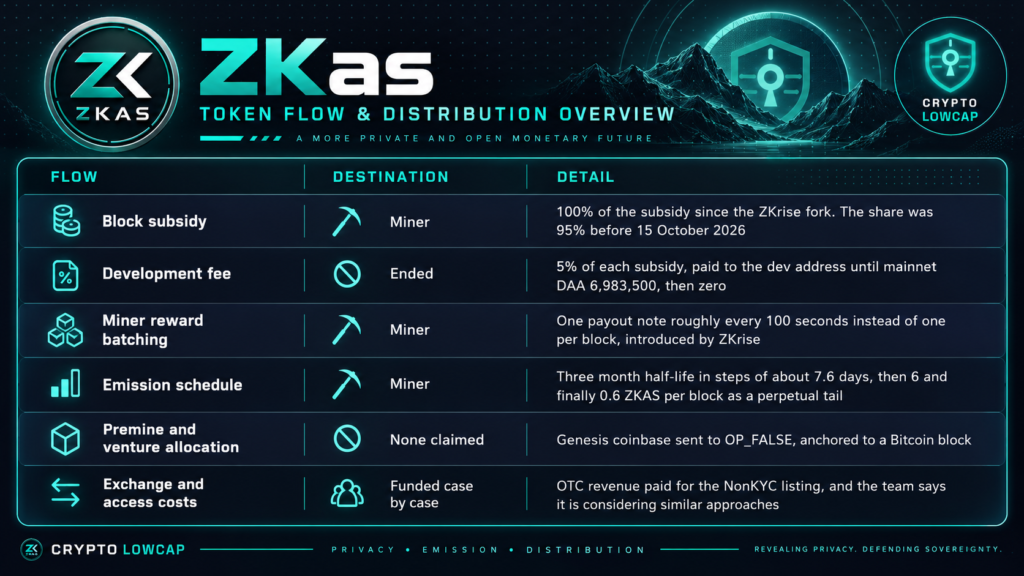
Sources: Ronnie’s answers in this interview and the consensus parameters published in github.com/firecash/zkas-rusty. Figures on flows that nobody has measured independently remain declarative.
6. Positioning and the Kaspa question
If you had to explain the ZKas privacy coin to someone with no interest in DAGs or zero knowledge proofs, what would you actually say?
Ronnie: I’d ask: do you want to transact anonymously within 1 second?
ZKrise asked Kaspa pools to adopt a new standard on a deadline, which is a real test of that relationship. How do you see it: part of the Kaspa ecosystem, a respectful neighbour, or something that has to stand on its own?
Ronnie: All existing ZKas pools have upgraded their nodes to support the network upgrade without any complaints.
The issue is to get ZKas on leading Kaspa pools, F2Pool and ViaBTC. For some reason they prefer to stay away no matter how many people asked them to add ZKas. Obviously, miners on their pools are lacking the additional profit ZKas would bring.
ZKas is a respectful neighbour. We are using Kaspa’s codebase to build something different, we pay our respect by providing an option for Kaspa miners to get ZKAS for free, which raises the hashrate and therefore the network security of both networks.
7. Community and voice
Early messaging used lines like “4lemma solved” and speed comparisons with Zcash and Monero, while the X account is still under a thousand followers at a time when privacy is one of the louder narratives. Is the low profile deliberate, or a belief that the work should speak for itself?
Ronnie: ZKas grows organically. Our X started from 0 followers and now has 1,349 followers, along with 1,125 members on our Discord.
That’s only the beginning of the growth if ZKas proves itself as a secure, one of the best privacy money systems.
What is the ZKas privacy coin Discord actually for today? And since nearly everything that reaches the outside comes through you, is there a plan for ZKas to have a voice that is not yours?
Ronnie: There are many voices except mine, they just speak through Discord where I’m a mod. I have said many times that I’m all for more community-run channels and websites, so far only a few took the initiative. The built-in chat in our light wallet serves the same purpose, to decentralize the community opinions.
8. Reading the space, and what comes next for the ZKas privacy coin
Outside of ZKas, which projects do you actually follow or respect right now? And since ZKas is open source and built on a public codebase, what does it have that a well funded team could not copy in six months?
Ronnie: In the crypto space I respect Monero and Kaspa as fairly launched innovative projects.
It’s easy to detect the real reason why any team wouldn’t copy our work. VC funded teams almost never build privacy projects because of regulatory risks. All the old VC backed projects are optional privacy layers, and nowadays you don’t even hear about new funding rounds here. It seems very few are willing to build here.
Realistically, not best case, where is ZKas a year from now, and where would you want it to be in three years? And the open floor: anything I did not ask that you think matters?
Ronnie: Realistically speaking, in a year ZKas could climb to the top 5 privacy coins. In two to three years I want to see it as the third privacy coin, after Monero and Zcash. A big community work is required for any of these targets.
I’d love to see more people participating, pushing ZKas growth. Anyone should do what they are best at, promotional content, writing code, getting ZKas supported on CEXs, DEXs and mining pools, building strategies and anything else. If you want to do something, there’s a place for you in ZKas.
Ronnie, one of ZKas developers
| Follow ZKas Website zkas.info Explorer explorer.zkas.info Whitepaper zkas.info/whitepaper.html Documentation docs.zkas.info GitHub github.com/firecash/zkas-rusty Discord discord.gg/jysMS4XNFT X @ZKas_X |
Further reading on crypto-lowcap.com
Thanks to Ronnie for the time and the candour. If you want the analyst’s view of the ZKas privacy coin and its peers rather than the developer’s, start with Defending Financial Privacy on the Blockchain in 2026, and then read The Anonymous Crypto Stack in 2026: A Practical Field Guide.
Related reading: our exclusive interview on DragonX and CPU mining, the TensorCash interview with Imosuke Takakuni, and our conversation with Parano1d founder Ignotus Nemo.